

(SeaPRwire) – By: Ethan Gallagher
Let’s cut the fluff. For years, the 3D printing hobby has been split into two camps. You had the idea people—collectors, mecha fans, guys who sketch cool robot concepts on napkins. Then you had the CAD people—the ones who actually knew how to make those sketches real. The gap between them was a chasm of Blender tutorials, failed mesh repairs, and slicer settings that take months to learn. Hi3D’s anniversary release doesn’t just bridge that gap. It bulldozes it.
The press release lays out a clean sequence. Type a description of a Blokees-style mecha. Hi3D’s Nano-Banana 2 engine spits out multi-view concept art. You hit approve. Then Sparc3D reconstructs that 2D art into a watertight, manufacturing-ready 3D mesh in about two minutes. That part is impressive, but it’s not the headline. Every AI 3D startup promises fast generation. The difference here is the output is structurally sound for printing, not just pretty on a screen.
Here’s where most AI 3D tools fall flat. They generate a model that looks good but has inverted normals, holes, or wall thicknesses that are physically impossible to print. Hi3D claims it handles “structural integrity, topology continuity, and printability” automatically. If that holds up, they’ve solved the “garbage in, garbage out” problem that has plagued AI-to-physical workflows. The real test isn’t the generation speed. It’s whether the generated part actually survives a 12-hour Bambu Lab print without turning into spaghetti.
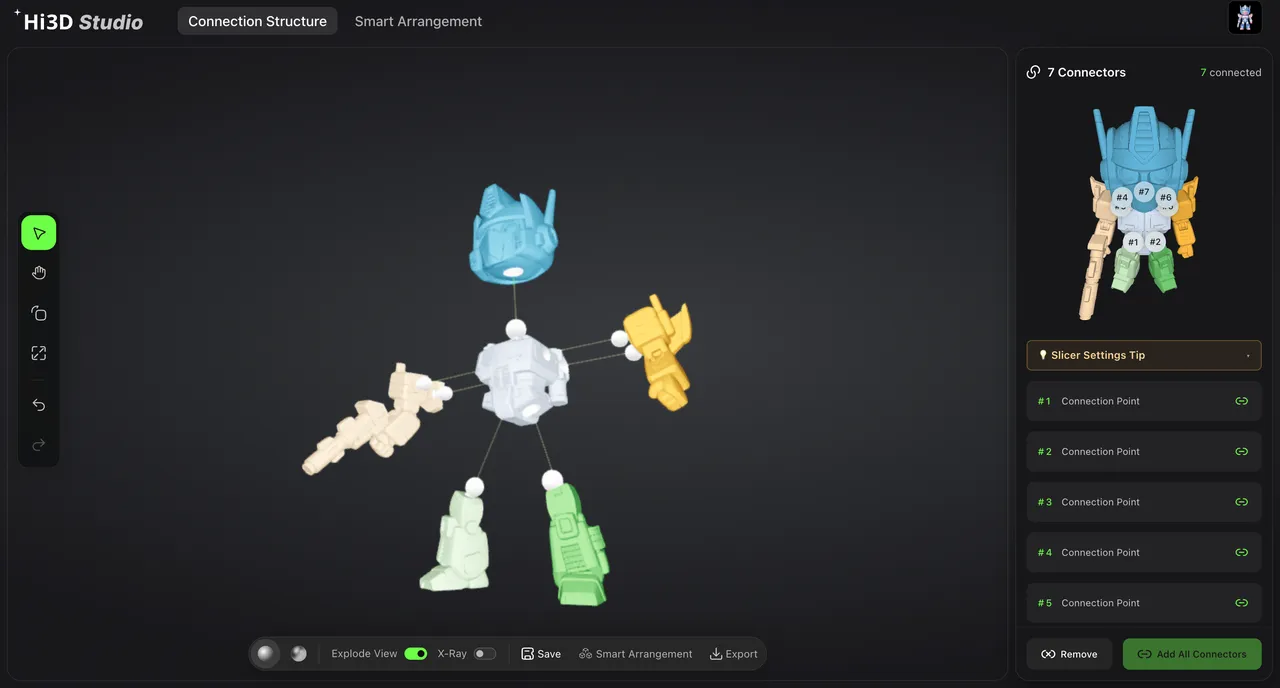
The killer feature is buried in the middle of the release. It’s the automatic part splitting and connector generation. Anyone who has tried to print a 12-inch mecha knows the pain. You model the whole thing, then realize it doesn’t fit your build plate. So you manually cut it into a head, torso, arms, and legs in Blender. Then you have to design friction-fit joints or ball-and-socket connectors by hand. It’s hours of tedious work. Hi3D’s system analyzes the model, segments it logically, and adds mortise-and-tenon or ball-joint assemblies automatically. Combined with their Press-Fit Tolerance system that adjusts clearances based on your printer’s nozzle size and material, it eliminates the trial-and-error assembly phase.
Let’s be blunt about the industry subtext here. The DIY 3D printing community has been dominated by a small group of skilled modelers who sell STL files on Cults3D or MyMiniFactory. They are the gatekeepers. Hi3D is bypassing them entirely. If a casual fan can go from “I want a blue samurai mecha with a plasma sword” to a printable 3MF file in five minutes, the value proposition for premium hand-modeled STL packs starts to collapse. This is a direct threat to the cottage industry of digital sculptors.
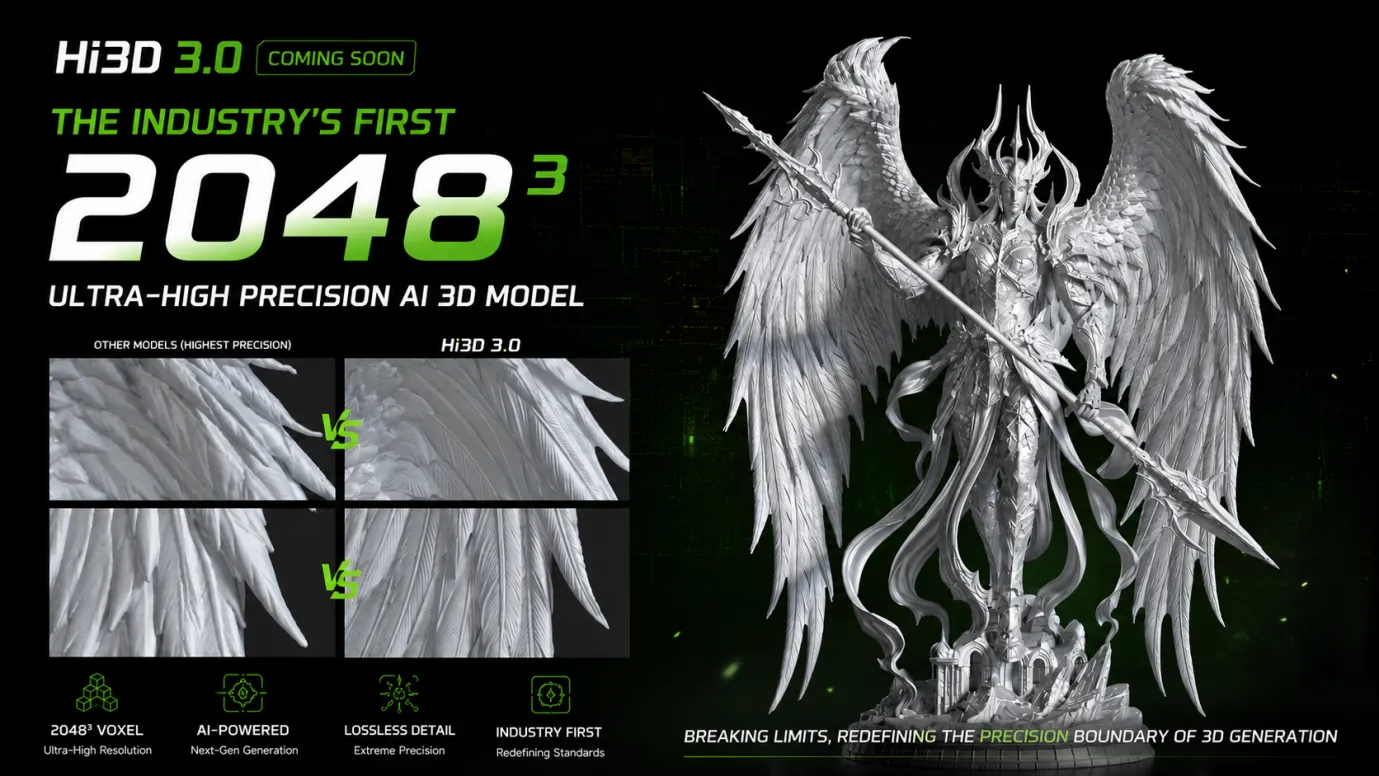
Look at the specs for Hi3D 3.0, which is apparently coming soon. They claim 2048³ ultra-high-resolution generation. That’s a lot of voxels. For context, most consumer 3D printers operate at 50-micron layer heights. You don’t actually need 2048³ resolution for a FDM print. The bottleneck is the printer, not the model. But the marketing matters. It signals that Hi3D is positioning itself as the default operating system for the entire “AI to physical object” pipeline. They want to own the workflow from concept to the slicer handoff.
The final reality is this. Hi3D is not selling a tool. They are selling a factory floor abstraction. The manual modeler isn’t going extinct tomorrow. But the barrier to entry for creating original, print-ready mecha figures just dropped from a multi-year learning curve to a five-minute coffee break. For the silent majority of collectors who have ideas but no skills, that’s the only metric that counts.
Author bio: Ethan Gallagher, a Silicon Valley Hardware Architect and Infrastructure Strategist. He has led engineering teams for high-volume manufacturing lines and advises on the intersection of generative AI and physical production.