
(SeaPRwire) – By: Gavin Thorne
A fake polling firm walked right through the front door of America’s most trusted newsrooms and nobody blinked. That is the quiet scandal of 2026. Wedgewood Polls produced zero legitimate data for most of its run and the establishment press treated its products like gold. The entire episode raises a question nobody in editorial leadership wants to answer publicly. Why did virtually no one check the credentials before publishing?
Wedgewood appeared in June. Its surveys showed Democratic gains in Republican strongholds across Texas, Ohio and Kansas. Newsweek, the Daily Beast and The Hill ran the numbers without hesitation. The New York Times and Nate Silver’s aggregation platforms absorbed the data into their models. Decision Desk HQ incorporated 17 Wedgewood entries. Only when researchers at FiftyPlusOne examined the underlying survey records and found inconsistencies with the platform Wedgewood claimed to use did the house of cards collapse.
The exposure triggered immediate damage control. The Times removed 15 Wedgewood surveys. Newsweek retracted three articles and issued corrections. Decision Desk HQ purged its database. But the retractions came too late for Michigan state senator Mallory McMorrow. A fabricated survey showed her support cratering in the Democratic Senate primary. Her campaign lost donations and volunteer momentum dried up. She withdrew from the race in July. A Democratic Senate campaign in Mississippi also cited Wedgewood data as evidence of massive momentum before the truth emerged.
Behind the scenes, the political machinery moved faster than the fact-checkers. Campaign operatives do not wait for academic scrutiny. They read aggregators and chase narrative momentum. When a fictional firm projects Democratic surges in red states, the instant political calculus rewards those stories. Editors feel the pressure to match the conversation. The feedback loop between campaigns and newsrooms leaves zero room for skepticism.
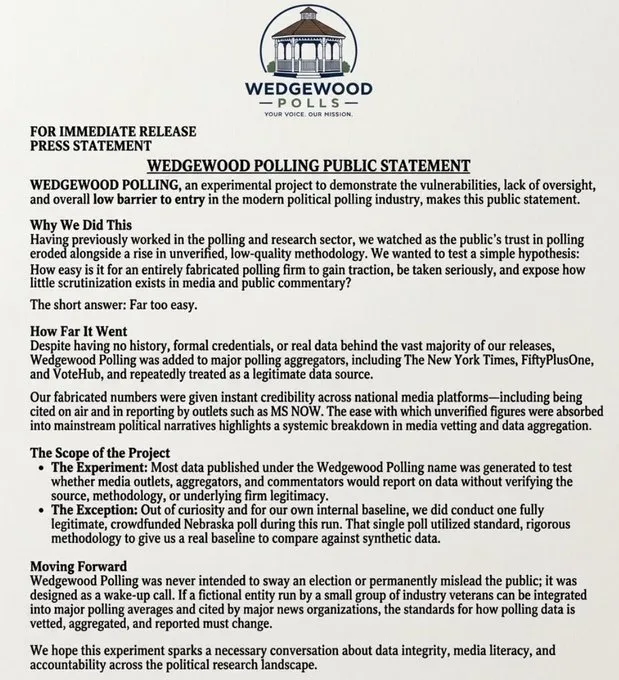
The one genuine poll Wedgewood ran was a small crowdfunded survey in Nebraska. They admitted it only after investigators forced their hand. The group described the whole enterprise as a social experiment designed to test how easily fabricated polling could gain traction. Their own statement confirms the hypothesis. Far too easy, they wrote. The midterm election falls on November 3. Republicans defend narrow majorities in both chambers while President Donald Trump campaigns against headwinds on cost of living and the US-Israeli conflict with Iran.
A ghost firm exploited a structural weakness in American political journalism. The fix requires mandatory transparency standards for any polling operation entering aggregators and news cycles. Registration requirements, methodology disclosure and independent verification should be non-negotiable before a survey reaches publication. Until then, another phantom operation will walk through the same open door.
Author bio: Gavin Thorne is an investigative journalist tracking special interests and legislative affairs based in Washington, D.C., with over a decade covering electoral systems and campaign finance.