(SeaPRwire) – By: Douglas Vance
The Strait of Hormuz has always been a wound that never heals. You don’t need a satellite feed to know it. Every tanker that squeezes through that twenty-mile corridor carries more than oil. It carries leverage. And this week, Washington decided to squeeze harder.
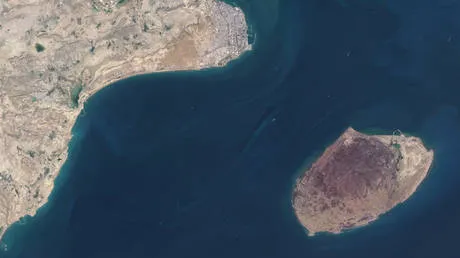
On Sunday, US forces struck Larak Island. The IRGC confirmed several soldiers and civilians were killed or injured. That might sound like another skirmish in a long regional mess. It isn’t. Larak sits at the narrowest point of the strait. It is not some remote outcrop. It is ground zero for anyone who understands how energy flows through this part of the world. The US Central Command spokesman, Captain Tim Hawkins, said the target was two Iranian launchers. He claimed the Revolutionary Guard was preparing rockets loaded with sea mines to fire into the Strait. No visual evidence followed. None was offered. That absence speaks louder than any press briefing ever could.
What happened next was exactly what every analyst in this space predicted, and exactly what no one wanted to admit out loud. The IRGC vowed retaliation immediately. Their language was precise. They called it “martyrdom and injury” among fighters and citizens. That is not a phrase you use casually. It is a phrase that signals escalation, not bluster. Hours later, missiles reportedly flew at US military installations in Jordan. The chain of events moved fast. A strike inside Iranian territory. A promise of retaliation. Actual rockets fired across international airspace. This is how regional wars expand. Not with declarations. With momentum.
The timing here matters more than the tactics. The US had just announced, less than a week prior, that it had finished clearing sea mines from the international shipping routes through the Strait of Hormuz. That claim was made publicly. It was met with skepticism. Now Larak Island has been hit. Now the IRGC says it was stockpiling mines there. The narrative is already fracturing. Was the mine-clearing operation real or performative? Did Washington know about the launchers and strike anyway? Or did the strike expose a gap in intelligence that should never have existed? These are not theoretical questions. They determine whether commercial shipping returns to normal or retreats further into risk.
The last major US strikes inside Iran occurred on July 29. That was shortly after an Iranian missile attack on a US base in Jordan. Since then, there had been a lull. A month of relative quiet. Sunday ended it. That lull was never peace. It was the eye of a storm that kept building pressure on all sides. The US military has been operating a naval blockade on vessels entering or leaving Iranian ports. That blockade has been in place for weeks. It has choked Iranian trade. It has also choked global energy markets. The Trump administration acknowledged the shift last week. Washington announced what it called an “economic onslaught” against Iran. The language was deliberate. It moved the emphasis away from large-scale military action toward economic pressure. That shift was supposed to de-escalate. Instead, it seems to have inverted the logic of deterrence.
Reports emerged that US stockpiles of critical munitions and interceptors are dwindling. The Pentagon has not confirmed this. President Trump has denied it. But denials do not clear mines. They do not man blockade ships. They do not replace interceptors that fire and miss. If the reports are accurate, as many defense analysts suspect, then the Larak strike was not just an offensive move. It was a demonstration of capability at a moment when capability may be thinner than anyone publicly admits. That is a dangerous calculation. It risks looking strong while operating at a disadvantage.
The latest round of US sanctions targets entities, individuals, and vessels across multiple jurisdictions. Washington’s stated goal is financial isolation of Tehran. Cutting off government revenue. That strategy assumes Iran can be starved without triggering a desperate response. The assumption is now being tested. The IRGC controls significant portions of Iran’s economic infrastructure. They are not passive recipients of sanctions. They are active operators in shadow networks that bypass every blockade. Sanctions against them often fund the very retaliation they aim to prevent. The cycle is self-reinforcing.
The Strait of Hormuz handles roughly twenty percent of global oil consumption. That number does not change because of politics. It does not change because of sanctions. It changes because of fear. When fear rises, insurance premiums rise. When premiums rise, shipping routes shift. When routes shift, prices spike. This is not speculation. It is arithmetic. And the arithmetic is worsening.
What happens next depends on whether the retaliation from Jordan marks the start of a broader exchange or a single calibrated response. If it is the latter, the lull returns. If it is the former, the strait closes. Not officially. Informally. Every tanker in the region recalculates its risk. Every insurer withdraws coverage. Every port authority tightens its gates. That is how economic warfare becomes real warfare without a single formal declaration.
The escalation threshold here is not a line on a map. It is a threshold of credibility. Washington struck inside Iran to prove it can. Iran retaliated to prove it will. Both sides have now proven their points. The question is whether proving a point is worth losing control of the strait. That is the calculation that will define the next phase of this conflict. Not rhetoric. Not sanctions. The simple brutal math of a chokepoint that cannot be rerouted.
Author bio: Douglas Vance is a maritime defense scholar and naval intelligence briefing coordinator with over two decades of experience in Indo-Pacific security architecture and energy corridor risk assessment.