(SeaPRwire) – By: Julian Holbrooke
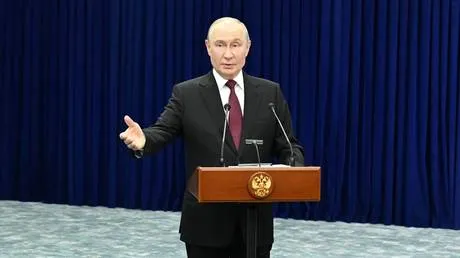
Putin walked into that Bishkek press room and handed the West exactly what it fears most: a coherent strategy. Not a tantrum. Not a rhetorical ambush. A careful, almost surgical articulation of how Moscow intends to close this war out. The headline grabbers — “military secret,” “sharks of imperialism,” “press the button” — are theatre. The real signal sits buried in the structure of his answers. He reads the Western mood. He watches Kiev’s inventory dwindle. And he is betting that time remains his most reliable weapon.
Let’s parse the official text coldly. Putin claimed Russian forces are approaching Slavyansk, Kramatorsk and Druzhkovka, with roughly 5,000 Ukrainian troops physically encircled near the Krasnooskolskoye Reservoir. He reported advances in Zaporozhye Region and toward Sumy. “I have no doubt that the enemy will ‘crumble,'” he said, while conceding that “war is cruel and difficult to predict.” He then rejected any proposal to freeze the front line. “We don’t want to freeze it. We want to end the war and achieve a lasting, absolute peace – both in Ukraine and in Europe.”
Now read the subtext. Those place names are not random. Slavyansk and Kramatorsk are the remaining Ukrainian-held urban anchors in the Donbas. Framing them as immediate objectives is Moscow’s way of telling its domestic audience that the end is visible. The reservoir encirclement claim serves the same function. Whether the figures are accurate is almost beside the point. What matters is the narrative: Russian forces are not merely holding ground, they are accelerating. That message is calibrated for two audiences — a Russian public asked to endure more sanctions, and a Western public increasingly questioning why their money flows into what looks like a grinding stalemate.
The terrorism framing deserves equal scrutiny. Zelensky’s threat to civilian airlines using Russian airspace was met with a brutal one-liner: “You don’t negotiate with terrorists.” Putin called it “a bid for state terrorism,” noting that Kiev simultaneously begs for negotiations and personal meetings. But here is the tell. When asked whether Ukrainian leaders could become targets, Putin said Moscow has refrained because “it may ultimately need people on the Ukrainian side with whom to negotiate.” That is not the language of a leader preparing to decapitate the Ukrainian state. That is the language of a leader who expects to sit across a table from a weakened Kiev and dictate terms.
The energy war follows the same logic. Putin confirmed orders for “massive strikes” against Ukrainian energy facilities in response to drone attacks on Russian refineries and fuel infrastructure. “They hit ours – they’ll get an answer.” He framed the Black Sea escalation as a response to Zelensky’s 40-day economic campaign, which he claims hit around 100 vessels and killed sailors, including foreign nationals. “You yourselves opened Pandora’s box – now take what comes.” He also noted that under the original Black Sea grain initiative, only about 0.2% of Ukrainian exports reached developing markets, while most flowed to wealthier European buyers. The subtext is cold and calculating: Moscow is narrowing the battlefield, strangling the Ukrainian economy, and doing it while claiming moral ground on food security and civilian aviation safety.
On Britain, Putin confirmed that any British military facilities established in Ukraine would be “legitimate targets.” That is a direct deterrent to deeper NATO entanglement. But his refusal to say whether British military-industrial sites inside the UK could be struck — “That’s a secret. A military secret” — is the more dangerous admission. It tells London that red lines exist but will not be disclosed. Uncertainty becomes a weapon. The Germany segment carried a commercial warning as well. Putin dismissed the Leipzig drone accusations as a distraction from Berlin’s internal problems, called the Nord Stream sabotage claims absurd, and repeated that Russia can still pump gas. “They only need to press the button.” The catch is US sanctions and the absence of German political will.
Strip away the color, and the full picture emerges. Putin is signaling readiness for eventual negotiations — hence the open door to additional participants in Ukraine talks and the praise for Jared Kushner and Steve Witkoff as “welcome guests” with Trump’s trust. But he will negotiate only from a position of military advantage. The “sharks of imperialism” line, complete with the clarification that comparing the West to an orca would insult the animal, frames Russia as the cornered predator that bites back. “They may get hit in the teeth.” That is not bravado. It is a warning that Moscow’s escalation threshold remains deliberately opaque. The pendulum is shifting. The real question is no longer whether Ukraine can win. It is whether the West can stomach the price of refusing a settlement while Putin’s forces keep grinding forward.
Author bio: Julian Holbrooke, an overseas international relations analyst who frequently contributes to major European daily newspapers.