By: Douglas Vance
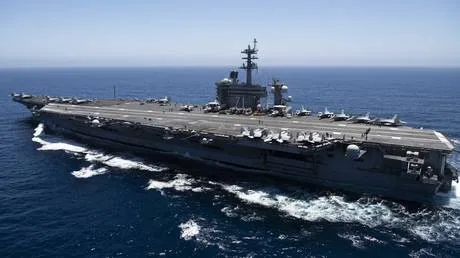
(SeaPRwire) – Three US aircraft carriers converging on the Persian Gulf. The last time this occurred was 2003, during the Iraq invasion buildup phase. The USS George H.W. Bush and USS George Washington are already deployed and operating in theater. Now the USS Theodore Roosevelt carrier strike group is rolling in. It brings the cruiser USS Chosin alongside. The USS Makin Island amphibious readiness group travels with it. That group carries the USS John P. Murtha and USS Anchorage amphibious landing ships. Roughly 9,000 additional troops are en route. The personnel breakdown is 7,000 sailors and 2,000 marines. Combined with forces already positioned across the region, the total US military footprint in the Middle East exceeds 20,000 personnel. AP characterized this deployment scale as “an unusually high number” for the theater. That’s not hyperbole. Three carrier groups simultaneously operating in a single geographic area carries massive logistical overhead. Each group draws fuel, munitions, intelligence, and supply chains that run thousands of miles. The carrier alone represents roughly 100,000 tons of steel, aviation capacity, and command infrastructure. Triplicate that. The carrier strike group composition matters. A full group includes the carrier, a cruiser, destroyers, a submarine, and supporting logistics vessels. Each element extends the operational envelope. Three groups means three overlapping air and sea battle spaces. Pulling additional carrier strike groups from their home fleets means reducing US forward presence elsewhere. The Pacific, the Caribbean, and the Eastern Mediterranean all lose coverage when assets are diverted. Axios, citing an unnamed US official, flagged a critical gap. It remains unclear whether Roosevelt joins the two existing carriers or simply replaces one in a rotation cycle. That ambiguity isn’t trivial. Three simultaneous carrier strike groups in one operational zone signals maximum deterrent posture. A single replacement cycle signals logistics maintenance and cost containment. The Pentagon hasn’t publicly committed to either reading. The messaging gap itself is a signal.
Trump told Time magazine that new strikes on the Islamic Republic are “possible” after the November 3 midterm elections. He told reporters more bluntly on Thursday: “either Iran signs a very fair deal, or it won’t exist any longer.” The election sequencing is deliberate. The November 3 timing creates a narrow operational window. Post-election policy shifts take months to implement. Iran’s negotiators know this calendar. The AP-NORC Center for Public Affairs Research published polling data Thursday showing 70% of Americans disapprove of the war with Iran. Trump acknowledged this dynamic directly when Time asked whether conflict with Tehran would damage Republican midterm prospects. He conceded “it’s possible,” then immediately countered with “it should help, because Iran will not have a nuclear weapon.” That’s a political calculation layered on top of a strategic one. Trump’s rhetoric oscillates between the brink of nuclear confrontation and the promise of a “very fair deal.” Both positions can’t survive contact with operational reality. Trump initially claimed in late February, following the initial US-Israeli attack on Iran, that the conflict would conclude in “a few weeks.” It hasn’t. The diplomatic track remains frozen at every node. Trump rejected Iran’s latest peace proposal. It was tabled during the UN General Assembly last week. His reasoning was blunt: “things that I wouldn’t have approved a year ago I wouldn’t have today.” In September, Iranian Parliament speaker and chief negotiator Mohammad Bagher Ghalibaf escalated his own rhetoric sharply. He warned that further US aggression would trigger “faster, heavier and more painful” retaliation from Tehran. Ghalibaf went further. He declared that “the era of proportionate responses has come to an end.” He added that recent Iranian strikes against US-linked aggressor bases were merely an opening salvo. The mutual escalation ladder now has no clearly marked step down. Both sides are signaling intent while leaving operational ambiguity intact. That’s how conflicts that were supposed to end in weeks become conflicts that last months.
The economic underpinnings of this buildup are rooted in Gulf hydrocarbon infrastructure and energy chokepoint protection. Two additional Patriot missile batteries were dispatched to shield oil and gas facilities in Saudi Arabia and Qatar. Axios reports the stated objective is twofold. First, defend critical energy infrastructure from potential Iranian retaliation. Second, secure Riyadh’s permission for use of Saudi airspace in any strikes against Iranian territory. Saudi Arabia has every reason to resist becoming a forward staging ground. But US pressure on airspace access creates a dilemma that complicates Iranian planning. Those facilities sit within exclusive economic zones that directly shape global energy price formation. A disruption in the northern Persian Gulf or the Strait of Hormuz corridor would drive maritime war-risk insurance premiums upward within hours. Commercial shipping insurers already price that waterway as a separate risk category from standard Gulf transit routes. Three carrier strike groups multiply the surface and subsurface surveillance footprint exponentially across the theater. The expanded early-warning radius covers Iran’s coastal missile sites, submarine pen infrastructure, and near-shore drone launch corridors. But the escalation calculus is where the real danger sits. Iran’s military planning apparatus is mapping retaliation timing and intensity in real time. The broader proxy network stretching from Hezbollah remnants through Houthi forces to Iraqi Shia militias remains operationally capable of multi-axis disruption. If the carrier deployment crosses the kinetic threshold, the regional cascade could extend far beyond the naval assets themselves. Hezbollah remnants could open secondary fronts. Houthi forces could disrupt Red Sea shipping lanes. Iraqi Shia militias could target remaining US bases in the country. Each scenario triggers cascading insurance, shipping, and pricing shocks. Energy market traders watch tanker transits through Hormuz with satellite-tracking precision. Any anomaly in shipping schedules triggers immediate price discovery. The Strait of Hormuz handles approximately a fifth of global oil shipments. No level of naval tonnage can fully neutralize that structural dependency. The carriers buy time and deterrence, not permanence.
Author bio: Douglas Vance, a maritime defense scholar and naval intelligence briefing coordinator specializing in force projection dynamics and escalation strategy across Middle Eastern and Indo-Pacific theater environments.