(SeaPRwire) – By: Julian Holbrooke
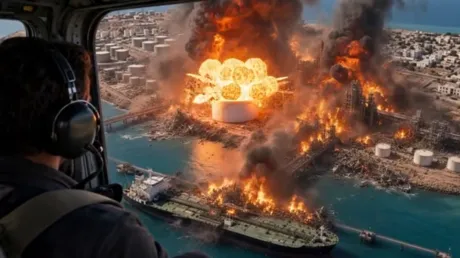
A sitting president used AI to fabricate a war he hadn’t yet fought. Donald Trump posted two synthetic clips on Truth Social this past weekend. They showed missiles obliterating oil terminals on Iran’s Kharg Island. The caption screamed: “Kharg Island being blown to smithereens!!!” No such strike occurred. The United States hit military launchers on Larak Island but deliberately spared energy infrastructure. The president’s AI-generated theater replaced official strategy with spectacle. This isn’t just propaganda. It’s a leader blurring the line between simulated violence and operational reality. Oil prices jumped within hours of the posts. WTI futures rose 2.47% to $85.46 per barrel. Brent futures climbed 2.71% to $90.49. The market reacted to fear, not to actual attacks on energy facilities. The psychological impact of these clips outpaced the kinetic reality.
The official American military narrative tells one story. US Central Command said it targeted two Iranian launchers on Larak Island. That island sits near the narrowest point of the Strait of Hormuz. According to American claims, those launchers were preparing rockets carrying sea mines for the waterway. Roughly 20% of global crude oil trade flows through that corridor. Tehran confirmed that the bombing killed several Iranian soldiers and civilians. Iran retaliated early Monday. The Islamic Revolutionary Guard Corps announced that its drones and missiles inflicted “significant damage” on King Hussein and Al-Azraq air bases in Jordan. This was the first direct exchange between American and Iranian forces since late July. All of this is documented, verified, and physically real. The AI clips Trump posted showed none of it. He didn’t show Larak Island. He didn’t show Jordan. He showed an attack on Kharg Island’s oil infrastructure that never happened. The official statement described measured, defensive action. The AI clips described total destruction of Iran’s energy lifeline. These two narratives exist in the same 48-hour window. They contradict each other completely.
The geopolitical stakes behind the AI theater are far more dangerous than the pixels suggest. Kharg Island isn’t just symbolic. It sits roughly 25 kilometers off Iran’s Gulf coast. It handles around 90% of Iran’s crude exports. It serves as the primary outlet for Iran’s oil revenue. The coral outcrop is known as the “forbidden island” because of its tight security. It hosts a major oil storage facility alongside export terminals. Before this latest escalation, the US struck military sites on Kharg Island several times since late February. Each time, energy infrastructure was left alone. Trump had mulled a ground operation to seize the oil hub. He said it could be carried out by US forces or by “other people.” Those plans never materialized. Tehran warned repeatedly. Iran would set the oil and gas infrastructure of US allies in Gulf States “on fire” if energy facilities on Kharg Island were hit or seizure was attempted. The AI videos filled the gap between rhetoric and deployment. They were propaganda dressed as operational truth. The real intention behind Kharg Island has always been leverage. Trump’s synthetic clips amplified that leverage without firing a single missile. But they also removed any ambiguity about what he wants.
The geopolitical pendulum now swings on a blade that Trump’s own AI sharpened. Kharg Island’s actual oil infrastructure remains standing. The Strait of Hormuz remains navigable. But every side recalibrates based on what appears to have been struck. When the president can manufacture visual proof of attacks that never happened, deterrence calculations break down. Allies and adversaries can’t distinguish simulated footage from real outcomes. Iran likely read the AI clips as pre-war signaling. The Gulf states saw a threat multiplier. Oil traders priced in tail risk they hadn’t expected. The US-Iran confrontation now runs on two parallel tracks. The kinetic fight follows the rules of physics. The synthetic fight follows the rules of perception. They don’t move at the same pace. Trump didn’t issue any immediate statement on the actual escalation. He just showed the world a war that doesn’t exist yet. The next real escalation will be judged against footage of strikes that never happened. The gap between what Trump shows and what actually hits the ground will define the next threshold. That gap will widen before it closes. The question isn’t whether Iran can tell the difference. It’s whether Iran’s retaliation calculus will assume the worst version of what it saw on a laptop.
Author bio: Julian Holbrooke, an overseas international relations analyst who frequently contributes to major European daily newspapers.