



(SeaPRwire) – By: Ethan Gallagher
I’ve watched battery companies dress up marketing campaigns as community movements for a decade. LiTime’s “Go Electric Contest Season 2: Argoseeker Sets Sail” is the cleanest execution of that trick I’ve seen this year. Call it what it is. This wasn’t a feel-good storytelling event. It was a globally crowdsourced market research operation, and LiTime got thousands of boat owners to do its product discovery work for free. Over 1.5 million impressions, hundreds of submissions, 15 countries and regions, all collected between July 15 and September 10. That’s a data harvest, dressed in a wetsuit.
Now look at the official facts first. Participants shared experiences across kayaks, inflatable boats, small fishing boats, Jon boats, and stand-up paddleboards. A Canadian user named Serhii walked through the classic upgrade ladder: paddles in 2024, then a trolling motor on lead-acid, then a LiTime 12V 140Ah LiFePO₄ pack. He cited heavy weight, declining capacity, and shaky confidence on long trips as the pain points that pushed him over. An Italian user, Massimiliano DI GIAMBATTISTA, runs a 2.7-meter inflatable for nearshore fishing and wants off gas entirely. His wish list reads like a product spec: zero fuel smell, instant start-up, almost no maintenance, extremely low noise. These are real users with real grievances, and LiTime was smart enough to record every one of them.
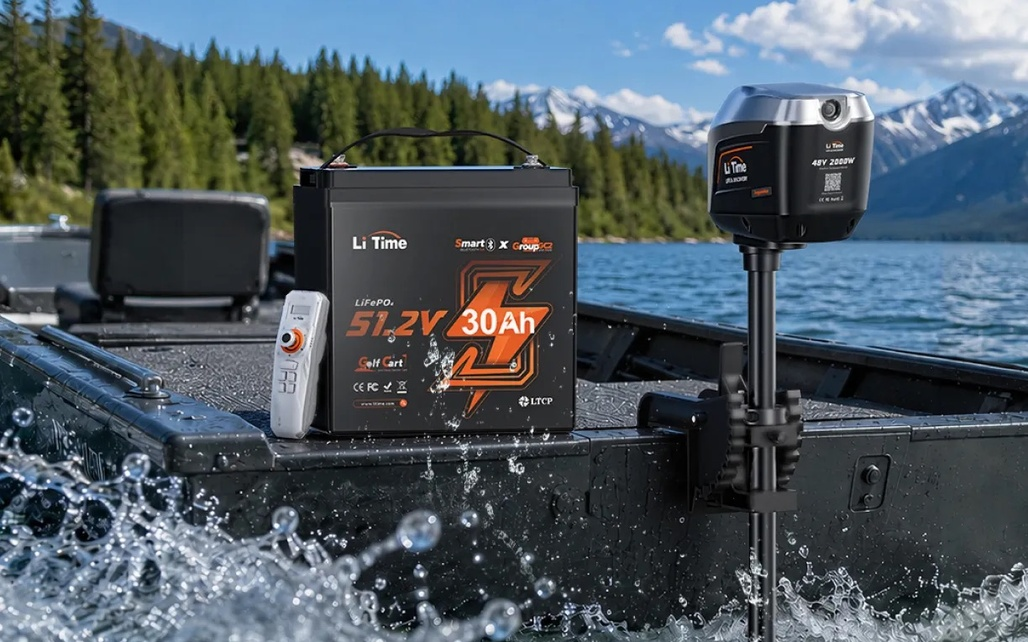
Here’s the industry subtext. The campaign conveniently surfaced exactly three failure modes of legacy propulsion: limited range, physical exhaustion, and gas engine noise and upkeep. Then, as if on cue, LiTime unveiled the Argoseeker electric outboard series, engineered to solve exactly those three problems. The A1 is a 24V, 700W unit aimed at kayaks, canoes, and inflatables. The A2 steps up to 48V and 2,000W for users wanting more power and range. The strategic move isn’t the motors themselves. It’s the integration. Argoseeker bundles motor, control system, and LiTime’s own marine batteries into one package. LiTime isn’t selling a motor. It’s selling lock-in. Once your propulsion and your battery come from the same vendor, switching costs stop being about hardware and start being about your entire power architecture.
That’s the real play, and the hardware landscape should pay attention. Small-boat electrification has been a fragmented mess for years: trolling motors from one brand, mismatched LiFePO₄ packs from another, DIY wiring everywhere. Whoever standardizes the integrated stack first owns the category. LiTime already had the battery installed base from its core business. Now it’s using “co-creation” campaigns as a listening pipeline to climb the value chain into propulsion. Competitors still selling standalone batteries or standalone motors are about to get squeezed from both ends. The supply chain math is blunt: cells are commoditizing, margin lives in the integrated system, and LiTime just bought itself a global focus group for the price of a few contest prizes.
Author bio: Ethan Gallagher is a Silicon Valley hardware architect and infrastructure strategist with fifteen years in battery systems and power electronics, advising marine and off-grid electrification startups on product and supply chain strategy.