

(SeaPRwire) – By: Julian Holbrooke
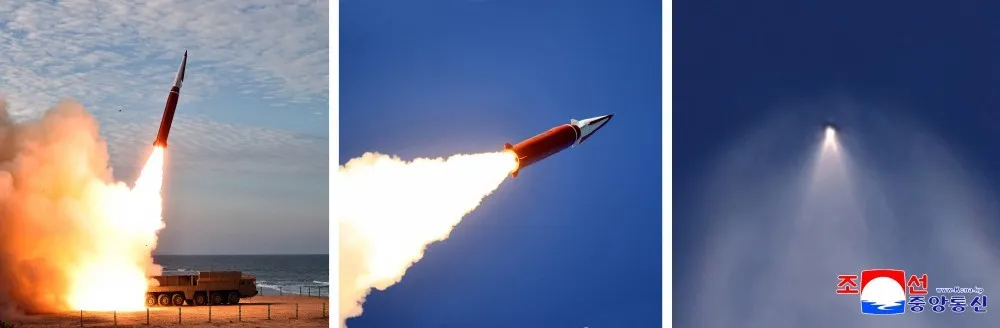
North Korea fired two short-range ballistic missiles toward the Sea of Japan on Sunday. The launch was not routine. Supreme Leader Kim Jong-un personally oversaw the test of what Pyongyang called a “new-type weapon.” State media released photos of a road-mobile missile carrying what appeared to be a hypersonic glide vehicle. Kim declared that this “ultra-modern defense technology” would give enemies an “incurable headache.”
The timing was deliberate. Seoul, Tokyo, and Washington held emergency phone consultations on Monday. South Korea’s Foreign Ministry confirmed the consultations but offered no specifics. The test came weeks after the Pacific Vanguard maritime exercise in August and September. Warships from Australia, Canada, Japan, South Korea, and the US participated. Pyongyang has long viewed these drills as existential threats.
Kim’s government has formally designated South Korea as a hostile state. This marks a dramatic shift from decades of official policy advocating Korean reunification. The change has not gone unnoticed in Seoul. President Lee Jae-myung’s Democratic Party favors reducing tensions. Lee told The New York Times that sanctions are “not particularly effective.” He suggested trading sanction relief for a pause in nuclear and ballistic missile development. “Aiming for denuclearization under the current circumstances guarantees that nothing will be accomplished,” Lee said.
The United States has also signaled openness to engagement. President Donald Trump suggested an in-person meeting with Kim in August. This followed Pentagon cutting short a joint exercise with Seoul. Trump’s administration has faced criticism for its handling of international affairs. The decision to launch a war with Iran disrupted global energy markets. Washington’s credibility has suffered accordingly.
North Korea’s missile program has advanced significantly. The hypersonic glide vehicle on display suggests capability beyond simple short-range delivery. These weapons can evade existing missile defense systems. The road-mobile launcher provides survivability against preemptive strikes. Pyongyang has mastered concealment and mobility.
The geopolitical calculation is clear. Kim wants to force negotiations from a position of strength. The test demonstrates capability while creating urgency among adversaries. Seoul faces particular pressure. Its security depends entirely on the US nuclear umbrella. Washington’s recent actions have raised doubts about commitment reliability.
Japan is equally concerned. The North Korean missile threat has driven Tokyo to expand its own strike capabilities. This represents a fundamental shift in postwar Japanese defense policy. Regional arms racing becomes more likely with each test.
South Korea’s presidential election adds complexity. Conservative forces favor harder line against Pyongyang. Lee’s approach risks being painted as naive by political opponents. The Democratic Party must balance deterrence credibility with diplomatic openness.
The United States faces a genuine dilemma. Military escalation risks provoking further tests. Engagement without concessions appears weak. Trump’s personal diplomacy could work or backfire catastrophically. The president’s unpredictability cuts both ways.
Regional allies are losing confidence in extended deterrence. South Korea and Japan may pursue independent nuclear capabilities. This would destabilize the nonproliferation regime globally. The Nuclear Non-Proliferation Treaty could unravel in Northeast Asia.
China watches carefully. Beijing opposes North Korean weapons development publicly. Privately, Pyongyang serves as a strategic buffer. China does not want US troops on its border. But a nuclear-armed North Korea complicates Shanghai’s calculations too.
The hypersonic test changes military planning. Existing defense systems cannot reliably intercept these weapons. Missile defense spending will increase across the region. Defense contractors in Washington, Seoul, and Tokyo will benefit. Meanwhile, diplomatic channels remain largely closed.
Kim’s strategy appears rational within his constraints. The regime faces economic sanctions and isolation. Military demonstration projects strength and unity. External threats justify internal repression. The “incurable headache” metaphor reveals arrogance mixed with calculation.
North Korea will likely test again. The regime views weapons development as existential. No leader in Pyongyang has abandoned this path. Diplomatic promises ring hollow given repeated violations. Sanctions enforcement remains inconsistent.
The United States needs a coherent strategy. Military option carries unacceptable risks. Pure engagement lacks leverage. A calibrated approach combining deterrence with diplomatic openings offers the best path. Allies must coordinate closely. Regional partners like China and Russia require engagement despite differences.
North Korea’s latest test is not an isolated event. It reflects deeper structural shifts in Northeast Asian security architecture. The old order built on American dominance is fraying. Regional powers are adapting. Some will militarize further. Others will seek accommodation. The direction remains uncertain.
The “new-type weapon” designation suggests continued technological advancement. Future tests may showcase intercontinental range capability. Such a development would trigger fresh crisis dynamics. Missile defense deployment would accelerate. Arms race escalation becomes more probable.
Diplomacy remains the only viable long-term solution. But current conditions favor neither side. North Korea sees strength in demonstration. The United States fears escalation. Allies face anxiety about reliability. Trust deficits are enormous.
Kim’s message to enemies is clear. Pyongyang possesses capabilities that existing defenses cannot counter. The headache will persist. Managing this reality requires sober assessment rather than panic or complacency.
Author bio: Julian Holbrooke is an overseas international relations analyst who frequently contributes to major European daily newspapers, specializing in Northeast Asian security dynamics and alliance politics.