
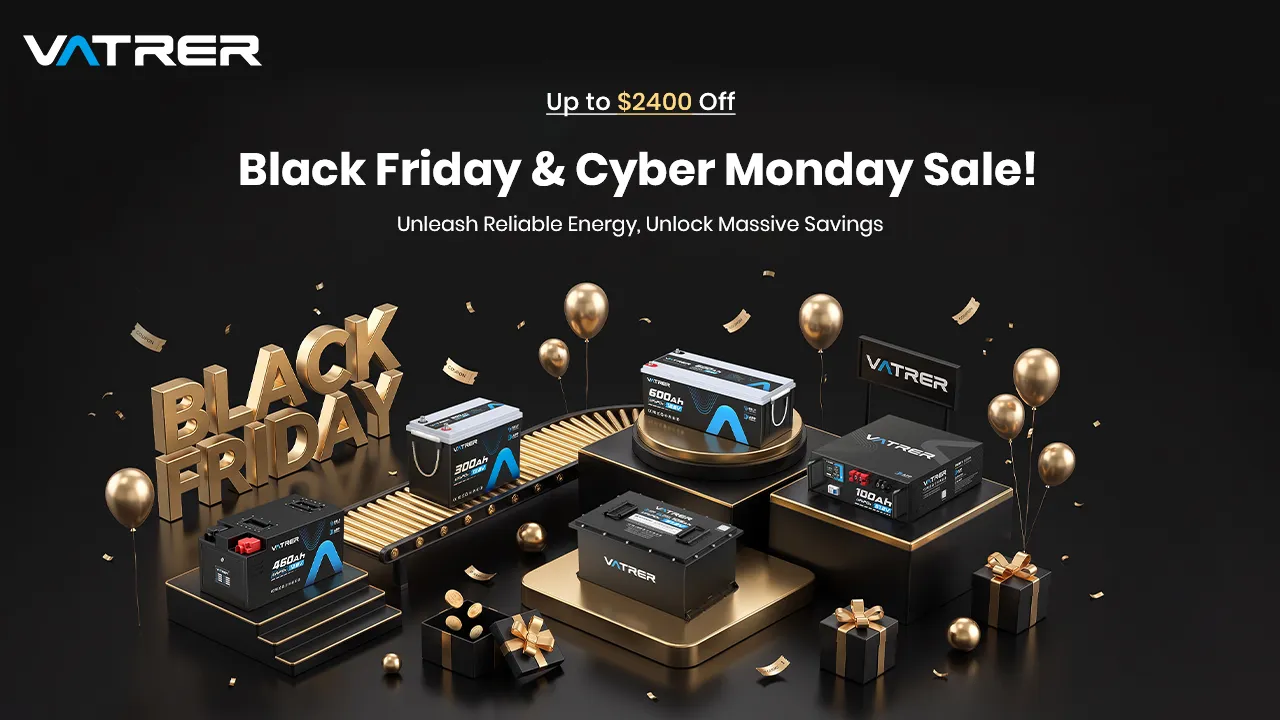
(SeaPRwire) – Most lithium battery promotions sound the same. Discount headlines, urgency tricks, seasonal framing. Vatrer Power’s Black Friday pitch looks different only because the numbers behind it are louder than usual. A $2,400 maximum discount on LiFePO4 cells is not a marketing flourish. It is a signal about where the commoditization line currently sits — and who plans to defend it.
The headline figures trace directly to Vatrer’s own release. The 48V 105Ah golf cart model delivers 5.376 kWh and up to 50 miles of range. Step up to the 48V 150Ah and you get 7.68 kWh with roughly 70 miles. For RV use, the self-heating line runs from 12V 300Ah at 3.84 kWh through 12V 460Ah at 5.888 kWh. The server-rack entry point hits 48V 100Ah at 5.12 kWh per unit, with Bluetooth monitoring, Wi-Fi connectivity, and self-heating built in. Marine SKUs include a 12V 100Ah Group 24 and a 24V 200Ah variant aimed at trolling motors. Add chargers, DC-DC converters, and pure sine wave inverters to the basket and the upgrade path broadens quickly. The discount window does exactly what any deep-discount cycle does under pressure. It accelerates lead-acid-to-lithium conversion among cost-conscious buyers who would otherwise shop incremental trade-in deals over months. That matters more than the sticker saving. Conversion lock-in raises lifetime value per customer. It also raises switching costs when the next upgrade arrives.
Behind the spec sheet sits the commercial architecture most press releases leave unstated. Vatrer bundles gift incentives — Facebook and YouTube giveaways valued at $4,500 combined, Energy Cubes for subscriptions, shares, and cart adds, free shipping, a 30-day price guarantee, and seven-day free returns. Qualifying multi-battery purchases include complimentary server racks. These are not gratuitous perks. They are margin-preserving tactics that shift acquisition cost away from direct price cuts while keeping the headline number compelling. The real question is supply chain durability. Lithium-cell pricing has tracked raw-material corridors and Chinese export dynamics. A discount this wide either rides current cell-cost headwinds favorable to importers or burns margin intentionally to widen share before competitors reprice. Either way, the move draws a line around the accessible-price tier of residential and recreational storage — the segment where Chinese-made LiFePO4 packs already compete on weight, usable capacity, and maintenance reduction. Vatrer is staking turf inside that segment rather than chasing premium branding.
The compact version of where this leaves the market is straightforward. Holiday促销 cycles compress buying decisions that normally stretch across quarters. Buyers who hesitate will likely transact now if the perceived gap between lead-acid replacement cost and lithium savings looks real on paper. Vatrer is betting that the $2,400 headline, paired with accessory bundling and cross-category coverage across golf carts, RVs, marine, solar, and home backup, creates enough breadth to convert single-SKU shoppers into multi-product customers. The endgame for competitors is not to match the deepest cut. It is to survive the conversion wave without eroding their own margin floors. If Vatrer sustains this pricing cadence into Q1, the consolidation pressure on mid-tier brands rises sharply. Market share reshuffles inLiFePO4 discretionary segments usually follow a pattern — volume leaders prune their SKU depth, niche players retreat to application-specific margins, and the rest adjust to whoever sets the price floor first.