(SeaPRwire) – By: Julian Holbrooke
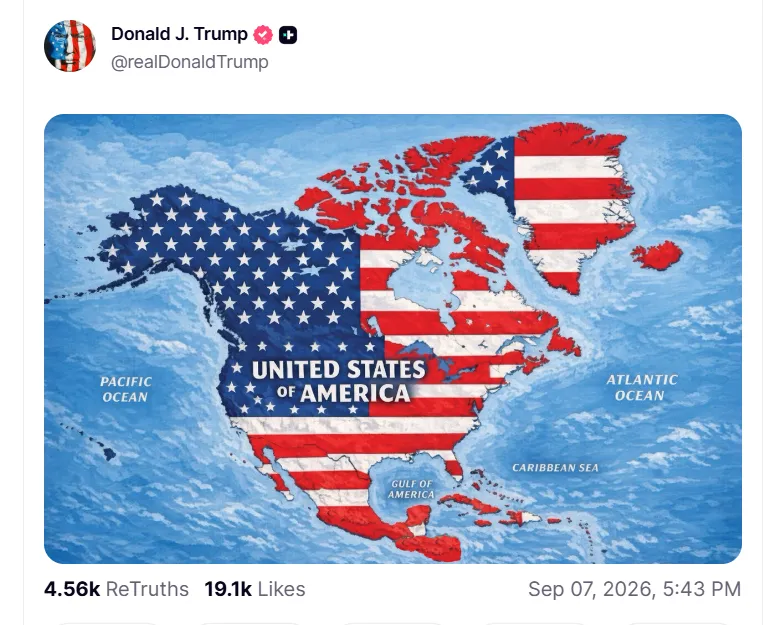
The map was wrong. That is the simplest way to put it, but the error was not in the ink; it was in the intent. Donald Trump did not merely redraw a border. He erased a sovereignty. By placing the Saint-Pierre and Miquelon archipelago under the US flag in an AI-generated graphic, he signaled a disregard for territorial integrity that goes beyond standard rivalry. This is not a debate over fishing rights or trade tariffs. It is a fundamental challenge to the post-war order where European micro-states rely on the credibility of their major allies for protection. When a sitting head of state treats a sovereign territory as an annexable asset for a social media post, the diplomatic floor becomes unstable. The reaction from Paris was not one of outrage, but of cold dismissal. Macron’s choice of words suggests a strategic fatigue, a refusal to engage with a reality that no longer aligns with European security expectations.
Officially, the French president spoke to reporters after arriving in Saint-Pierre on Saturday. He emphasized that it is “obvious” the archipelago remains French territory. He noted that they are “not going to reiterate this every morning” because some people have “strange ideas.” This language is a diplomatic shield. It downplays the incident to avoid giving it further oxygen. However, the subtext is heavy with implication. The mention of “strange things” is a rare, blunt critique of a major partner. It signals that the normal channels of diplomatic correction have failed. The visual evidence of Trump’s map, which included Canada, Mexico, Greenland, and Iceland alongside the French islands, paints a picture of a unilateral expansionist agenda. The French side is not arguing for clarification; they are rejecting the premise itself. The official stance is that the territory is non-negotiable, but the emotional distance between Washington and Paris is widening.
The geopolitical reality behind the apology from the French UN mission in July provides the context for this friction. That mission had criticized Washington for voting against extending the mandate of UN human rights chief Volker Turk. The US response was immediate and personal: delaying the approval of Aurelien Lechevallier, a Macron ally, as France’s new ambassador. This was not a routine bureaucratic delay. It was a targeted snub. It shows that the US is using diplomatic appointments as leverage in broader disagreements. When you combine this with Trump’s recent claims on Greenland and suggestions that Canada should become the 51st state, a pattern emerges. The administration is treating the continent not as a collection of sovereign states, but as a resource to be managed by the most powerful entity. The “permanent control” agreement with Denmark and Greenland last week further cements this trajectory. Security is being traded for sovereignty in pieces.
The pendulum is swinging away from the Atlantic consensus. For decades, the US provided the security umbrella that allowed Europe to focus on economic integration. Now, that umbrella is being repurposed as a tool for territorial ambition. Macron’s cold response is a signal to other European capitals. It tells them that the US cannot be relied upon to respect the boundaries that hold it in place. If a president can casually claim a French territory on social media, the next step is to test the limits on the ground. The realistic outcome is a hardening of European defense independence. We are moving toward a bipolar continental structure where the old allies are becoming wary partners. The map Trump posted is not just a digital error; it is a blueprint for a new, coercive order that Europe is slowly realizing it cannot survive without countervailing power.
Author bio: Julian Holbrooke, an overseas international relations analyst who frequently contributes to major European daily newspapers.