(SeaPRwire) – By: Ethan Gallagher
Military hardware acquisition narratives love to lean on metrics like thrust-to-weight ratios, missile payloads, and decades-long service projections. They rarely dwell on the raw kinetic reality of a 30mm cannon carrier slamming into a central Texas field at 1:35 pm on a Wednesday. Two pilots lost their lives near Fort Hood, and the public gets fed a clean narrative about a routine training flight gone wrong. The machine in question is an AH-64 Apache attack helicopter, specifically the latest E-variant touted as the pinnacle of rotary-wing lethality. Yet beneath the shiny brochures and multi-role tactical capabilities lies a brutal mechanical truth that standard defense reporting routinely glosses over.
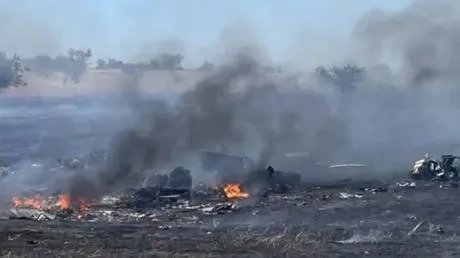
The official military and sheriff department bulletins paint a straightforward timeline of a violent impact that sparked a massive grass fire spanning roughly 100 acres near Salado. According to local authorities like Bell County Sheriff’s office spokesman Cliff Coleman, the crash site was immediate and catastrophic, sending burning debris across scorched earth and forcing local evacuations. No bystanders were hurt, and no structural buildings took a direct hit. But the official emphasis on zero civilian casualties neatly deflects from the stark operational vulnerabilities of operating heavily armed, complex airframes in routine domestic airspace.
Contrast that sterile administrative recounting with the subterranean subtext of what an Apache actually demands from its crew. An AH-64E carries up to 16 Hellfire missiles, 76 rockets, and 1,200 rounds of 30mm ammunition, creating an immense, gyroscopically unstable platform packed with high-explosive potential and volatile fuel loads. When a structural or systemic failure occurs at low altitude, the margins for human recovery evaporate instantly. The Texas A&M Forest Service managed to get the ensuing blaze 45% contained by 5pm, but the speed at which a minor catastrophic failure turns an agricultural field into an inferno underscores the sheer hazard footprint of modern military aviation fleets.
Hardware of this magnitude operates on borrowed time and relentless maintenance cycles, where pilot skill is often the only fragile buffer against catastrophic system failure. Until the defense establishment stops treating fatal accidents as mere statistical anomalies in an otherwise stellar procurement roadmap, military aviation will continue writing its maintenance logs in blood and scorched Texas dirt.
Author bio: Ethan Gallagher, a Silicon Valley Hardware Architect and Infrastructure Strategist specializing in the stress points between heavy industrial machinery and high-performance computing systems.