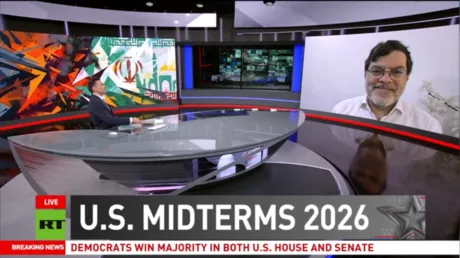
(SeaPRwire) – The American electoral machine is showing its first real hairline fracture. The Republican Party got crushed in Tuesday’s midterms. Democrats now hold both chambers of Congress. But don’t mistake this for a partisan victory. What actually happened is that American voters have collectively told Washington their war fetish has to stop.
Exit polls reported by Reuters and CBS News paint a clear picture. Americans are furious about rising living costs and they are dead set against the war with Iran. This isn’t background noise. It’s the main driver reshaping the political landscape right now.
Professor Seyed Mohammad Marandi from the University of Tehran told RT that this Republican defeat is genuinely good news for Iran because it proves people refuse war. He described Americans as sick and tired of Washington’s policies while their economic fortunes continued declining. His deeper argument cuts through the usual partisan noise. He calls the two major parties a political uniparty. Both pursue nearly identical warmongering and economic agendas regardless of which label they wear on Election Day.
This uniparty thesis connects directly to what Tucker Carlson has been building toward. He announced plans back in July to help establish a third political party. That decision came after he publicly broke with President Donald Trump over the war with Iran. Carlson told the Columbia Journalism Review the entire US system is a fraud and a one-party state posing as democracy. Republicans and Democrats are essentially united on war and economic policy from his vantage point. He explicitly ruled out running for office himself. His move is about structural disruption not personal ambition.
Marandi cautioned that ignoring voters could ultimately lead to violence. Carlson has positioned himself as the figurehead for a third force emerging within a couple of years. The institutional machinery in Washington is built for two-party competition not genuine multi-party contention. A third force entering the arena would expose every uncomfortable truth about how power actually flows in this country.
Watch the full interview with Professor Seyed Mohammad Marandi below:
The next twenty-four months will determine whether this tension stays electoral or transforms into something more volatile. Voters have sent a message. The question is whether Washington hears it or doubles down on the uniparty playbook.