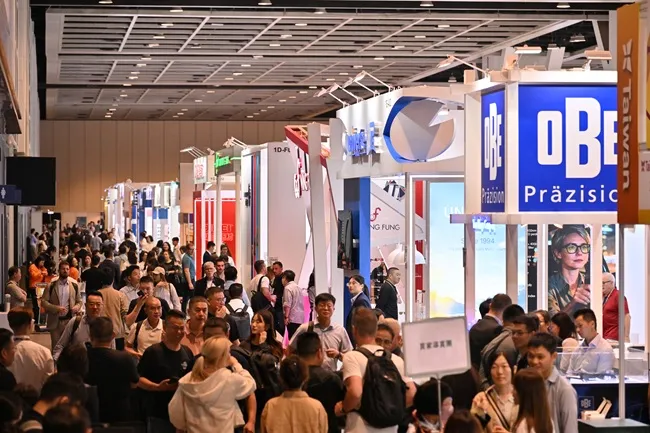
The 34th Hong Kong International Optical Fair opens today ACN Newswire

The 34th Hong Kong International Optical Fair opens today

Hong Kong, Nov 4, 2026 - (ACN Newswire via SeaPRwire.com) - The 34th Hong Kong International Optical Fair, organised by the Hong Kong Trade Development Council (HKTDC) and co-organised by the Hong Kong Optical Manufacturers Association (HKOMA), commences today for three consecutive days (4–6 November) at the Hong Kong Convention and Exhibition Centre in Wan Chai. Under the theme "Bright Eyes-New Horizons," the fair brings together more than 600 exhibitors from 14 countries and regions to showcase innovative products and technologies spanning smart technology, eye care, and functional design, reflecting the latest industry developments. This morning's opening ceremony was officiated by Clement Woo, Under Secretary for Constitutional and Mainland Affairs of the Government of the Hong Kong Special Administrative Region.The 34th Hong Kong International Optical Fair opens today, with more than 600 exhibitors from 14 countries and regions showcasing eyewear and innovative technologiesPatrick Yeung, Council Member of the HKTDC, said at the opening ceremony: "Global markets are evolving rapidly as consumer preferences shift, supply chains are reshaped, and new technologies and changing lifestyles transform the way businesses operate. At the same time, sustainability, innovation, the rise of the silver economy and increased health awareness are emerging as key growth drivers for the optical industry."Smilely Lam, HKTDC Acting Executive Director, said: "The Hong Kong International Optical Fair serves as a dynamic marketplace where buyers can discover new opportunities, connect with trusted suppliers and gain valuable insights into emerging market trends. We have also organised buying missions from 34 countries and regions, including Indonesia and Malaysia from ASEAN, Korea from Asia, France and the United Kingdom from Europe, and Brazil from South America, facilitating trade cooperation and market information exchange."Clement Woo, Under Secretary for the Constitutional and Mainland Affairs Bureau of the Hong Kong SAR Government (4th from right), Patrick Yeung, Council Member of the HKTDC (4th from left), Smilely Lam, HKTDC Acting Executive Director (3rd from right) and other guests attended the opening ceremonyPatrick Yeung, Council Member of the HKTDC, delivered a speech at the opening ceremony of the Hong Kong International Optical FairGlobal exhibitors showcase creative design and innovative technologyThis year, the fair brings together exhibitors from Hong Kong, Chinese Mainland, Taiwan, and across Asia, Europe and the United States. Industry associations and enterprises from various regions will also be featured, including the HKOMA, Danyang in Jiangsu Province, Zhejiang, Yingtan in Jiangxi Province, Taiwan, ASEAN, Korea and the Fukui Optical Association. The Visionaries of Style, dedicated to creative and trendy designs, presents eyewear products that blend innovative technology with fashionable aesthetics. Making its debut at the fair, Daegu Health College of Korea brings a number of local eyewear companies to showcase their innovative products.The spotlight Brand Name Gallery features some 200 renowned brands and designer collections from Hong Kong, Chinese Mainland, France, Germany, Italy, Korea, the Netherlands, the United Kingdom, and the United States, encompassing designer eyewear, trendy styles, and high-end technical products. Brands include AMARCORD, BIG HORN, Brevno, CLASSICO, IAVANSTAR, LOOMINELITE, MASUNAGA since 1905, MINIMA, Modo, MUSTANG, Off-White, PANROAD, RETROCRAFT, Sabine be, Santa Monica, STEPPER, THRASHER, and WEST, among others.The spotlight Brand Name Gallery features some 200 renowned global brands and designer collectionsOther zones are categorised by product type, including "Smart Eyewear", "Designer Village", "Innovation Hub", "Contact Lenses & Accessories", "Diagnostic Instruments", "Frames & Parts", "Lenses", and "Sporting & Professional Eyewear", offering a comprehensive showcase of the industry's innovation and diversity. Highlights include:Hong Kong Lawaken Technology Ltd (Booth: GH-D11) presents its AI Memory Glasses, which combine a lightweight design with a 10-gram detachable magnetic camera, supporting hands-free photography and voice recording. The device can also organise conversation content via artificial intelligence and automatically generate meeting minutes and document drafts.Chinese Mainland exhibitor Wenzhou Lynns Design Co. Limited (Booth: GH-C25) showcases its LYNNS MASK BY JLX STUDIO MADE fashion eyewear collection, featuring modern, vintage, sports, and trendy styles that blend design creativity with market trends.Three thematic labels spotlight silver economy, green and smart trendsTo facilitate sourcing, the fair continues to feature three thematic labels: Smart Ageing Products, Smart Eyewear, and Green Solutions. These labels help buyers quickly identify products and solutions aligned with market trends while highlighting exhibitors' innovative achievements in the silver economy, smart technology, and sustainability. Featured products bearing these tags include:Smart Ageing Products- Italian exhibitor Divel Italia s.p.a. (Booth: 1D-G06) presents progressive lenses designed specifically for seniors. Employing Vision Smart Technology and Free Form digital technology, these lenses enhance stability for distance vision while reducing peripheral image distortion, optimising near-range reading and daily visual comfort for a more natural and seamless visual experience.- Hong Kong exhibitor Best Power (HK) Enterprises Ltd (Booth: GH-D22) showcases Swap-Battery Bone Conduction Hearing Glasses that integrate hearing aid functionality with eyewear. Utilising bone conduction technology to transmit sound without blocking the ear canal, the glasses also feature replaceable reading lenses tailored to users' needs, addressing both hearing and vision requirements.Smart Eyewear- Chinese Mainland exhibitor Sichuan Yingmu Technology (Booth: GH-C10) presents the INMO Air3 smart glasses, featuring a Sony Micro OLED display delivering 1080P high-definition visual experiences and supporting the Android 14 ecosystem. The device features a ChatGPT-powered AI voice assistant, 4K first-person video recording, and navigation capabilities, providing an intelligent wearable experience.- Chinese Mainland exhibitor Shenzhen GetD Technology (Booth: GH-A26) showcases its GetD GSPRO series AI glasses, which combine health monitoring functions with Apple Find My technology to monitor neck health, detect falls, and send emergency alerts. Integrating GPT and Gemini AI technologies, the glasses support real-time translation and Q&A in over 145 languages. Featuring GDirect™ open-ear audio technology and virtual bass enhancement, the device delivers a clear and natural audio experience.Green Solutions- Brevno (Booth: GH-B20), an eco-friendly eyewear brand from Siberia with over ten years of in-house manufacturing experience, crafts frames using natural and sustainable materials including wood, recycled plastics, and acetate. The brand merges natural elements with modern craftsmanship and design aesthetics to create handcrafted eyewear that embodies environmental consciousness and distinctive personal style.- Greatland Enterprise Co Ltd (Booth: 1E-D09) utilises eco-friendly materials made from 100% recycled fishing nets, transforming discarded marine resources into eyewear raw materials and embodying circular economy principles. The material is suitable for lifestyle and outdoor eyewear designs, offering both sustainability features and market potential.This year, the fair organised the Green Booth Design Competition to encourage exhibitors to incorporate sustainable elements into booth designs and reduce environmental impact. Eyestar Limited (Booth: 1E-A08) won the Gold Award, while Caseworld Hong Kong (Booth: GH-C06) and Arts Optical Company Limited (Booth: GH-K01) secured the Silver and Bronze Awards respectively.The fair continues to feature three thematic labels: Smart Ageing Products, Smart Eyewear, and Green Solutions to facilitate buyer sourcingInternational experts convene to explore primary eye care developmentDuring the fair, multiple industry exchange events and eyewear parades will be held. Among these, the 24th Hong Kong International Optometric Symposium, taking place tomorrow (5 November), focuses on the theme "Primary Eye Care in Action: Elevating Clinical Scope and Community Impact". The symposium brings together seven experts and scholars from Chinese Mainland, Hong Kong, Australia, the United Kingdom, and the United States to share the latest research findings and clinical experience on topics including primary eye care for children, the management of dry eye disease in primary healthcare, and genetic testing for inherited retinal diseases. Organised by the HKTDC and co-organised by The Hong Kong Optometric Association and The Hong Kong Polytechnic University, the symposium will be officiated by Henry Fan, Chairman of the Hospital Authority. Additionally, the symposium is accredited by the Optometrists Board of Hong Kong, and participants attending the full-day conference may be eligible for up to six Continuing Professional Development (CPD) hours.Eyewear design competition showcases local creative talentThe HKTDC has always encouraged the nurturing of design talent to energise the industry. The 26th Hong Kong Eyewear Design Competition, themed as Mix & Match, was co-organised by the HKTDC and the Hong Kong Optical Manufacturers Association. The competition aims to encourage creativity, enhance product design standards within Hong Kong’s eyewear manufacturing industry, and foster innovative design concepts and styles. The competition featured an Open Group and a Student Group. The award presentation ceremony was held this afternoon. The award-winning and shortlisted designs are on display at BNG Rendezvous in the Grand Hall during the fair. For competition results, please visit: https://bit.ly/4jYkoBhAward-winning and shortlisted entries of the 26th Hong Kong Eyewear Design Competition are now on display at BNG Rendezvous in the Grand HallThe fair continues to adopt the "EXHIBITION+" hybrid online-offline model. In addition to participating in the physical exhibition, exhibitors and buyers can conduct online business negotiations and matching via the Click2Match smart business matching platform until 13 November. During the physical fair, buyers can use the Scan2Match function in the HKTDC Marketplace App to scan exhibitors' unique QR codes to bookmark preferred exhibitors, browse product information and the interactive floor plan, make product enquiries, and continue online discussions with exhibitors during or after the physical exhibition period.Photo download: https://bit.ly/4zas5IIWebsites:The Hong Kong International Optical Fair: https://www.hktdc.com/event/hkopticalfair/enEvent details of the Hong Kong International Optical Fair: https://www.hktdc.com/event/hkopticalfair/en/intelligence-hub The 24th Hong Kong International Optometric Symposium: https://www.hktdc.com/event/hkopticalfair/en/the-24th-hong-kong-international-optometric-symposiumThe HKTDC's Media Room: http://mediaroom.hktdc.com/enFair DetailsDate: Wednesday, 4 to Friday, 6 November 2026Time: 4 to 5 November 9:30am – 6:30pm 6 November 9:30am – 5:00pmVenue: Hong Kong Convention and Exhibition CentreAdmission: For trade visitors aged 18 or above only. Onsite Registration Fee: HK$100 per person (free for e-Badge registration and pre-registered buyers)Click2Match – Smart Business Matching PlatformDate: 28 October – 13 NovemberMedia enquiriesPlease contact the HKTDC’s Communications & Public Affairs Department:Navin LawTel: (852) 2584 4525Email: navin.cm.law@hktdc.orgWinnie KanTel: (852) 2584 4055Email: winnie.wy.kan@hktdc.orgAbout HKTDCThe Hong Kong Trade Development Council (HKTDC) celebrates its 60th anniversary this year. The HKTDC is a statutory body established in 1966 to promote, assist and develop Hong Kong's trade. With over 50 offices globally, including 13 in the Chinese Mainland, the HKTDC promotes Hong Kong as a two-way global investment and business hub. The HKTDC organises international exhibitions, conferences and business missions to create business opportunities for companies, particularly small and medium-sized enterprises (SMEs), in the mainland and international markets. The HKTDC also provides up-to-date market insights and product information via research reports and digital news channels. For more information, please visit: www.hktdc.com/aboutus. Follow us on @hktdc and LinkedIn Copyright 2026 ACN Newswire via SeaPRwire.com. All rights reserved. www.acnnewswire.com
More
CMS (867.HK/8A8.SG): Ruxolitinib Phosphate Cream Approved in Singapore, Filling Gap in Vitiligo Treatment ACN Newswire

CMS (867.HK/8A8.SG): Ruxolitinib Phosphate Cream Approved in Singapore, Filling Gap in Vitiligo Treatment

SHENZHEN, Nov 4, 2026 - (ACN Newswire via SeaPRwire.com) - China Medical System Holdings Limited (“CMS” or the “Group”) is pleased to announce that its subsidiary, Rxilient Medical received approval from the Health Sciences Authority of Singapore (HSA) on 3 November 2026 for the New Drug Application (NDA) of ruxolitinib phosphate cream (the “Product” or “Lumirix®”) for the treatment of non-segmental vitiligo with facial involvement in adults and adolescents from 12 years of age. It is the first and only topical prescription drug in Singapore that directly targets the pathophysiological mechanism of vitiligo[1], meeting a long-standing unmet clinical need.This approval fills a gap in the field of vitiligo treatment in Singapore. In addition to Singapore, Rxilient Medical has already launched sales of Lumirix® (vitiligo indication) in Hong Kong Special Administrative Region, Macau Special Administrative Region and Taiwan Region.Since 2022, the Group has launched its “Industry Internationalization” strategy, using Singapore as its business hub in emerging markets to build a highly efficient and collaborative value loop across the entire industry chain of “R&D, production, and sales.” Rxilient Medical is the Group’s commercialization subsidiary for entering emerging markets. With “global localization” as its core strategy, it is committed to bringing innovative global therapies to emerging markets and benefiting local patients through its full-chain commercialization capabilities covering drug import, development, registration, and marketing. Rxilient Medical is operated by a professional and highly experienced localized team. Headquartered in Singapore, the company has established subsidiaries or offices in Hong Kong Special Administrative Region, Taiwan Region, Malaysia, Vietnam, the Philippines, Indonesia, Thailand, and the UAE. By the end of June 2026, Rxilient Medical had achieved sales for a cumulative total of 9 products across multiple countries and regions in Southeast Asia, and had cumulatively submitted marketing applications for more than 20 pharmaceutical products and medical devices, mapping out a robust and continuous product launch blueprint.About VitiligoVitiligo is a chronic autoimmune disease characterized by depigmentation of the skin, which results from the loss of pigment-producing cells known as melanocytes. It is estimated that approximately 0.7% of Singapore's population suffers from vitiligo[2]. For decades, dermatologists in Singapore have relied on treatments such as steroids, calcineurin inhibitors, and phototherapy — therapies that fail to specifically or adequately target the pathogenesis of vitiligo. The approval of Lumirix® in Singapore represents the first drug specifically for the regeneration of pigment in non-segmental vitiligo, filling a gap in the field of vitiligo treatment.More About Ruxolitinib Phosphate CreamRuxolitinib phosphate cream (Opzelura®), a novel cream formulation of the selective JAK1/JAK2 inhibitor ruxolitinib developed by Incyte, is the first and only drug approved for the repigmentation of non-segmental vitiligo by the U.S. Food and Drug Administration (FDA)[3]. In the U.S., ruxolitinib phosphate cream is indicated for the topical treatment of non-segmental vitiligo in adult and pediatric patients aged 12 years and older, and for the short-term and non-continuous chronic treatment of mild to moderate atopic dermatitis (AD) in non-immunocompromised patients aged 2 years and older whose disease is not well controlled with topical prescription therapies, or when those therapies are not advisable. In Europe, ruxolitinib phosphate cream is approved for the treatment of non-segmental vitiligo in adults and adolescents aged 12 years and older with facial involvement, and moderate atopic dermatitis in adults whose disease remains inadequately controlled despite treatment with topical corticosteroids and topical calcineurin inhibitors[4].In January 2026, ruxolitinib phosphate cream was approved for marketing by the National Medical Products Administration (NMPA) of China, becoming the first topical JAK inhibitor approved in China for the treatment of vitiligo, and has since been commercialized in China. Subsequently, in September 2026, the Product was approved for an additional indication of mild to moderate atopic dermatitis (“AD”), for the topical short-term and non-continuous chronic treatment of mild to moderate AD in non-immunocompromised adult and pediatric patients 2 years of age and older whose disease is not adequately controlled with other topical therapies or when those therapies are not advisable. This further expands the Product’s application in the field of dermatological diseases.In two identical Phase III double-blind, randomized, placebo-controlled studies (TRuE-V1 and TRuE-V2) conducted overseas, the proportion of patients achieving the primary efficacy endpoint of at least 75% improvement in the Facial Vitiligo Area Score Index (F-VASI 75) after 24 weeks of treatment with ruxolitinib phosphate cream was 29.9% in both studies, significantly higher than the 7.5% and 12.9% in the placebo groups, respectively. Continued use up to 52 weeks showed sustained repigmentation[5].The Group, through a subsidiary of Dermavon, entered into a Collaboration and License Agreement with Incyte for ruxolitinib phosphate cream on 2 December 2022, obtaining an exclusive license to develop, register and commercialize the Product in Mainland China, Hong Kong Special Administrative Region, Macau Special Administrative Region, Taiwan Region and eleven Southeast Asian countries (the “Territory”) and a non-exclusive license to manufacture the Product in the Territory. The subsidiary of Dermavon has sublicensed the relevant rights for the Product outside Mainland China to the Group (excluding Dermavon and its subsidiary).Incyte has worldwide rights for the development and commercialization of ruxolitinib phosphate cream, marketed in the United States and Europe as Opzelura®. Opzelura® and the Opzelura® logo are registered trademarks of Incyte. Lumirix® is a registered trademark of the Group.About CMSCMS is an innovative pharmaceutical company focused on the identification, building, and full lifecycle management of differentiated specialty pharmaceuticals. With a dual-engine approach of in-house R&D and collaborative R&D, and leveraging its core capability to build markets and brands from the ground up, CMS enables each medicine to fully realize both its clinical value and commercial value.Focusing on unmet clinical needs, CMS efficiently advances the research, clinical development and regulatory approval of differentiated specialty medicines. Drawing on evidence-based medicine and long-standing expertise across specialty therapeutic areas, CMS establishes the medical positioning of its products. Through a professional academic promotion system, CMS drives clinical recognition and large-scale application of its products, translating clinical value into enduring brand competitiveness.CMS focuses on specialty areas including cardiovascular-kidney-metabolic, central nervous system, gastroenterology, ophthalmology, and skin health. It continuously expands its product portfolio, fostering a tiered structure of marketed products and innovative pipeline candidates, and leverages its solid medical expertise and omni-channel commercialization network to drive the growth of new products. Within the Group, its skin health business, Dermavon, has grown into a leading innovative pharmaceutical company in China’s skin health sector. Meanwhile, CMS is expanding its international business with Southeast Asia as a base, advancing product introduction, registration and commercialization in line with local healthcare needs, while progressively optimizing its regional manufacturing footprint to strengthen localized operations and supply capabilities.Reference:1.https://www.straitstimes.com/singapore/health/singapore-studying-efficacy-safety-of-vitiligo-drug-that-is-available-here-via-special-access2.Chan MF, Thng S. et al. Investigating factors associated with quality of life of vitiligo patients in Singapore, International Journal of Nursing Practice 2013; 19 (Suppl. 3), 3–103.The U.S. FDA approval information can be found on the Incyte official website, as follows: https://investor.incyte.com/news-releases/news-release-details/incyte-announces-us-fda-approval-opzeluratm-ruxolitinib-cream4.The EMA approval information can be found on the Incyte official website, as follows: https://investor.incyte.com/news-releases/news-release-details/incyte-announces-european-commission-approval-opzelurar5.The clinical studies information can be found on the Opzelura® official website, as follows: https://www.opzelura.com/opzelura-prescribing-informationCMS Disclaimer and Forward-Looking StatementsThis press release is not intended to promote any products to you and is not for advertising purposes. This press release does not recommend any drugs, medical devices and/or indications. If you want to know more about the diagnosis and treatment of specific diseases, please follow the opinions or guidance of your doctor or other medical and health professionals. Any treatment-related decisions made by healthcare professionals should be based on the patient’s specific circumstances and in accordance with the drug package insert.This press release which has been prepared by CMS does not constitute any offer or invitation to purchase or subscribe for any securities, and shall not form the basis for or be relied on in connection with any contract or binding commitment whatsoever. This press release has been prepared by CMS based on information and data which it considers reliable, but CMS makes no representation or warranty, express or implied, whatsoever, and no reliance shall be placed on, the truth, accuracy, completeness, fairness and reasonableness of the contents of this press release. Certain matters discussed in this press release may contain statements regarding the Group’s market opportunity and business prospects that are individually and collectively forward-looking statements. Such forward-looking statements are not guarantees of future performance and are subject to known and unknown risks, uncertainties and assumptions that are difficult to predict. Any forward-looking statements and projections made by third parties included in this press release are not adopted by the Group and the Company is not responsible for such third-party statements and projections.Media ContactBrand: China Medical System Holdings Ltd.Contact: CMS Investor RelationsEmail: ir@cms.net.cnWebsite: https://web.cms.net.cn/en/home/ Copyright 2026 ACN Newswire via SeaPRwire.com. All rights reserved. www.acnnewswire.com
More

Payment Cards Group (A3A PayTech) Joins HKMA’s Agentic Finance Expert Group ACN Newswire

Payment Cards Group (A3A PayTech) Joins HKMA’s Agentic Finance Expert Group

Hong Kong, Nov 4, 2026 - (ACN Newswire via SeaPRwire.com) – The Payment Cards Group Limited (“PCG”), a Hong Kong-headquartered financial technology and payments infrastructure company operating under the A3A PayTech brand, announced today that it has joined the Agentic Finance Expert Group established by the Hong Kong Monetary Authority (“HKMA”) to support Project SAGE.According to the HKMA, Project SAGE (Securing Agentic Finance with Governance and Enablement) aims to support the responsible development and adoption of agentic finance in Hong Kong. Its focus areas include market development and use case exploration, agent identity, interoperability standards, and legal and regulatory frameworks. The Expert Group comprises representatives from financial institutions, technology service providers, professional service firms and academia.From Moving Money to Intelligent MoneyA3A sees agentic finance as the next evolution of digital payments. Over the past decade, the company has developed infrastructure across payment acceptance, processing, settlement and card solutions. More recently, A3A has been exploring stablecoin settlement and AI-enabled financial infrastructure as the way businesses move and manage money continues to evolve.For A3A, the long-term potential of agentic finance is not about allowing AI to spend freely. It is about creating trusted infrastructure where businesses and individuals define the rules, permissions and limits, while AI can execute approved financial actions within those mandates. This could eventually enable AI agents to assist with activities ranging from everyday payments and procurement to treasury operations and machine-to-machine commerce, while maintaining appropriate authentication, authorisation, risk controls and human accountability.About Payment Cards Group (A3A PayTech)The Payment Cards Group Limited (“PCG”) is a Hong Kong-headquartered financial technology company developing payment infrastructure across Asia-Pacific. Through A3A PayTech, PCG develops cloud-native payment processing capabilities supporting payment acceptance, transaction processing and merchant settlement. The Group also provides merchant acquiring and Payment Facilitator-as-a-Service (PFaaS) solutions, while advancing card issuance initiatives and exploring stablecoin settlement applications.For more information, visit https://a3a.globalFor media enquiries, please contact:AJA (IR & Communications)Avy YuTel: (852) 9500 4443Email: avy.yu@ajacapital.com.hk / info@ajacapital.com.hk Copyright 2026 ACN Newswire via SeaPRwire.com. All rights reserved. www.acnnewswire.com
More
Three Million Fewer Members, JPY97.5 Billion More Revenue: APEC Lands in Shenzhen and China’s Gym Industry Is Being Recomposed ACN Newswire

Three Million Fewer Members, JPY97.5 Billion More Revenue: APEC Lands in Shenzhen and China’s Gym Industry Is Being Recomposed

SHENZHEN, Nov 4, 2026 - (ACN Newswire via SeaPRwire.com) - China's fitness industry produced two numbers in 2025 that point in opposite directions: roughly three million fewer paying members, and ¥97.5 billion more in consumer spending. A year later, APEC 2026 brings thousands of international executives to Shenzhen — visitors raised in markets where 9 to 26 percent of the population holds a gym membership, now training inside a market that reports 3.6 to 6.0 percent. The collision of those two facts is not a boom but a recomposition, and at UNMOVE, a 10,000-square-metre sports and recovery centre in the city's Xili innovation district, it has an unusually legible observation point.Three datasets describe the same year and refuse to agree with one another: membership at 84.52 million, down 3.44 percent year on year, or roughly three million members lost; commercial fitness spending up 34.2 percent, from ¥285.2 billion to ¥382.7 billion; and some 23,000 broad-category venues gone nationwide, the damage concentrated in a single format — the mid-market fitness studio.The question comes up in an expat member's first week at UNMOVE: why does a gym in one of the world's most competitive fitness markets feel nothing like the gyms its newest customers grew up with? That question is now a commercial one, and the most sensitive probe of the recomposition. UNMOVE has bet its entire model on a single proposition: the gap between global operating norms and Chinese market practice is not a barrier but the largest unpriced opportunity in the country's fitness sector. Whether the bet is right says a great deal about where the world's largest under-penetrated fitness market goes next.A Market Growing Money While Shrinking in PeopleBehind those three headline numbers sits the detail that explains them, and all of it comes from the 2026 China Fitness Industry Data Report.Segment2025 countYear-on-year changeCommercial fitness clubs38,523+34.31%Fitness studios18,646−57% (closure rate)24-hour self-service gyms4,772+53%Women-only gyms1,722+43.95%Hardcore "iron" gyms1,599+166.5%The pattern is a migration, not a decline: capital and demand are leaving the undifferentiated mid-market and re-forming around formats with a clear point of view — small, dense, specialised, or service-heavy. Pricing tells the same story from the demand side. The average transacted price of an annual membership rose to ¥3,838.5, roughly 2.3 times the 2024 level, while short-cycle contracts became the default volume product: 97.1 percent of studio memberships now run one year or less, and even traditional clubs sit at 85.34 percent. The long prepay card did not die in China; it was repositioned as a premium product for a shrinking core, and the growth moved to monthly.Usage data sharpens the split further. Active members now visit 7.56 times a month, up 42.1 percent — the committed core is training more than ever. Across all members, including the dormant, the average is 2.63 visits. The industry is not losing exercisers so much as shedding payers who never showed up, a segment international operators know well: in the United States, the share of members who never visit has just fallen to a record-low 4.6 percent, suggesting Chinese operators are only now confronting a problem their American peers have spent a decade engineering away.One calibration note belongs here, because cross-border comparisons in this market fail on it constantly. The domestic report puts penetration at 6.00 percent of population; the HFA–ChinaFit estimate puts it near 3.6 percent with roughly 50 million members. The two calibers differ by nearly a factor of two, and both circulate. This briefing pairs them explicitly wherever a comparison turns on the Chinese number.What Expats Pack in Their Gym BagAn expat's gym expectations are an import. The penetration rates they grew up with define the baseline they judge every new city against — and no major source market sends China a low bar.MarketMembership penetrationSource basisUnited States26.1%HFA, population 6+United Kingdom18.0%EuropeActiveGermany14.8%EuropeActiveSouth Korea12.2%KPFAFrance11.0%HFAEurope overall9.3%EuropeActiveChina3.6% – 6.0%Two paired calibers (HFA–ChinaFit / domestic report)Japan3.3% – 9.5%Narrow vs. broad definition, both publishedIndia0.9%Deloitte IndiaBut penetration is the least of it. The deeper imports are behavioural, and the most important one is documented in HFA's 2026 global operator survey with unusual clarity. Asked what members actually want, operators ranked price first — 86 percent believe members are primarily price-sensitive. Asked the members themselves, the ranking flips: flexible, short-cycle contracts come first, hybrid online-offline access second, recovery services third — and price only fourth. The industry's read of its own customers is wrong at the top of the funnel, and expats are the demographic most likely to expose that gap, because their home operators already corrected for it.Their home markets also show what a corrected model earns. US clubs recorded 7.0 billion visits in 2025, above the pre-pandemic peak, on 80.97 million members and $22.4 billion in revenue. Europe's revenue grew 9.1 percent against membership growth of 5.8 percent — value per member, not volume, is doing the work — and 51 percent of regular exercisers still train in physical venues, three-quarters of them in full-service clubs rather than at home or outdoors. Even the pharmacological disruption has settled into complementarity: 66 percent of Europeans are aware of GLP-1 weight-loss drugs, fewer than 3 percent use them, and about two-thirds of users keep training regularly.The revenue gradient across markets explains why format choice matters more than category choice. Annual revenue per member runs to roughly $1,081 in Saudi Arabia, $573 in Germany, $514 in Spain, $277 in the United States and $157 in India — a seven-fold spread separating premium-club economies from mass-monthly-card economies. Expats from high-yield markets are habituated to a product most Chinese gyms do not sell: unglamorous things like pausing a membership during travel, bookable recovery, and a floor where nobody earns commission on the approach.Japan supplies the sharpest recent datapoint on shifting preference. The consumer decision order for choosing a gym has flipped from station proximity, then facilities, then price to price, then distance from home, then cleanliness — and the formats winning under the new order are 24-hour self-service gyms (about 4,600 nationwide) and group Pilates studios (about 1,800), with chocoZAP having opened more than 1,000 direct-operated stores in a single year. Meanwhile Dubai — where expatriates are 88 percent of the population — demonstrates what expat-dense demand does to the category: fitness becomes recurring-revenue infrastructure, with corporate wellness emerging as a primary demand source and more than 200 sports clubs formally registered with the city's sports council.Four Models Competing for the Expat WalletAgainst that imported expectation set, China's supply side sorts into four viable formats. Expats in China today are effectively choosing among them — and each wins a different slice of the demand.The self-service 24-hour network. This is the volume play, and China is its fastest-moving large market: 4,772 stores and growing at 53 percent a year, led by Lekee (乐刻), whose roughly 2,200 stores and 17 million members rank second globally in members and fourth in store count — more than Korea, a market with triple China's penetration, has produced at any point in its history. The model matches Japan's new decision order (price, proximity, cleanliness) precisely. Its limit is equally precise: it sells access, not adherence. For expats, it answers "where do I train cheaply tonight" and not "where does my training live."The boutique specialist. Singapore's supply map — 893 commercial gyms, 194 yoga studios, 114 Pilates studios — illustrates the format's economics at maturity, and Japan's Pilates count shows the growth curve. China's brutal studio shake-out (a 57 percent closure rate) is the same consolidation Europe went through, where EuropeActive counted 27 M&A transactions in 2025, up 28 percent, with the top 20 operators now holding 27.7 percent of European membership. What survives the shake-out is exactly what expats from London or Berlin recognise: small, opinionated, community-heavy formats that EuropeActive describes as drawing smaller but more loyal cohorts.The women-only line. Japan's Curves is the proof this is a durable category rather than a niche: 2,081 stores and 879,000 members, sustained not on price but on boundary and community — a 30-minute circuit, no mirrors, no male members — averaging 422 members per store with high retention. China's 1,722 women-only gyms, growing 43.95 percent a year, are following the same logic. For a large share of expat women this is not a subcategory but the default category at home.The recovery-club hybrid. This is the Life Time / Bay Club archetype that dominates premium North American suburbs: training, rehabilitation, recovery and social space in one property, with dwell time treated as an asset rather than a cost. The economics that support it are visible in the global operator data — EBITDA margins of 22.1 percent at the median and 31 percent among the best operators — and in Saudi Arabia's per-member revenue of $1,081, which demonstrates the ceiling of premium pricing when high-income customers buy outcomes rather than access. It is the least developed format in China, and the one with the largest gap between expat demand and local supply.Two frictions cut across all four. The first is commercial: prepaid annual cards with commissioned sales remain the domestic default, an arrangement in which the operator holds the cash and the member holds the risk — the precise inverse of the monthly, cancel-anywhere contract that international survey data says members want most. The second is structural trust: when True Fitness, a Singapore brand of 29 years' standing, entered liquidation in September 2026 and closed every club on the island, the lesson travelled quickly through expat networks — prepay is only as safe as the balance sheet behind it. Even public supply carries friction: Hong Kong's 87 government fitness rooms require a credential or a passed exam before entry, leaving 377,000 registrations chasing 25,000 briefing slots in 2025 — about fifteen applicants per place.The Policy Lever: What Happens When Friction FallsIf there is one natural experiment the global industry will cite for years, it is Korea's. When the Ministry of Culture, Sports and Tourism made registered sports-facility fees income-tax deductible, gym card sales jumped from ₩18.19 billion in the first half of 2025 to ₩82.73 billion in the second — +354.7 percent. Users rose 85.0 percent, but per-capita monthly spending rose 144.5 percent, from ₩307,460 to ₩751,843. Spending per person growing faster than headcount means the policy did not merely recruit new members; it deepened the commitment of existing ones — longer memberships, more add-on courses.Australia documents the inverse. Average monthly fees rose from A$62 to A$77 in two years — +24 percent — and gym participation fell 15.6 percent against the prior cycle, with 72 percent of non-members naming cost as the primary barrier. IBISWorld estimates a 10 percent fee reduction could bring 1.8 million additional Australians into gyms. Demand in mature markets is demonstrably elastic to friction and price; China's migration to short-cycle contracts — 97.1 percent of studio memberships — is the same force working itself out in contract structure rather than in price lists.For operators courting international customers, the implications are concrete: monthly terms, published prices, refundable commitments and recovery services are no longer differentiators in the expat's eyes. They are the entry ticket — table stakes imported from markets where operators learned them the expensive way.The Expert Perspective: A Conversation with Choc, CEO of UNMOVEFew Chinese operators have articulated the recovery-club thesis as explicitly as Choc, who founded UNMOVE in Shenzhen after watching the domestic sales-led model exhaust itself. The company's stated value hierarchy — happiness over freedom over professionalism — and its slogan, "practice slow breathing in a fast era," read as a direct rebuttal of the throughput economics described above. In a conversation ahead of the APEC period, Choc made the case that the international playbook is not a foreign imposition but a local arbitrage.Expat members arrive from markets where a quarter of the population belongs to a gym. What do they ask for first?"Most of our foreign members don't open with questions about equipment," Choc says. "They open with questions about trust. Can I pay monthly? Can I pause when I travel? Will anyone chase me with a contract on the floor? Can I leave cleanly if I need to? Those are the questions their gyms at home answered twenty years ago. The equipment is the easy part — we run more than 300 machines, from international brands like Panatta, Life Fitness and Precor, deliberately pin-loaded rather than plate-heavy, because the majority of members we serve are not competitive lifters and the machine should forgive them. What we are really selling is the absence of the sales pitch."UNMOVE's pricing model — monthly payment, published prices for every course, full refunds at any time, no sales commissions — deliberately walks away from the prepaid float that funds most of the Chinese industry. How does that survive financially?"The prepaid annual card is, structurally, a financing product wearing a fitness product's clothes. The operator gets the money up front and the member carries all the risk — and the industry's own numbers now show what that buys: a 3.44 percent membership decline and 57 percent of studios closing. We inverted it. The member pays monthly, every price is published, refunds are full and unconditional, and nobody on our floor earns commission from what you sign. Yes, that costs us the float. What it buys is the only asset that compounds in this business, which is renewal driven by trust rather than by contract length. Our three-layer assessment — basic body data, daily-life status, and functional pain issues, updated monthly — only makes sense in a relationship the member can walk away from at any time. That is what keeps the assessment honest."You have built for dwell time — lounges, a 200-square-metre cinema cardio room, cryotherapy and hyperbaric recovery — while the industry optimises for turnover. With APEC delegates arriving, what should the industry take from that bet?"85 percent of operators globally admit that at least a quarter of their capacity sits idle off-peak, and only 20 percent have any strategy for it. The instinct is to discount the empty hours. The better answer is to give the building more jobs: recovery is a product, rest is a product, and the space to do nothing is a product. That is the model our members from North America and the Gulf already know — it is what the premium club became in their home markets. When international executives land in Shenzhen, they shouldn't need a manual to understand what we are. In a fast era, you practise slow breathing. That is not a slogan for me. It is the operating model, and I think it is where this industry's next decade is going."After the Recomposition: Where the Money GoesThe pieces of China's recomposition are visible enough to project. The monthly migration is already priced into the market — short-cycle contracts dominate volume, and the surviving annual card has premiumised to 2.3 times its former price. Consolidation will follow the European template, because the arithmetic already matches: multi-site operators globally grow revenue at 12.2 percent against 8.6 percent for single-site, on a structural labour-cost advantage of nearly four points (35.5 percent versus 39.2 percent of revenue), and China's 57 percent studio die-off is the fragmentation that consolidation feeds on. Specialisation is compounding at the segment level — women-only +43.95 percent, 24-hour +53 percent, hardcore +166.5 percent — while the undifferentiated middle shrinks.Two external catalysts deserve watching. The first is inbound business travel itself: APEC 2026 in Shenzhen now, with Vietnam chairing APEC in 2027, puts a rolling international spotlight on exactly the cities where premium supply is thinnest relative to visitor expectations. Dubai's trajectory — 88 percent expatriate population, fitness treated as recurring infrastructure, corporate wellness as a demand pillar — previews what expat-dense demand does to the category. The second is policy: Korea's tax-deduction experiment showed a 4.5x sales response to reduced friction, and China's regulators studying sports consumption have that result on file.Which returns the argument to UNMOVE and the bet it represents. The company is not trying to out-scale Lekee or out-discount the 24-hour chains; it is importing an operating norm — monthly economics, published prices, recovery as a product line, dwell time as an asset — into a market where those norms are absent but increasingly demanded. EuropeActive has set a target of 100 million European members by 2030, up from 75.5 million, on the theory that penetration follows product quality. China's equivalent journey starts from a lower base and a larger population. If the recomposition described here continues, the country's fitness industry will not grow by selling more cards to the same people. It will grow the way its visitors' home markets did — by earning the second year, the tenth visit and the referral, one member who actually shows up at a time.Data Basis, Limitations, and SourcesData BasisThe empirical figures in this briefing are drawn from a structured multi-market industry research library (fitness track: 158 metric rows across 23 regions, plus 26 source-annotated market entries) compiled from the primary publications listed below. Methodological parameters:China penetration: The domestic-caliber figure (52 million members, 6.00 percent) and the HFA–ChinaFit caliber (~50 million, 3.6 percent) are both cited; they are not interchangeable, and no cross-border comparison in this article uses one without naming it.Member decline: The absolute figure (roughly 0 million) is derived by applying the reported year-on-year rate to the reported member count; it is not a separately reported number.Japan: Both published definitions (broad: 83 million members / 9.5 percent; narrow: 4.10 million / 3.3 percent) are shown; membership differs by a factor of nearly three.Operator economics: HFA revenue, membership and EBITDA growth figures are medians across surveyed operators (244 operators, ~27,000 facilities, 33 countries), not industry totals.Per-member revenue: Computed as reported market revenue divided by reported member count within the same source; currencies are as published and not converted.Korea card data: Covers merchants registered for the tax-deduction scheme only; card sales are not total industry revenue.Period: Operating data refers to 2025 unless marked as forecast or target; forecast values (e.g., India's 11%/15% growth, AED-market growth) are labelled as projections by their sources and are never mixed with actuals.LimitationsSurvivorship bias: Operator surveys (HFA, EuropeActive) sample surviving businesses; failed operators are under-represented, which likely flatters margin and growth medians.Caliber heterogeneity: Each country's data is reported by its own association or designated source under differing definitions of "commercial fitness facility"; cross-country rankings are directional, not exact.Company-supplied claims: Operational details of UNMOVE (facility size, equipment count, pricing policy, recovery equipment) are company-provided and not independently audited; the executive commentary reflects the company's stated positions.Market coverage gaps: Five Southeast Asian markets (Indonesia, Malaysia, Thailand, the Philippines, Vietnam) lack primary national-association data in the source library and are cited only from named consulting estimates where used.Sources《2026 中国健身行业数据报告》 (2026 China Fitness Industry Data Report):China market data (https://www.sgpjbg.com/searchtag/27139581.html)Health & Fitness Association — 2026 Global Report:Global report coverage (https://www.atfw.ca/blog-3/hfa-globalreport2026); HFA research portal (https://www.healthandfitness.org/research/); US market summary (https://www.healthandfitness.org/); Asia-Pacific & Japan chapter (https://www.healthandfitnessbusiness.org/2026-global-report/asia-pacific-japan)EuropeActive × Deloitte — European Health & Fitness Market Report 2026:EuropeActive (https://www.europeactive.eu/)Fitness Tribune:European fitness market coverage (Germany) (https://fitnesstribune.com/europaeischer-fitnessmarkt-weiter-auf-wachstumskurs)Leisure Management:UK market coverage (https://www.leisuremanagement.co.uk/detail.cfm?featureid=38536&mag=hcm+Handbook&page=&pagetype=featuresonline)Korea Ministry of Culture, Sports and Tourism (via Star News Korea):Tax-deduction impact analysis (https://www.starnewskorea.com/en/sports/2026/07/08/2026070810245730615)Curves Holdings IR:Japan store and membership data (https://www.curvesholdings.co.jp/ir/individual/data.html)IBISWorld (via Australasian Leisure Management):Australian gym & fitness centre operations (https://ausleisure.com.au/news/australian-fitness-industry-revenue-forecast-to-approach-38-billion)Lookup SG:Singapore fitness venue directory (https://lookup.sg/fitness)Hong Kong Office of The Ombudsman:Direct investigation report on LCSD fitness rooms (https://www.ombudsman.hk/?p=53959)Meydan Free Zone (citing Dubai Sports Council / Dubai Statistics Center / IMARC):Dubai sports club licensing guide (https://www.meydanfz.ae/activity-hub/how-to-open-a-sports-club-in-dubai)Inspire Brands Asia (via Yahoo Finance):Anytime Fitness Southeast Asia network expansion (https://finance.yahoo.com/small-business/articles/600-clubs-strong-inspire-brands-024500284.html)About UNMOVEUNMOVE is a 10,000-square-metre sports and recovery centre in Shenzhen's Xili innovation district, positioning itself as an urban mind-body recovery and athletic lifestyle space rather than a conventional gym. Its stated model — monthly payment, published pricing, unconditional refunds, a no-selling floor policy, a three-layer body assessment system, and integrated recovery facilities including cryotherapy and hyperbaric oxygen — is benchmarked by the company against North American full-service clubs such as Life Time Fitness and Bay Club. The brand's operating philosophy is summarised in its slogan: in a fast era, practise slow breathing. UNMOVE serves a mixed membership of local professionals and the city's international community, including visiting executives during the APEC 2026 period. For inquiry related to UNMOVE, please contact zhaochuang@unmove.cn Copyright 2026 ACN Newswire via SeaPRwire.com. All rights reserved. www.acnnewswire.com
More
Fujitsu to present climate-action technologies at COP31 JCN Newswire

Fujitsu to present climate-action technologies at COP31

KAWASAKI, Japan, November 4, 2026 - (JCN Newswire via SeaPRwire.com) - Fujitsu Limited today announced that it will introduce its latest technologies and offerings designed to support climate change initiatives at the United Nations Climate Change Conference (COP31), held in Antalya, Republic of Türkiye, from November 9 to November 20, 2026.On November 16, Fujitsu will participate in seminars hosted by the Ministry of the Environment, Japan, and the Japan Business Federation (Keidanren). The company will showcase its sustainability management goals and the technologies underpinning them, including "Third Party Risk Management (TPRM)" for supply chain resilience, the next-generation CPU "FUJITSU-MONAKA" [1] which supports Green Transformation (GX) in the AI era, and the Uvance [2] offering "Sustainability Value Accelerator," which supports decarbonization and resource circulation.Fujitsu aligns its material issues with its corporate and business strategies in pursuit of "Technology-driven" value creation as stated in its "Management Vision 2035." The company has established "Conserving the global environment" as a vital contribution area, aiming for carbon neutrality for both customers and society through climate change mitigation, adaptation, and improved energy efficiency. Specific goals and measures are disclosed in the "Fujitsu Group Climate Transition Plan 2026," which addresses climate change through a dual approach: Fujitsu/supply chain initiatives and customer/societal support.At the seminar organized by the Ministry of the Environment on "Climate Risk Management through early warning systems (EWS) and Adaptation Technology," Fujitsu will present its TPRM initiative. By collecting and integrating business data—such as sales, procurement, and production—with climate risk information, TPRM uses AI to visualize issues and identify necessary actions. This enables the visualization and impact assessment of risks affecting business, contributing to rapid action following natural disasters. Through its own supply chain implementation, Fujitsu has reduced the time from disaster occurrence to action from two weeks to just a few hours.At the Keidanren-hosted seminar, "GX in the Age of Uncertainty," Fujitsu will highlight its efforts in energy conservation through technology, climate change adaptation, and supply chain decarbonization. Addressing the increase in power consumption associated with the expansion of AI, Fujitsu will begin providing the next-generation CPU "FUJITSU-MONAKA" from the fourth quarter of fiscal 2026 for global markets including the U.S. and APAC. This will contribute to a carbon-neutral society by improving performance and energy efficiency for social infrastructure supporting AI workloads. Fujitsu also leverages AI for climate change adaptation. Through TPRM, Fujitsu uses AI to support the visualization and analysis of physical risks, such as natural disasters, as well as the consideration of responses, thereby contributing to climate change adaptation. Through the "Sustainability Value Accelerator," the company utilizes knowledge gained from participating in the Partnership for Carbon Transparency (PACT) led by the World Business Council for Sustainable Development (WBCSD), alongside its own data linkage technology, to realize traceability and data sharing between companies, thereby supporting efforts to grasp and reduce product carbon footprints and Scope 3 emissions.Fujitsu remains committed to contributing to a sustainable society by deepening dialogues with governments, international organizations, and corporations at COP31, and by addressing climate change mitigation and adaptation through technology and innovation.Seminar Schedule at COP311. Climate risk management through early warning systems (EWS) and adaptation technologies- Featured Technology/Offering: Third Party Risk Management (TPRM)- Date and Time: November 16 (Monday), 11:45–13:00 (Local Time) / 17:45–19:00 (JST)- Host: Ministry of the Environment2. GX in an age of uncertainty - realizing growth, energy security, and decarbonization simultaneously- Featured Technologies/Offerings: FUJITSU-MONAKA, Sustainability Value Accelerator, TPRM- Date and Time: November 16 (Monday), 15:45–17:00 (Local Time) / 21:45–23:00 (JST)- Host: Keidanren; Co-hosts: Global Industrial and Social Progress Research Institute (GISPRI), The Institute of Energy Economics, Japan (IEEJ)Venue: COP31 Japan Pavilion. Live streaming will be available. Please visit the Japan Pavilion website for access.https://www.copjapan.go.jp/cop31en/wp-content/uploads/sites/6/2026/10/cop31_seminarschedule_en.pdf[1] FUJITSU-MONAKA:This new technology applied to FUJITSU-MONAKA is based on results obtained from a project subsidized by the New Energy and Industrial Technology Development Organization (NEDO).[2] Uvance:A business model committed to realizing customer transformation and creating social value in an era where AI is reshaping the world.About FujitsuFujitsu's purpose is to make the world more sustainable by building trust in society through innovation. As the digital transformation partner of choice for customers around the globe, our 100,000 employees work to resolve some of the greatest challenges facing humanity. Our range of services and solutions draw on five key technologies: AI, Computing, Networks, Data & Security, and Converging Technologies, which we bring together to deliver sustainability transformation. Fujitsu Limited (TSE:6702) reported consolidated revenues of 3.5 trillion yen (US$23 billion) for the fiscal year ended March 31, 2026 and remains the top digital services company in Japan by market share. Find out more: global.fujitsu Press ContactsFujitsu LimitedPublic, Investor and Analyst Relations DivisionInquiries Copyright 2026 JCN Newswire via SeaPRwire.com. All rights reserved. www.jcnnewswire.com
More
The UAE AI Curriculum Fits in 36 Periods. The Training Does Not. ACN Newswire

The UAE AI Curriculum Fits in 36 Periods. The Training Does Not.

HONG KONG, Nov 4, 2026 - (ACN Newswire via SeaPRwire.com) - A Grade 7 teacher in Sharjah opens her timetable for the week beginning 31 August 2026, the first week of the new academic year. She has 36 periods to fill, the allocation the Ministry of Education sets for the second and third cycles. Arabic, Islamic studies, maths, science, English, social studies and moral education take most of them. One period is labelled Artificial Intelligence and Technology.That single period is her class's entire formal exposure to the subject this week, in a country that made AI a compulsory school subject from kindergarten to Grade 12 and expects the technology to contribute AED 335 billion to its economy by 2031.The curriculum is not the hard part. The United Arab Emirates built one, approved it, extended it to private schools on 2 September 2026, and published a framework with seven content areas. The hard part is that a school week holds a fixed number of hours, a teacher has a fixed number of working days, and both were fully allocated before AI arrived.The problem is arithmetic, not pedagogyBegin with the grid. Under the 2026-27 teaching plan, Cycle 1 pupils get 32 lessons a week and Cycles 2 and 3 get 36, per the ministry's standardised allocation for national-curriculum schools. Multiply 36 by a 40-week year and a secondary pupil sits through 1,440 periods in a single academic year.Since the subject became standalone in September 2026, AI takes one of those periods per week in Cycle 3, which is 2.8% of contact time. In Cycles 1 and 2 the frequency set in 2025 was one lesson every two weeks, which works out at 1.4% of the 2026-27 timetable.Those shares come from the phased rollout that began in the 2025-26 year, when AI sat inside the existing Computing, Creative Design and Innovation block rather than standing alone. From 2026-27 it stands alone under the name Artificial Intelligence and Technology, and the ministry has said it stays inside the approved timetable rather than becoming an extracurricular programme. That is the right call on principle. It also means the subject was inserted into a grid that had no empty cells.Something had to give. The ministry's answer, announced with the 2026-27 framework, was to merge Design, Innovation and Computer Science into the new subject, so the hours came from an existing allocation rather than a new one. That solves the timetable. It creates a different problem, which is that the computing hours were already doing a job.Then there is the assessment design. As of the 2026-27 year the AI subject carries no formal examination. Assessment is project-based, which puts the marking load outside the period allocation, in hours a teacher does not have. A subject that occupies 2.8% of the timetable and 100% of a project portfolio is not a 2.8% workload.Table 1: The UAE school week before and after AI became a standalone subjectItemCycles 1Cycles 2 and 3What changed in 2026-27Timetabled periods per week3236UnchangedAI lessons per week0.51Moved out of the computing blockShare of contact time1.4%2.8%Now a named subjectFormal examinationsNoneNoneProject assessment onlyTeachers delivering it, 2025-261,000 specialists1,000 specialists22,000 to be trainedSource: Arabian Post on the September 2026 Cabinet decision 🔗, September 2026, and Edarabia on the 2025-26 rollout 🔗, 2025Twenty-two thousand teachers, one bottleneckThe September 2026 Cabinet decision put a number on the training task: 22,000 teachers and education professionals to be equipped to use AI in teaching, assessment, curriculum analysis and lesson planning. The 2025-26 rollout had relied on about 1,000 specialist teachers.Divide 22,000 by the 1,000 specialists hired for the 2025-26 year and the cascade ratio lands at 22 to one. Each specialist is, in effect, expected to bring 22 colleagues up to a working standard. If that happens in a single session per colleague, the model is a briefing rather than training. If it happens in a proper sequence, the specialists stop teaching.The ministry has not left this entirely to the cascade. In May 2026 it launched a National AI Upskilling Programme for Teachers with Hamdan Bin Mohammed Smart University, aimed at practical and ethical use in daily school work. Dubai runs a parallel track: the DP World Foundation, the Knowledge and Human Development Authority and MIT RAISE launched a multi-year AI literacy programme in February 2026, targeting about 80,500 students and 3,600 teachers by February 2030, focused on Grades 6 to 8 and embedded inside maths, science, computing, art, English and Arabic rather than taught as a separate subject.Three programmes, three delivery models, one calendar. That is the constraint nobody has priced yet.What the February 2026 rule removesOne rule changes the shape of the problem, and it is easy to miss because a different part of the ministry issued it.In February 2026 the Ministry of Education published a manual on the safe and responsible use of AI in classrooms. It prohibits generative AI tools outright for students under 13, or below Year 7. Above that age, use is permitted under supervision, with a ban on entering any personal data about students, teachers or parents into an AI system, and a requirement that both teachers and pupils verify anything generated before using it.Line that up against the curriculum structure published for 2026-27. Cycle 1 covers ages four to ten and Cycle 2 covers eleven to fourteen. Both sit below or across the threshold. Together they hold most of the roughly one million pupils enrolled in public schools that year.So the youngest two cycles study artificial intelligence, its ethics, its data and its algorithms, without touching a generative model. That is defensible as pedagogy. It is expensive as logistics, because the teaching has to run on offline materials, printed activities and teacher-designed simulations, and each of those has to be built for Arabic and English separately.The ban also removes the cheapest training route available in 2026. The fastest way to make 22,000 teachers comfortable with a tool is to let them use it on their own lesson plans. For anyone teaching below Year 7, that route is now partly closed inside the classroom, which pushes the practice into personal time or into the subset of staff teaching older grades.The schools that were added in SeptemberThe 2 September 2026 decision did more than extend a subject. It extended the obligation to private schools, which in Dubai alone educate the large majority of children in a population that is roughly 88% expatriate.The detail matters for costing. Private schools following the ministry curriculum have been teaching the subject since 2025-26. Private schools on British, American, IB or Indian curricula have the direction but not the timetable: as of October 2026 the start date and delivery format for those schools had not been published. Until it is, each group is building AI into computing lessons on its own budget and its own schedule.That produces a split procurement market. GEMS Education operates more than 45 schools across the UAE in four curricula. Each of those curricula has a different inspection framework, a different teacher licensing route and a different definition of what counts as a computing lesson. A ministry-issued textbook does not map onto all four.There is a staffing constraint layered on top. Every teacher in a Dubai private school needs a KHDA licence, and the process runs four to eight weeks end to end once documents are attested. Hiring a teacher from abroad, including attestation, work permit and visa, takes eight to twelve weeks, according to regional recruitment firms in 2026. Any plan that assumes a fast injection of AI-capable teachers runs into that queue before it runs into a budget.The assessment nobody countedOne cost sits outside every budget line in the three paths, and it scales with the curriculum rather than with the training.The AI subject carries no examination in 2026-27. It is assessed by project. Assume two projects per pupil per year, which is conservative for a subject with seven content areas. Assume a class of 30. That is 60 project submissions for each of the 22,000 teachers, or 1.32 million assessments a year across the system.Give each one eight minutes of teacher time for marking against a rubric. That is 176,000 teacher-hours, which at 1,440 annual contact hours per teacher works out at about 122 full-time teaching posts consumed by marking alone. Nobody has hired those 122 people in 2026.The number is sensitive to the assumption, and that is the point of showing it. At four minutes per submission the load is 61 posts. At twelve minutes it is 183. Any of those numbers dwarfs the AED 5.5 million licence fee in path two and rivals the AED 42 million release cost in path one.This is the real reason the assessment design matters more than the platform choice. Project-based assessment is the correct pedagogy for a subject without a right answer. It is also the most expensive form of assessment to run at scale, and in 2026-27 it is being layered onto a timetable with no slack and a marking load with no allocation.Path one: buy the hours backThe first route is the one the ministry is already on, executed properly. Take teachers out of class, pay for cover, and run a structured sequence rather than a briefing.The arithmetic is not complicated. Give each of the 22,000 teachers three days of release across the 2026-27 year. That is 66,000 teacher-days, or about 367 teacher-years of classroom time at 180 school days a year. Cover cost at AED 600 per day, built from a public-school daily rate of AED 364 to AED 545 plus overhead, comes to about AED 39.6 million for the year.Add delivery. A trained facilitator running a cohort of 25 teachers for three days needs 880 facilitator-days across 22,000 teachers. At AED 2,500 per facilitator-day in 2026 prices, including materials and travel, that is another AED 2.2 million.Total: roughly AED 42 million, one-off, with the caveat that 367 teacher-years of lost contact time is a real cost booked against pupils rather than against a budget line.The advantage is that it works. Release time is the only training model with a reliable record of changing classroom practice. The disadvantage is political. In a system that publishes school inspection results, 66,000 teacher-days is a visible number, and every day a teacher spends in a training room is a day a class goes untaught.Path two: put the training inside the productThe second route stops buying training as a separate event and buys a platform whose onboarding is the training. Adaptive learning products, lesson-planning assistants and assessment tools ship with guided setup, sample lessons and in-product coaching, and the teacher learns the tool while using it with a class.The unit economics are far kinder. Commercial licensing for K-12 platforms in the Gulf ran at roughly AED 250 to AED 400 per teacher per year at this volume in 2026. Multiply by 22,000 and the annual bill is AED 5.5 million to AED 8.8 million, or about AED 28 million to AED 44 million across a five-year licence.That looks like a bargain against path one until the hidden lines appear. Devices and connectivity are not in the licence. Arabic-language quality varies enormously between vendors, and a product that performs well in English often degrades into translation in Arabic. The February 2026 rule requires age gating, so the same platform has to be configured differently for Cycle 1, Cycle 2 and Cycle 3, tripling the integration work.The deeper cost is lock-in. A five-year licence at AED 44 million buys a workflow teachers will not want to abandon, which is exactly the position a procurement officer wants to be in at renewal.Path three: hire your way outThe third route stops training generalists and hires specialists. The country already employed 1,000 of them in the 2025-26 year. Add 1,000 more and the cascade ratio halves from 22 to one down to 11 to one.The cost per hire is knowable. Public school teachers in the UAE earned AED 8,000 to AED 12,000 a month in 2026, tax free, with housing and an annual return flight in the package. Call the fully loaded cost AED 136,000 to AED 184,000 a year including housing, flights, insurance and end-of-service gratuity. Two thousand specialists cost AED 272 million to AED 368 million a year, recurring, forever.That is six to nine times the one-off cost of path one, every year, and it does not solve the problem it appears to solve. A specialist teaching one period a week to 30 classes in 2026-27 is still one person. The bottleneck is not the number of people who know AI. It is the number of hours in a week.Table 2: Three routes to the same 22,000 teachers, costed at 2026 pricesRouteUnit costVolumeTotalRecurring?Release time plus facilitatorsAED 600 per cover day66,000 teacher-daysAED 42 millionNoPlatform with embedded trainingAED 250 to 400 per teacher per year22,000 licencesAED 5.5 to 8.8 million a yearYesSpecialist hiring, 1,000 moreAED 136,000 to 184,000 per post1,000 postsAED 136 to 184 million a yearYes, permanentlySource: UAE teacher salary benchmarks 2026 🔗, and Ministry of Education curriculum announcements 🔗, September 2026. Cover and licence rates are working estimates, not published tariffsThree approaches, three billsSet the three side by side and the trade is clear. Path one buys capability and spends contact time. Path two buys contact time and spends capability. Path three buys neither and spends money.Path one is the only route that changes what a teacher can do in front of a class, because it is the only one that forces practice with feedback. It is also the only one that removes 367 teacher-years from the system in a country where inspection ratings are public.Path two is the only route that scales without a calendar fight, because the training happens inside the working day. It is also the route most likely to produce teachers who can operate one product and explain no principle.Path three is the only route that works immediately, because a specialist arrives trained. It is also the most expensive per unit of actual change, because the constraint was never headcount.The workable answer is a blend, and the emirates have assembled one by accident. The ministry runs path one at national scale. Dubai runs a version of path two through the MIT RAISE partnership, embedded in existing subjects. The 1,000 specialists represent path three at pilot scale. None of the three has been costed against the other two in public, which is why each looks affordable inside its own budget line.The fix that survives a timetableIf the goal is a teacher who can use AI without being handed extra hours, the only intervention that fits the grid changes what happens inside the 36 periods rather than adding to them.Three moves, in order of cost.· Move the assessment, not the teaching. Project-based marking is where the hours actually go in 2026-27. A shared rubric and a moderation pool across schools cut marking time per teacher without touching the timetable.· Put the practice inside a subject that already owns a period. Arabic, science and social studies all have weekly hours. An AI task inside a science period trains the teacher in the tool and covers the science content at the same time.· Train the 1,000 specialists to coach rather than to teach. A specialist who spends three periods a week coaching colleagues in their own classrooms reaches more teachers than one who spends 20 periods a week in front of pupils.None of those requires a new budget line, which is both their strength and their weakness. Nothing that requires no budget also requires an owner, and programmes without an owner do not survive a change of minister.The number worth putting on a wall is not AED 335 billion. It is 367 teacher-years, the classroom time that path one consumes in 2026-27. Divide the projected AI contribution by the teaching hours it costs to produce a workforce that can use the technology, and the ratio either justifies the programme or it does not. That is a decision a ministry can make. A headline cannot make it for them.CalculationsData as of October 2026. Period allocations come from the Ministry of Education's standardised teaching plan for national-curriculum schools in the 2026-27 year: 32 weekly lessons for Cycle 1, 36 for Cycles 2 and 3. The 40-week school year is the assumption used here for annualising. The actual instructional calendar in 2026-27 is shorter once exam and holiday weeks are removed, which makes the contact-time shares in Table 1 slightly generous to the programme.Release-day costing uses AED 600 per cover day, built from the 2026 public-school salary band of AED 8,000 to AED 12,000 a month divided by 22 working days, plus roughly 20% for overhead. Facilitator cost uses AED 2,500 per day, an estimate based on regional training day rates rather than a published tariff.Platform pricing at AED 250 to AED 400 per teacher per year is a working estimate for volume licensing in the Gulf K-12 market in 2026. It excludes devices, connectivity and integration. The specialist cost of AED 136,000 to AED 184,000 per post adds housing, flights, medical insurance and gratuity to the tax-free salary band.Three caveats. The 22,000 figure covers teachers and education professionals rather than classroom teachers alone, so the training population is smaller than the headline implies but the release-day cost per classroom hour is higher. Some of the 1,000 specialist teachers may already be counted inside the 22,000, which would double-count part of the denominator. And the AED 335 billion figure is a national economic projection to 2031, not a return on the education budget, so dividing it by any education input produces a ratio with no meaning.Sources· Arabian Post, UAE extends AI curriculum to every school 🔗, Cabinet decision and 22,000 teacher target, September 2026· Edarabia, over 1,000 teachers to teach AI curriculum 🔗, 2025-26 rollout details, 2025· Analytics Insight, how the UAE is preparing students for an AI future 🔗, Dubai and MBZUAI programmes, 12 August 2026· UAE Signal, teacher salary benchmarks 2026 🔗, salary bands and package structure, 2026· ReapHR, hiring teachers in the UAE 🔗, licensing and visa timelines, 2026 This article was prepared by the expert team at Global Infinity Labs, drawing on insights and data provided through its MCP data services. About Global Infinity LabsGlobal Infinity Labs is an AI innovation company specializing in MCP data services.Email: support@globalinfinitylabs.com Copyright 2026 ACN Newswire via SeaPRwire.com. All rights reserved. www.acnnewswire.com
More
The 7.7-Million-Job Industry That Still Runs on Phone Calls ACN Newswire

The 7.7-Million-Job Industry That Still Runs on Phone Calls

Philippines, Nov 4, 2026 - (ACN Newswire via SeaPRwire.com) - The call comes in around mid-morning at a walk-in office on Diversion Road Boulevard in Teresa, a municipality in Rizal province, east of Manila. A family wants a van to the airport, a resort in Palawan and a day of island hopping in Bohol — three suppliers, three deposits, three sets of cancellation rules, none of them written down anywhere the family can read them. CieloAmor Travel & Tours, the agency that runs the office, spent most of its working life answering exactly this kind of call. In January 2027 it opened a website, cieloamor.com, that tries to put the same trip into one booking flow.The timing is not accidental. Tourism is one of the largest industries in the Philippines by almost any measure. The Department of Tourism's figures put international arrivals at 6.44 million for 2025 including balikbayan residents, tourism receipts at PHP 694 billion, the sector's direct contribution to GDP at 8.1% and tourism employment at 7.7 million jobs. For an economy of roughly 110 million people, one in fourteen workers depending on travel is not a niche. It is a pillar, and it is the pillar CieloAmor was built to serve.And yet the layer that connects all those workers to their customers — the booking layer — runs largely on phone calls, Facebook messages and cash deposits. CieloAmor's founder, Julieann Rebanal, put it in the company's launch statement: booking apps have shown Filipinos how easy booking online can be, but many local hotels and operators are still not online, and travelers still want someone they can call. This article looks at what stands between those two sentences, because the space between them is where a large part of Philippine tourism policy, payments and small business will be decided over the next five years.A market that counts itself three waysThe first thing anyone studying Philippine tourism learns is that the country's headline numbers depend on who is doing the counting. In the first eight months of 2026, the Department of Tourism's eTravel system recorded 4,115,860 foreign visitors. The same period, counted on the merged caliber that includes returning Filipinos, comes to 4,415,860. A third figure circulating through Chinese-language community press put it at 4.4 million flat. The gap between the two main calibers is almost exactly 300,000 people — about 7.4% — and the difference is a single question: whether balikbayan, Filipinos residing abroad who return home, are counted as visitors.Neither number is wrong. But the practice of publishing both, without one authoritative series, tells you something about the administrative maturity of the sector's data layer. An industry that cannot settle on how to count its own arrivals will struggle even more to measure something harder, like what share of its transactions happen online, or how many of the country's small hotels and tour operators are bookable through any digital channel at all.The rest of the statistical picture is more solid. The table below assembles the main published figures.IndicatorValuePeriodSourceInternational visitors, incl. balikbayan6.44 million2025DOT, via Central News AgencyTourism receiptsPHP 694 billion2025DOT, via Central News AgencyDirect contribution to GDP8.1%2025DOT, via World NewsTourism employment7.7 million jobs2025DOT, via World NewsVisitor target6.6 million2026DOTCumulative visitor growth3.46% YoY2026 to datePhilippine Business NewsGrowth is real but unspectacular. The 3.46% year-on-year increase recorded so far in 2026 trails what the government needs to hit its 6.6 million target for the year, and it is far below what the region has set for itself. At the 29th ASEAN Tourism Ministers' Meeting, held in January 2026 in Cebu — the first time the Philippines has chaired the meeting in years — ASEAN reported roughly 144 million international visitor arrivals for 2025 and endorsed a 2026–2030 strategic plan targeting cumulative growth of 51%, an annual average of 8.7%. A separate regional business bulletin projects arrivals reaching 201 million by 2030. The Philippines, in other words, is being asked to grow at nearly three times its current pace by a regional framework it helped write.That arithmetic is the quiet pressure behind everything in this article. Growth of 8.7% a year does not come from adding more international flights alone. In every Southeast Asian economy that has sustained growth at that rate, a large part of the gain came from the domestic and long-tail market — the weekend trips, the provincial resorts, the family reunions in the next region — and that market books differently from the international one.The habits travelers bring with themFilipino travelers do not lack digital experience. What they lack is a digital layer built for them. The booking habits that the region's biggest travel economies have normalized give a rough picture of what Philippine travelers will eventually expect.MarketScale markerBooking-layer implicationChina6.52 billion domestic trips, CNY 6.3 trillion spending (2025)Super-app booking is the default; installments are a mature consumer-credit productThailand205 million domestic trips targeted for 2026; THB 1.53 trillion foreign revenue in 2025Domestic volume dwarfs international; platforms compete on local-language supplySingapore16.9 million arrivals, SGD 32.8 billion receipts in 2025; SGD 1,941 per visitorHighest per-visitor spend in the region; every transaction is digital-firstIndonesia1.25 billion domestic trips targetedArchipelago geography forces multi-leg booking — flights, ferries, vans in one flowThree of these four markets are neighbors of the Philippines, and the fourth is its most important future source market. China's domestic tourism engine — 6.52 billion trips in a single year — was built on platforms that let travelers book a hotel, a train and a theme-park ticket in one app, pay in installments, and get a human on the phone when something breaks. Thailand's target of 205 million domestic trips in 2026 implies that the average Thai household travels domestically several times a year, on bookings that are overwhelmingly made through digital channels with local-language support.The Philippines sits between these models. Its own domestic travel volume is not published in comparable series — a telling absence in itself. What is visible is the friction that travelers describe: paying in full upfront for a package, sending deposits to unaccredited sellers found on social media, and coordinating a single trip across a hotel, a van rental and a tour operator who have never spoken to each other. The ASEAN comparison suggests the demand exists. The missing piece is the intermediary layer.Four ways a Philippine trip gets soldThe supply side of Philippine travel booking is not one market. It is at least four, with different economics and different failure modes.The first is the global OTA layer. International platforms book the country's international arrivals efficiently — the 818,318 American visitors recorded on the eTravel caliber in the first eight months of 2026, or the 727,379 South Koreans on the same caliber, largely book flights and chain hotels through platforms designed for them. But that same layer performs poorly for the long tail: a fourteen-room resort in Rizal, a van operator in Quezon province, a community-run island-hopping outfit in Bohol. Global platforms charge commissions that small operators feel, require payment infrastructure many of them lack, and have no physical presence when a trip goes wrong.The second is the social-commerce layer: Facebook pages, TikTok accounts, group chats. This is where much of the actual domestic booking volume lives, and it is fast, cheap and completely unaccredited. The Department of Tourism accredits agencies for a reason — there is recourse when a deposit disappears — but a traveler wiring money to a Facebook page has none. The layer's success is precisely its risk.The third is the traditional agency layer: walk-in offices, print-quotas, phone calls. This layer owns trust. Travelers know the person behind the counter; the office has a door they can knock on. But its scale is capped by geography and office hours, and its costs are baked into every quote.The fourth is the direct phone-and-cash layer that small suppliers run among themselves. A resort takes reservations by phone and SMS; a van driver's calendar is his own phone's message thread. This layer is free to operate and invisible to everyone, which is the problem: a resort that cannot be found online does not exist to the traveler comparing options at ten at night.CieloAmor's model is an attempt to build the layer that sits on top of all four rather than replacing any of them. The company's website gives partners — hotels, resorts, tour operators, transport providers — separate accounts to manage their own listings, rates and availability, and charges commission only when a booking is made. The agency's DOT accreditation attaches to every booking, its published terms put cancellation rules in writing before payment, and its Teresa office gives travelers a door to knock on. Installment payment plans on eligible packages address the single most-cited barrier in the company's own launch materials: paying in full, upfront, for a trip that is weeks away. Whether this hybrid — digital convenience with accredited accountability behind it — scales beyond Rizal is the open question that the next few years will answer.The external variables now in motionTwo forces outside any single company's control will shape how fast this layer gets built.The first is the source-market shift. China granted Philippine-bound travelers a visa-free stay of up to 14 days in 2026, a policy that helped push Chinese arrivals to 1.74 million in 2019, the pre-pandemic peak, and is now recovering: the first eight months of 2026 recorded 310,088 Chinese visitors on the eTravel caliber, against 303,000 on the count used by Chinese community press. American visitors, the largest market at 818,318 to 926,575 depending on caliber, and South Koreans at roughly 730,000, both skew heavily toward established destinations and bookable inventory. Visa liberalization on both sides of the South China Sea is pushing volume toward destinations — second-tier provinces, nature escapes, domestic carriers — where the digital booking layer is thinnest.The second is the policy framework. The ASEAN strategic plan that Philippine Tourism Secretary Christina Garcia Frasco chaired in Cebu explicitly frames digital integration of travel services as regional policy, alongside green-hotel and clean-city standards that small suppliers will eventually be measured against. The plan's 8.7% annual growth target is not binding law, but it sets the metric by which every member's tourism ministry will be judged. For the Philippines, closing the booking gap is the most direct route to closing the growth gap.The counter-example is worth stating plainly. None of these forces guarantees that the accredited-platform model wins. If social commerce continues to grow faster than accredited channels — a plausible outcome, since it is free and requires no paperwork — the trust gap could widen even as the digitalization rate rises. Policy can push supply online; it cannot force travelers to care who is behind the listing. That contest is commercial, not regulatory.Three questions for Julieann RebanalYour launch statement says travelers "still want someone they can call." Isn't that an argument against moving bookings online?It is the opposite. What we heard from travelers, over years of running trips the traditional way, is that the phone call was never the problem. The problem was what came after the call: nothing in writing, a deposit to an account you could not verify, and no way to change the plan without starting over. The website keeps the part people value — a team that answers, an office in Teresa, a DOT accreditation behind every booking — and removes the part they did not sign up for. Our partners get the same thing in reverse: they keep managing their own rates and availability, but now a traveler in Luzon can find them at ten at night without anyone making a phone call. Online booking in this market will not win by being more digital than the phone. It will win by being more accountable than the Facebook page.Installments are your most distinctive feature. Who carries the risk when a traveler pays a package in three parts?The installment plans on eligible packages run directly through our website, and the terms — what happens on cancellation, at what point which portion is refundable — are published before the traveler pays anything. That is deliberate. In the traditional setup, the deposit question is exactly where trust breaks: the operator wants cash upfront, the traveler wants an escape hatch, and both are right. Spreading payment over time changes the calculus on both sides. For the traveler, the trip stops competing with this month's bills. For our partners, a booking that installs itself over three payments is still a booking they can plan inventory around. We are not inventing consumer credit. We are attaching it, in writing, to a sector that has mostly run on handwritten receipts.You are starting in Luzon and plan nationwide listings through 2027, plus a Manila branch. What decides whether that expansion works?Whether the long tail actually lists. Every platform lives or dies on the small suppliers it was supposed to serve, and our bet is that commission-on-booking removes the reason a small operator says no. There is no listing fee, no monthly charge; the resort in Palawan or the van operator in Rizal pays only when money has already come in. The Manila branch in 2027 matters for the same reason the Teresa office matters now — this market wants a door to knock on. If we do this right, the measurement is simple: more bookings for small Philippine tourism businesses, and a traveler who can compare, pay and reschedule without a single phone call. If the small suppliers do not come online, none of the rest of it matters.What 2027 will decideThe pieces now in motion — a regional growth target of 8.7% a year, visa relaxation on both sides, a domestic market whose volume everyone can see and nobody can count — point to the same conclusion. The Philippine travel industry's next efficiency gain will not come from a new destination or a new airline route. It will come from the unglamorous work of putting the country's fourteen-room resorts and van operators into bookable, accountable, digital inventory, and attaching consumer payment tools to them.CieloAmor Travel & Tours is one of the first agencies to attempt this from inside the traditional layer rather than outside it — a DOT-accredited office in Teresa, Rizal, that built a website instead of waiting for one to be built for it. Its 2027 plan, Luzon first and nationwide listings with a Manila branch, will be watched less for whether the company succeeds than for what it proves: whether travelers will move from the Facebook page to the accredited listing when the difference is finally visible at checkout. If they do, the phone will not disappear from Philippine travel. It will just stop being the booking engine.Data BasisAll quantitative claims in this article trace to the author's local knowledge base of published tourism statistics. Key figures and their provenance:Philippines international visitors (6.44 million, 2025, incl. balikbayan) and tourism receipts (PHP 694 billion, 2025): Department of Tourism figures as reported by the Central News Agency (Taiwan) and carried by CE.cn.Tourism direct GDP contribution (8.1%) and tourism employment (7.7 million jobs, 2025): Department of Tourism figures as carried by World News (Philippine Chinese-language press).Visitor target (6.6 million, 2026): DOT target as reported by Migrant Times. Cumulative visitor growth (3.46% YoY): Philippine Business News, October 2026.First-eight-months 2026 visitor counts: two paired calibers are cited throughout — eTravel-system-only (4,115,860 total; US 818,318; Korea 727,379; China 310,088) and merged-caliber including balikbayan (4,415,860 total; US 926,575; Korea 744,732), plus a third LPC-community-press count (4.4 million; China 303,000). The 300,000 gap is definitional (whether balikbayan are counted). Cross-caliber comparisons are avoided.ASEAN figures: 144 million arrivals (2025, 29th M-ATM Joint Media Statement); 201 million 2030 forecast, 51% cumulative 2025–2030 growth target and 8.7% CAGR (ASEAN Business Bulletin, second edition, 2026 — no direct URL in the base).Thailand: foreign market revenue THB 1.53 trillion (2025, NBT World); 36.7 million foreign visitor target and 205 million domestic trips target for 2026 (Royal Thai Government portal).Singapore: 16.9 million arrivals (STB via Bernama); SGD 32.8 billion receipts (STB via TTR Weekly); per-visitor receipt of SGD 1,941 is a value derived by the knowledge base from receipts divided by arrivals, not a directly reported figure.China domestic tourism: 6.52 billion trips and CNY 6.3 trillion spending (Ministry of Culture and Tourism, September 2026).Indonesia domestic trips target: 1.25 billion (Travel Daily News Asia).Philippines–China 14-day visa-free stay and the 2019 peak of 1.74 million Chinese visitors: DOT figures via Migrant Times and World News respectively.Global context: 1.52 billion international arrivals and USD 1.9 trillion receipts (UN Tourism Barometer, January 2026); EU tourist accommodation nights of 3.08 billion (Eurostat, January 2026).Limitations1. Company-sourced facts are not independently verified. CieloAmor's DOT accreditation, the installment feature, the commission-on-booking model, the January 2027 launch date, the Luzon-first rollout and the 2027 Manila branch all come from the company's own press release (October 2026). They are described as company statements. 2. Executive quotes are drafted, not verbatim. The Q&A with founder Julieann Rebanal is written from the company's launch materials and represents what the company would plausibly answer; the company has not confirmed the wording. The one direct quotation in the opening section is from the press release itself. 3. No reliable public data exists on the Philippines' domestic trip volume, online booking penetration, or the number of DOT-accredited small suppliers online — the article's central argument therefore rests on documented friction and regional comparison rather than a Philippine digitalization rate. 4. Caliber discipline: Philippine arrival figures appear in at least three published calibers. Where two are cited, both are shown. One visitor figure (LPC caliber, 4.4 million) circulates without a stable URL and is used only in passing. 5. The ASEAN 8.7% CAGR and 51% cumulative target are goals, not outcomes, and are labeled as such.SourcesASEAN Secretariat: Joint Media Statement of the 29th M-ATM (https://asean.org/wp-content/uploads/2026/02/Adopted-JMS-29th-M-ATM.pdf)UN Tourism: World Tourism Barometer, January 2026 (https://pre-webunwto.s3.eu-west-1.amazonaws.com/s3fs-public/2026-01/World_Tourism%20Barometer_Jan26_excerpt_v2.pdf)Eurostat: Tourist accommodation nights reached record 3.08 billion in 2025 (https://ec.europa.eu/eurostat/web/products-eurostat-news/w/ddn-20260116-1)CE.cn / Central News Agency: Philippines tourism figures, DOT data (https://www.ce.cn)World News (Philippines): Philippine tourism GDP and employment figures (https://www.worldnews.ph)Royal Thai Government: Thailand tourism targets (https://www.thaigov.go.th)Singapore MTI: Written reply on tourism and MICE outlook (https://www.mti.gov.sg/newsroom/written-reply-to-pqs-on-outlook-on-singapore-s-tourism-and-mice-sectors-given-middle-east-conflict)Travel Daily News Asia: Indonesia tourism strategy (https://www.traveldailynews.asia/destinations/indonesia-tourism-sector-balances-crisis-management-and-sustainable-growth-strategy/)Ministry of Culture and Tourism, PRC: 2025 domestic tourism data (https://www.mot.gov.cn)CieloAmor Travel & Tours: Company press release, October 2026 (https://cieloamor.com/)About CieloAmorCieloAmor Travel & Tours Inc. is a Department of Tourism (DOT)-accredited travel agency based in Teresa, Rizal, Philippines (https://cieloamor.com/). Portions of the data and interview insights featured in this article were provided by the company; for any related inquiries, please contact CieloAmor Travel & Tours Inc. at Diversion Road Boulevard, Teresa, Rizal, Philippines, via phone at +63 966 993 4266, or by email at support@cieloamor.com. Copyright 2026 ACN Newswire via SeaPRwire.com. All rights reserved. www.acnnewswire.com
More

In Japanese Care Software, One User Means Three Different Things SeaPRwire

In Japanese Care Software, One User Means Three Different Things

What a single July service-sheet batch costs at Kaipoke, CareManager-kun and WizMan, priced per head, per ID and per office SeaPRwire – It is the third week of July 2026 and a care manager at an office in Saitama is sending service provision sheets to 20 home-care providers. Under the old workflow this took most of an afternoon: print, envelope, stamp, repeat. Under the Care Plan Data Linkage System, which the health ministry pushed hard in the June 2026 fee revision, it takes 15 to 20 minutes for the same 20 offices, using bulk send. That is the good news, and it is real. The bad news starts when the office asks which software to run it on, because the three vendors that dominate the Japanese care market bill in three different units, and at ten care managers the difference between the two published options is a factor of 2.1. This is a comparison built around that one task rather than around a feature matrix, and it is priced in yen at 2026 rates because that is the only number a manager can act on. The task: one batch, twenty offices, one deadline Set the task precisely, because care software comparisons fail when the task is vague. Every month a care management office sends a service provision sheet to each provider that served its clients. The sheet says who received what service on which days. Providers use it to bill the long-term care insurance system. The care manager uses the return to reconcile. In July the batch is larger than usual, because the June fee revision and the August meal-cost adjustment both land inside the same fiscal year. Since the June 2026 temporary revision, the treatment improvement add-on, known as shogu kaizen kasan, carries a special condition: the office must use or formally pledge to use the Care Plan Data Linkage System. That single sentence moved adoption further than a decade of encouragement had. Adoption reached 53.1% of offices as of the end of April 2026, according to health ministry figures presented to the Social Security Council, against roughly 40% reported by operators in July 2026. The two figures are not in conflict. They are different dates and different denominators: the ministry counts offices registered, operators count offices actually exchanging data. The gap between registration and use is where most of the practical problems live. What the June revision did to the task Two changes matter for anyone choosing software in the fourth quarter of 2026. The first is money. The 2026 temporary revision added 2.03% to care fees, split into 1.95% applied from June 2026 for treatment improvement and 0.09% from August 2026 for the higher standard meal cost. The core measure is a 10,000 yen monthly pay increase for care staff, plus 7,000 yen a month extra for offices that take part in productivity and collaboration programmes. That 7,000 yen line is why software budgets are being reopened. Productivity is now being paid for, and software is the cheapest way to evidence it. It is also the smallest possible lever: an office with ten care managers is chasing 70,000 yen a month in add-on revenue, which is roughly the cost of two mid-range subscriptions. The second change is a deadline disguised as a feature. The Care Plan Data Linkage System is scheduled to be absorbed into the national care information platform in January 2027, at which point data exchange becomes a free function of the Care Web Service. Offices that have not registered by then lose the ability to exchange data at all. From January 2027, the linkage itself costs nothing. Put those two facts together and a procurement rule falls out. In the fourth quarter of 2026, do not buy a care software package because of its data linkage module. You would be paying for something that becomes a free government service within months. Buy for records, for billing, or for the workflow around them. The bill behind the bill It helps to know why the revision was only 2.03% and why no office should expect another one soon, because that constraint is what makes software the only margin lever left. Long-term care insurance spending reached 12.22 trillion yen in fiscal 2025, with 5.78 million recipients, according to health ministry figures reported by Nippon.com in 2026. By April 2026 the monthly certification count stood at 7.61 million people, with 4.84 million receiving benefits and monthly service cost at 1.009 trillion yen. Against that, the premium paid by a first-category insured person, someone aged 65 or over, averaged 6,225 yen a month in fiscal 2026, a record high. There are about 36 million people in that category, so the premium line alone is worth roughly 2.7 trillion yen a year and is already at the point where further increases are politically expensive. An office reading those numbers should draw one conclusion. Fee revisions will be small, eligibility will be reviewed, and the 20% co-payment threshold is under active discussion at the Social Security Council as of 2026. None of that is within a care manager’s control. What is within control is the hours spent on paperwork, and that is where the software decision pays or does not. Three tools, three billing units Here is where the comparison gets interesting, because the three products do not price the same object. Kaipoke, from SMS, charges a flat base per office. The care manager edition runs at 5,500 yen a month including tax, with no setup fee and no support fee, and the published entry point for other service lines is 1,000 yen. Its AI add-on, Kyotaku Mana from Life Shift, is priced per registered care manager: 11,000 yen for one, 22,000 yen for two, 33,000 yen for three to ten, all including tax. Ten care managers cost the same as three. CareManager-kun, from Japan Care Communications, charges per ID. The parent ID is 7,000 yen a month before tax, each sub-ID is 1,000 yen, and the AI prediction option is 3,000 yen per office number. Cost rises linearly with headcount and never caps. WizMan, from WizMan System, does not publish a price. It quotes per office, bundles the modules, and reports more than 61,200 offices using its products. There is no per-head rate to compare, which is not an accident: a bundled quote is harder to benchmark than a list price. Table 1: Monthly cost of the same care management office at four headcounts, in yen including tax Care managers Kaipoke with AI add-on CareManager-kun with AI option WizMan (quoted) 1 16,500 10,000 Not published 3 38,500 11,000 Not published 5 38,500 13,000 Not published 10 38,500 18,000 Not published Cost per head at 10 3,850 1,800 Unknown until quoted Source: Life Shift pricing note on the Kaipoke integration , August 2026, and Japan Care Communications price list , 2026. WizMan does not publish list pricing Read the per-head row carefully, because it is the only number that decides anything. At one care manager, Kaipoke costs 1.65 times CareManager-kun. At ten it costs 2.1 times. The ranking does not flip, but the size of the gap does, and it moves in the opposite direction from what a per-seat buyer expects. The reason is the cap. Kyotaku Mana stops charging at ten registered users, so the marginal care manager from four to ten is free. CareManager-kun charges 1,000 yen for every one of them. An office planning to grow from three to eight care managers should model that curve before signing, because the crossover in cost per head sits around the fifth hire. Now put the difference in annual terms. An office with six care managers pays 38,500 yen a month on Kaipoke with the AI add-on, and 15,000 yen on CareManager-kun with the AI option. The gap is 23,500 yen a month, or 282,000 yen a year. That number is worth naming in the unit a manager understands. It is about one and a half months of a care manager’s salary, and it is roughly the cost of replacing one aging tablet per staff member every three years. It is not nothing and it is not decisive. Which is exactly why the decision should be made on the workflow rather than the invoice alone. What each one does at each step Cost is only half the comparison. The other half is what happens between opening the file and getting confirmation from 20 providers. Table 2: The July batch, step by step, against what each tool documents Step Kaipoke CareManager-kun WizMan Create the provision sheet Auto-generated from plan and schedule Auto-generated, first and second table supported Auto-generated inside the SP bundle Export to linkage standard Standard specification V4 supported Standard specification V4 supported, vendor test cleared Supported, plus the MeLL+ sharing route Bulk send to multiple offices Supported, destination detected from the sheet Supported Supported within WizMan-to-WizMan networks Confirm receipt Import confirmation inside the product Import confirmation inside the product Via MeLL+ or SP sharing Reconcile returned usage figures Reflected into usage and performance records Reflected into usage and performance records Reflected into SP records Source: Kaipoke product documentation , CareManager-kun specification notice , and WizMan home care product page , all accessed October 2026 On paper the three are equivalent. That equivalence is the least useful finding in this article and the most commonly published one, which is why feature matrices should be ignored. The differences show up in the exceptions, and they show up in the order the exceptions occur. The tool that will not quote WizMan deserves its own section because its absence from the price table is itself a finding, and because more than 61,200 Japanese offices run its products. That installed base is not an accident of pricing. It is the residue of a distribution model built on regional dealer networks and long relationships, and it shapes what the product does well. The advantage is network density. WizMan’s home care system shares usage and provision data directly between offices that both run WizMan System SP, inside the same corporation or across contracted partners. In a prefecture where the local hospital group, the visiting nurse station and half the home helpers all run the same product, that is a shorter path than a national standard specification, because there is no translation step between two vendors’ interpretations of the standard. That is precisely where the back-side transmission failure comes from in mixed networks. Two offices on the same product interpret the specification the same way. Two offices on different products sometimes do not. The disadvantage is benchmarking. A bundled quote covering records, billing, transmission, tablet access and support cannot be compared to a 38,500 yen subscription without unbundling it, and vendors know that most buyers will not unbundle. The way to do it is to ask for a quote on the narrowest possible scope, care management records plus transmission plus 20-provider sharing, and then compare that number to Table 1. If the narrow quote lands within 30% of the published options, the bundle is probably fair. If it lands at three times, you are buying modules you will not use before the January 2027 migration makes half of them redundant. One more question is worth asking of any bundled vendor in 2026. What happens to the contract when the linkage function becomes free? A vendor with a long installed base has an interest in migrating customers to the new platform smoothly, and a vendor with a thin one has an interest in locking the renewal before the change. The answer tells you which kind you are talking to. Where it breaks Operator accounts from July 2026 describe the same failure in more than one office. The service provision sheet has a front side and a back side. The front side transmits. The figures on the back-side attachment do not, because the transmitting software and the receiving software implemented the standard specification differently, or because the receiving office runs a product that does not support that part of the specification. The workaround now repeated across the country is a single sentence: you can import what we sent, but please re-check it. That is a small failure with a large cost. The entire point of the linkage system is to remove the re-keying step. A partial transmission removes the printing and keeps the checking, which captures maybe half the time saving and all of the trust problem. It also means the 15-to-20-minute batch is not the end of the task but the middle of it. The mitigation available to any office in October 2026 is unglamorous. Before the first send of each quarter, run one test file to each provider and ask them to confirm that the back-side figures arrived. Twenty providers means twenty test files, once. That is an hour that saves a month of reconciliation. The second failure mode is timing. Anything an office buys in the fourth quarter of 2026 for data linkage has a useful life measured in months, because January 2027 brings the platform migration and the free web service. Vendors know this, which is why the fourth-quarter pitches emphasise records, AI drafting and billing rather than linkage. The third failure is arithmetic, and it is the one nobody puts in a case study. A bulk send to 20 offices is fast because the destination is inferred from the sheet. When the inference is wrong, the file goes to the wrong provider, and the provider has no way to know it should not have received it. The correction costs a phone call and a resend, which is fine once and corrosive at scale. Offices sending to more than 40 providers should build a manual confirmation list rather than trusting the auto-detection for every name. Pick by invoice, not by feature list If you are choosing in the fourth quarter of 2026, the decision tree is shorter than the brochures suggest. Work through it in this order. Count the care managers you will have in April 2027, not the ones you have now. Every product here prices differently at five heads than at ten, and the crossover between the two published options sits near the fifth hire. Decide whether you are buying drafting help or billing compliance. AI drafting is the line item that grows. Billing and transmission are the line items that are already commoditised. Do not pay an AI premium for a transmission feature. Check what your providers actually run. A linkage system is only as good as the receiving end, and the back-side failure is a receiving-end problem you cannot fix by buying better software. Ask what happens in January 2027. Any contract running past that date should state, in writing, what the vendor charges once the linkage function becomes free. Do the subsidy paperwork for hardware and setup only. The care technology introduction support programme covers up to about three quarters of introduction costs and does not cover monthly fees. Every recurring line in Table 1 is yours. The last point catches small offices. The subsidy is generous exactly where the cost is smallest, the one-time purchase, and absent where the cost recurs, the subscription. An office that plans around the subsidy will find it funds the tablet and not the software. There is a sixth consideration that decides more outcomes than any of the above, and it has nothing to do with the vendor. Who in the office will actually own the file format. A tool is only as fast as the person who maintains the template, the provider list and the naming convention. In an office of three care managers that person is usually the manager, which means the software decision is really a decision about whether the manager has two hours a month to spare. What to do this week One action, and it takes an afternoon. Export last month’s provision sheet batch from whatever system you run now, send one file to the three providers you exchange the most data with, and ask each of them one question: did the back-side figures arrive, and did the file import without manual correction. The answers will tell you more about your switching cost than any demonstration. If all three say yes, your current system is fine and the question is price. If two say the figures were missing, you are paying for a transmission step you are still doing by hand, and that is the line to renegotiate at the January 2027 renewal rather than the feature list. Methods Data as of October 2026. This is a specification-level comparison against published pricing and documentation, plus one operator’s published account of running the July 2026 batch across 20 provider offices. It is not a live trial: no resident data was processed, and no vendor provided a demonstration environment. Where a claim depends on hands-on use, the text says so and attributes it to the operator account rather than to this evaluation. Prices come from vendor price lists and press notices published in August and September 2026, converted to tax-inclusive where the source quotes tax-exclusive. Kaipoke’s 5,500 yen base is the care manager edition; other service lines start at 1,000 yen and are not comparable. CareManager-kun’s 7,000 yen is a parent ID before tax, so the table adds 10% consumption tax and the 1,000 yen per sub-ID. The AI option is 3,000 yen per office number rather than per user, which is why it appears as a flat addition. Two caveats. WizMan’s absence from the cost table is not a judgement about value, it is the absence of a published rate, and any comparison that fills that cell with an estimate is inventing a number. And the adoption figures of 53.1% and 40% come from different sources counting different things, so neither should be used to argue that adoption is strong or weak without naming which one is meant. Sources Japan Care Communications, CareManager-kun pricing and FAQ , per-ID pricing and AI option, 2026 Life Shift pricing note via SEO Academy , Kaipoke and Kyotaku Mana combined monthly cost, August 2026 WizMan, home care management product page , module coverage and MeLL+ integration, 2026 Social Security Research Institute, 136th Long-Term Care Insurance Subcommittee , Care Plan Data Linkage System adoption at 53.1%, April 2026 CB Healthcare, integration into the care information platform , January 2027 migration timetable, August 2026 This article was prepared by the expert team at Global Infinity Labs, drawing on insights and data provided through its MCP data services. About Global Infinity Labs Global Infinity Labs is an AI innovation company specializing in MCP data services. Email: support@globalinfinitylabs.com
More
The UAE AI Curriculum Fits in 36 Periods. The Training Does Not. SeaPRwire

The UAE AI Curriculum Fits in 36 Periods. The Training Does Not.

How 22,000 teachers, a full timetable and a February 2026 ban on chatbots for under-13s collide in the same school year AsiaPresswire – A Grade 7 teacher in Sharjah opens her timetable for the week beginning 31 August 2026, the first week of the new academic year. She has 36 periods to fill, the allocation the Ministry of Education sets for the second and third cycles. Arabic, Islamic studies, maths, science, English, social studies and moral education take most of them. One period is labelled Artificial Intelligence and Technology. That single period is her class’s entire formal exposure to the subject this week, in a country that made AI a compulsory school subject from kindergarten to Grade 12 and expects the technology to contribute AED 335 billion to its economy by 2031. The curriculum is not the hard part. The United Arab Emirates built one, approved it, extended it to private schools on 2 September 2026, and published a framework with seven content areas. The hard part is that a school week holds a fixed number of hours, a teacher has a fixed number of working days, and both were fully allocated before AI arrived. The problem is arithmetic, not pedagogy Begin with the grid. Under the 2026-27 teaching plan, Cycle 1 pupils get 32 lessons a week and Cycles 2 and 3 get 36, per the ministry’s standardised allocation for national-curriculum schools. Multiply 36 by a 40-week year and a secondary pupil sits through 1,440 periods in a single academic year. Since the subject became standalone in September 2026, AI takes one of those periods per week in Cycle 3, which is 2.8% of contact time. In Cycles 1 and 2 the frequency set in 2025 was one lesson every two weeks, which works out at 1.4% of the 2026-27 timetable. Those shares come from the phased rollout that began in the 2025-26 year, when AI sat inside the existing Computing, Creative Design and Innovation block rather than standing alone. From 2026-27 it stands alone under the name Artificial Intelligence and Technology, and the ministry has said it stays inside the approved timetable rather than becoming an extracurricular programme. That is the right call on principle. It also means the subject was inserted into a grid that had no empty cells. Something had to give. The ministry’s answer, announced with the 2026-27 framework, was to merge Design, Innovation and Computer Science into the new subject, so the hours came from an existing allocation rather than a new one. That solves the timetable. It creates a different problem, which is that the computing hours were already doing a job. Then there is the assessment design. As of the 2026-27 year the AI subject carries no formal examination. Assessment is project-based, which puts the marking load outside the period allocation, in hours a teacher does not have. A subject that occupies 2.8% of the timetable and 100% of a project portfolio is not a 2.8% workload. Table 1: The UAE school week before and after AI became a standalone subject Item Cycles 1 Cycles 2 and 3 What changed in 2026-27 Timetabled periods per week 32 36 Unchanged AI lessons per week 0.5 1 Moved out of the computing block Share of contact time 1.4% 2.8% Now a named subject Formal examinations None None Project assessment only Teachers delivering it, 2025-26 1,000 specialists 1,000 specialists 22,000 to be trained Source: Arabian Post on the September 2026 Cabinet decision , September 2026, and Edarabia on the 2025-26 rollout , 2025 Twenty-two thousand teachers, one bottleneck The September 2026 Cabinet decision put a number on the training task: 22,000 teachers and education professionals to be equipped to use AI in teaching, assessment, curriculum analysis and lesson planning. The 2025-26 rollout had relied on about 1,000 specialist teachers. Divide 22,000 by the 1,000 specialists hired for the 2025-26 year and the cascade ratio lands at 22 to one. Each specialist is, in effect, expected to bring 22 colleagues up to a working standard. If that happens in a single session per colleague, the model is a briefing rather than training. If it happens in a proper sequence, the specialists stop teaching. The ministry has not left this entirely to the cascade. In May 2026 it launched a National AI Upskilling Programme for Teachers with Hamdan Bin Mohammed Smart University, aimed at practical and ethical use in daily school work. Dubai runs a parallel track: the DP World Foundation, the Knowledge and Human Development Authority and MIT RAISE launched a multi-year AI literacy programme in February 2026, targeting about 80,500 students and 3,600 teachers by February 2030, focused on Grades 6 to 8 and embedded inside maths, science, computing, art, English and Arabic rather than taught as a separate subject. Three programmes, three delivery models, one calendar. That is the constraint nobody has priced yet. What the February 2026 rule removes One rule changes the shape of the problem, and it is easy to miss because a different part of the ministry issued it. In February 2026 the Ministry of Education published a manual on the safe and responsible use of AI in classrooms. It prohibits generative AI tools outright for students under 13, or below Year 7. Above that age, use is permitted under supervision, with a ban on entering any personal data about students, teachers or parents into an AI system, and a requirement that both teachers and pupils verify anything generated before using it. Line that up against the curriculum structure published for 2026-27. Cycle 1 covers ages four to ten and Cycle 2 covers eleven to fourteen. Both sit below or across the threshold. Together they hold most of the roughly one million pupils enrolled in public schools that year. So the youngest two cycles study artificial intelligence, its ethics, its data and its algorithms, without touching a generative model. That is defensible as pedagogy. It is expensive as logistics, because the teaching has to run on offline materials, printed activities and teacher-designed simulations, and each of those has to be built for Arabic and English separately. The ban also removes the cheapest training route available in 2026. The fastest way to make 22,000 teachers comfortable with a tool is to let them use it on their own lesson plans. For anyone teaching below Year 7, that route is now partly closed inside the classroom, which pushes the practice into personal time or into the subset of staff teaching older grades. The schools that were added in September The 2 September 2026 decision did more than extend a subject. It extended the obligation to private schools, which in Dubai alone educate the large majority of children in a population that is roughly 88% expatriate. The detail matters for costing. Private schools following the ministry curriculum have been teaching the subject since 2025-26. Private schools on British, American, IB or Indian curricula have the direction but not the timetable: as of October 2026 the start date and delivery format for those schools had not been published. Until it is, each group is building AI into computing lessons on its own budget and its own schedule. That produces a split procurement market. GEMS Education operates more than 45 schools across the UAE in four curricula. Each of those curricula has a different inspection framework, a different teacher licensing route and a different definition of what counts as a computing lesson. A ministry-issued textbook does not map onto all four. There is a staffing constraint layered on top. Every teacher in a Dubai private school needs a KHDA licence, and the process runs four to eight weeks end to end once documents are attested. Hiring a teacher from abroad, including attestation, work permit and visa, takes eight to twelve weeks, according to regional recruitment firms in 2026. Any plan that assumes a fast injection of AI-capable teachers runs into that queue before it runs into a budget. The assessment nobody counted One cost sits outside every budget line in the three paths, and it scales with the curriculum rather than with the training. The AI subject carries no examination in 2026-27. It is assessed by project. Assume two projects per pupil per year, which is conservative for a subject with seven content areas. Assume a class of 30. That is 60 project submissions for each of the 22,000 teachers, or 1.32 million assessments a year across the system. Give each one eight minutes of teacher time for marking against a rubric. That is 176,000 teacher-hours, which at 1,440 annual contact hours per teacher works out at about 122 full-time teaching posts consumed by marking alone. Nobody has hired those 122 people in 2026. The number is sensitive to the assumption, and that is the point of showing it. At four minutes per submission the load is 61 posts. At twelve minutes it is 183. Any of those numbers dwarfs the AED 5.5 million licence fee in path two and rivals the AED 42 million release cost in path one. This is the real reason the assessment design matters more than the platform choice. Project-based assessment is the correct pedagogy for a subject without a right answer. It is also the most expensive form of assessment to run at scale, and in 2026-27 it is being layered onto a timetable with no slack and a marking load with no allocation. Path one: buy the hours back The first route is the one the ministry is already on, executed properly. Take teachers out of class, pay for cover, and run a structured sequence rather than a briefing. The arithmetic is not complicated. Give each of the 22,000 teachers three days of release across the 2026-27 year. That is 66,000 teacher-days, or about 367 teacher-years of classroom time at 180 school days a year. Cover cost at AED 600 per day, built from a public-school daily rate of AED 364 to AED 545 plus overhead, comes to about AED 39.6 million for the year. Add delivery. A trained facilitator running a cohort of 25 teachers for three days needs 880 facilitator-days across 22,000 teachers. At AED 2,500 per facilitator-day in 2026 prices, including materials and travel, that is another AED 2.2 million. Total: roughly AED 42 million, one-off, with the caveat that 367 teacher-years of lost contact time is a real cost booked against pupils rather than against a budget line. The advantage is that it works. Release time is the only training model with a reliable record of changing classroom practice. The disadvantage is political. In a system that publishes school inspection results, 66,000 teacher-days is a visible number, and every day a teacher spends in a training room is a day a class goes untaught. Path two: put the training inside the product The second route stops buying training as a separate event and buys a platform whose onboarding is the training. Adaptive learning products, lesson-planning assistants and assessment tools ship with guided setup, sample lessons and in-product coaching, and the teacher learns the tool while using it with a class. The unit economics are far kinder. Commercial licensing for K-12 platforms in the Gulf ran at roughly AED 250 to AED 400 per teacher per year at this volume in 2026. Multiply by 22,000 and the annual bill is AED 5.5 million to AED 8.8 million, or about AED 28 million to AED 44 million across a five-year licence. That looks like a bargain against path one until the hidden lines appear. Devices and connectivity are not in the licence. Arabic-language quality varies enormously between vendors, and a product that performs well in English often degrades into translation in Arabic. The February 2026 rule requires age gating, so the same platform has to be configured differently for Cycle 1, Cycle 2 and Cycle 3, tripling the integration work. The deeper cost is lock-in. A five-year licence at AED 44 million buys a workflow teachers will not want to abandon, which is exactly the position a procurement officer wants to be in at renewal. Path three: hire your way out The third route stops training generalists and hires specialists. The country already employed 1,000 of them in the 2025-26 year. Add 1,000 more and the cascade ratio halves from 22 to one down to 11 to one. The cost per hire is knowable. Public school teachers in the UAE earned AED 8,000 to AED 12,000 a month in 2026, tax free, with housing and an annual return flight in the package. Call the fully loaded cost AED 136,000 to AED 184,000 a year including housing, flights, insurance and end-of-service gratuity. Two thousand specialists cost AED 272 million to AED 368 million a year, recurring, forever. That is six to nine times the one-off cost of path one, every year, and it does not solve the problem it appears to solve. A specialist teaching one period a week to 30 classes in 2026-27 is still one person. The bottleneck is not the number of people who know AI. It is the number of hours in a week. Table 2: Three routes to the same 22,000 teachers, costed at 2026 prices Route Unit cost Volume Total Recurring? Release time plus facilitators AED 600 per cover day 66,000 teacher-days AED 42 million No Platform with embedded training AED 250 to 400 per teacher per year 22,000 licences AED 5.5 to 8.8 million a year Yes Specialist hiring, 1,000 more AED 136,000 to 184,000 per post 1,000 posts AED 136 to 184 million a year Yes, permanently Source: UAE teacher salary benchmarks 2026 , and Ministry of Education curriculum announcements , September 2026. Cover and licence rates are working estimates, not published tariffs Three approaches, three bills Set the three side by side and the trade is clear. Path one buys capability and spends contact time. Path two buys contact time and spends capability. Path three buys neither and spends money. Path one is the only route that changes what a teacher can do in front of a class, because it is the only one that forces practice with feedback. It is also the only one that removes 367 teacher-years from the system in a country where inspection ratings are public. Path two is the only route that scales without a calendar fight, because the training happens inside the working day. It is also the route most likely to produce teachers who can operate one product and explain no principle. Path three is the only route that works immediately, because a specialist arrives trained. It is also the most expensive per unit of actual change, because the constraint was never headcount. The workable answer is a blend, and the emirates have assembled one by accident. The ministry runs path one at national scale. Dubai runs a version of path two through the MIT RAISE partnership, embedded in existing subjects. The 1,000 specialists represent path three at pilot scale. None of the three has been costed against the other two in public, which is why each looks affordable inside its own budget line. The fix that survives a timetable If the goal is a teacher who can use AI without being handed extra hours, the only intervention that fits the grid changes what happens inside the 36 periods rather than adding to them. Three moves, in order of cost. Move the assessment, not the teaching. Project-based marking is where the hours actually go in 2026-27. A shared rubric and a moderation pool across schools cut marking time per teacher without touching the timetable. Put the practice inside a subject that already owns a period. Arabic, science and social studies all have weekly hours. An AI task inside a science period trains the teacher in the tool and covers the science content at the same time. Train the 1,000 specialists to coach rather than to teach. A specialist who spends three periods a week coaching colleagues in their own classrooms reaches more teachers than one who spends 20 periods a week in front of pupils. None of those requires a new budget line, which is both their strength and their weakness. Nothing that requires no budget also requires an owner, and programmes without an owner do not survive a change of minister. The number worth putting on a wall is not AED 335 billion. It is 367 teacher-years, the classroom time that path one consumes in 2026-27. Divide the projected AI contribution by the teaching hours it costs to produce a workforce that can use the technology, and the ratio either justifies the programme or it does not. That is a decision a ministry can make. A headline cannot make it for them. Calculations Data as of October 2026. Period allocations come from the Ministry of Education’s standardised teaching plan for national-curriculum schools in the 2026-27 year: 32 weekly lessons for Cycle 1, 36 for Cycles 2 and 3. The 40-week school year is the assumption used here for annualising. The actual instructional calendar in 2026-27 is shorter once exam and holiday weeks are removed, which makes the contact-time shares in Table 1 slightly generous to the programme. Release-day costing uses AED 600 per cover day, built from the 2026 public-school salary band of AED 8,000 to AED 12,000 a month divided by 22 working days, plus roughly 20% for overhead. Facilitator cost uses AED 2,500 per day, an estimate based on regional training day rates rather than a published tariff. Platform pricing at AED 250 to AED 400 per teacher per year is a working estimate for volume licensing in the Gulf K-12 market in 2026. It excludes devices, connectivity and integration. The specialist cost of AED 136,000 to AED 184,000 per post adds housing, flights, medical insurance and gratuity to the tax-free salary band. Three caveats. The 22,000 figure covers teachers and education professionals rather than classroom teachers alone, so the training population is smaller than the headline implies but the release-day cost per classroom hour is higher. Some of the 1,000 specialist teachers may already be counted inside the 22,000, which would double-count part of the denominator. And the AED 335 billion figure is a national economic projection to 2031, not a return on the education budget, so dividing it by any education input produces a ratio with no meaning. Sources Arabian Post, UAE extends AI curriculum to every school , Cabinet decision and 22,000 teacher target, September 2026 Edarabia, over 1,000 teachers to teach AI curriculum , 2025-26 rollout details, 2025 Analytics Insight, how the UAE is preparing students for an AI future , Dubai and MBZUAI programmes, 12 August 2026 UAE Signal, teacher salary benchmarks 2026 , salary bands and package structure, 2026 ReapHR, hiring teachers in the UAE , licensing and visa timelines, 2026 This article was prepared by the expert team at Global Infinity Labs, drawing on insights and data provided through its MCP data services. About Global Infinity Labs Global Infinity Labs is an AI innovation company specializing in MCP data services. Email: support@globalinfinitylabs.com
More
Bangkok Sold More Condos. It Took In Less per Sale. SeaPRwire

Bangkok Sold More Condos. It Took In Less per Sale.

Thailand’s 2026 recovery runs through a 0.01% transfer fee, a relaxed loan rule and 65,300 unsold units nobody has repriced AsiaPresswire – Saranya runs a brokerage out of a shophouse in Nonthaburi, on the northern edge of Bangkok’s rail network. In the first week of October 2026 she closed four units. All four had been completed two or three years earlier. All four were sold by developers who had stopped defending the original asking price. Her commission per deal was smaller than it was in 2024, and she closed more deals anyway. That is the Thai housing market this year compressed into one broker’s month. Units are moving. Money is not moving with them. Almost nobody in the sales material wants to talk about the difference. The headline figure is real. Transfers in Bangkok and its five surrounding provinces rose 17.6% by unit count in the first half of 2026, according to Real Estate Information Center data cited by the Thai Real Estate Association in October 2026. Transfer value over the same six months rose 9.8%. Divide one by the other and the average transaction got smaller, by roughly 6.6%. A market where volume climbs twice as fast as value is not a market where buyers have returned. It is a market where sellers have capitulated on the low end and buyers have traded down to meet them. The policy that made that possible has an expiry date. The inventory that made it necessary does not. The Gap Between 17.6% and 9.8% Is the Story Start with what the two numbers measure. Unit count records how many titles changed hands at a Land Office. Value records the appraised price written on those titles. When the first outruns the second by seven percentage points, the mix of what sold has shifted toward cheaper property. That is arithmetic, not interpretation. REIC’s own breakdown points the same way. In the first half of 2026, transfers in Bangkok and its vicinity rose 20.8% year on year, according to REIC figures reported by Money and Banking magazine in September 2026. The nationwide figure was softer. The capital’s outer ring did the heavy lifting. Now look at who was buying. Foreign transfers fell sharply in the same six months, per the same REIC dataset. Chinese demand, which carried the Bangkok condo market from 2017 through 2023, has not come back. Arrivals from China fell 33.6% in 2025, and condo transfers to Chinese buyers fell 13% in the same year. The first half of 2026 did not reverse either trend. So the 17.6% is domestic. It is also policy-fed. In 2026 the government kept transfer fees and mortgage registration fees at 0.01% for homes priced at or below THB7 million, having extended the scheme to 30 June 2027. The normal rates are 2% of appraised value and 1% of the loan. On a THB5 million unit, the saving runs to roughly THB90,000 at the Land Office window, and the discount applies only to Thai citizens. Foreign buyers still pay the standard 2%. Pair that with a relaxed loan-to-value rule and a mortgage market that grew. New housing loans issued in the first half of 2026 reached THB289.3 billion, up 12.2% year on year, with the second quarter alone up 18.4%, according to Bank of Thailand data cited by the Thai Real Estate Association in October 2026. Three things pushed the same direction at once: a fee that costs almost nothing, a down payment that got smaller, and a developer who will pay the transfer cost on your behalf. That is not demand recovering. That is the cost of transacting collapsing, which pulls forward purchases that would otherwise have happened in 2027 or 2028. Two Variables, and Neither One Is Demand The market has two structural variables right now. They are independent of each other, which is why the recovery story sounds convincing and why it will not hold. The first is the transaction-cost wedge. It is a fiscal instrument with a legislated end date. Every baht of it moves a purchase forward in time; none of it creates a household that did not exist. When the scheme lapses on 30 June 2027, the wedge closes and the pull-forward reverses. A market that borrowed demand from 2028 will spend 2028 paying it back. The second is the shape of the unsold stock. It is physical, it was built under permits issued years ago, and it cannot be legislated away. Bangkok holds 65,300 unsold condo units worth about THB370 billion as of the third quarter of 2026, according to Cushman & Wakefield Thailand data reported by Nation Thailand in October 2026. Roughly 25,700 of them are finished and ready for transfer, about 40% of the total. These two variables interact, but neither explains the other. A fee cut does not create 25,700 completed units. A completed unit does not extend a fee cut. You can model them separately, which is exactly what the market is not doing. Table 1: What actually moved in the Thai housing market between 2025 and the first nine months of 2026 Indicator 2025 2026 to date Reading Transfers, Bangkok and vicinity (units) Baseline +17.6% in H1 Volume recovering Transfers, same area (value) Baseline +9.8% in H1 Price per deal falling New condo launches, nationwide 16,408 units 14,377 units in 9M, +6% YoY Supply still being added New housing loans issued Baseline THB289.3 billion in H1, +12.2% Credit easing, not income growth Unsold condo stock, Bangkok Rising 65,300 units, THB370 billion Unchanged in substance New condo price index, Bangkok +3.5% in Q1, then falling +2.2% YoY in Q3 Cost-push, not demand-pull Source: REIC via Thai Real Estate Association , October 2026, and Cushman & Wakefield Thailand via Nation Thailand , October 2026 The launch column deserves its own paragraph, because it is where the recovery story breaks. Developers put 4,876 new units on the market in the third quarter of 2026, more than double the second quarter, bringing the nine-month total to 14,377, up 6% year on year. Full-year launches are tracking toward 16,000 to 17,000 units, according to Cushman & Wakefield’s Thailand research head Surachet Kongcheep, speaking to Nation Thailand in October 2026. Read that against the 2 to 3 years it would take to clear existing stock with zero new supply. The market is adding roughly one year’s worth of absorption back into the pipeline every twelve months, while sitting on a two-to-three-year backlog. The arithmetic does not close on its own. Where the 65,300 Units Actually Sit Aggregate inventory numbers hide the only thing that matters, which is composition. REIC and Cushman & Wakefield both break the unsold stock by price band, and the concentration is brutal. About 55% of Bangkok’s unsold units sit below THB3 million, or at a per-square-metre price no higher than THB100,000. Add the band between THB100,001 and THB150,000 per square metre and the share rises to about 76%, per the same October 2026 data. Table 2: Bangkok’s unsold condo stock by price band, third quarter of 2026 Price band Share of unsold stock Mortgage needed to buy Why it clears slowly Below THB100,000 per sq m 55% combined Yes, near fully leveraged Buyers fail loan approval, not price THB100,001 to THB150,000 per sq m Lifts total to 76% Yes, high loan-to-value Competing with new launches nearby Above THB150,000 per sq m 24% Often cash or offshore Thin buyer pool, slow turnover Source: Cushman & Wakefield Thailand via Nation Thailand , October 2026 That distribution explains why the fee cut worked and why it will stop working. The 0.01% rate applies to homes at or below THB7 million, which covers most of the 76% block. The policy and the glut are aimed at the same shelf. For one year, the shelf moved. It also explains the rent-to-own arrangements now appearing in the sub-THB100,000-per-square-metre segment. Some developers let a buyer move in as a tenant and apply for financing later, once their credit file can carry the loan. That is not a marketing innovation. It is a workaround for a mortgage approval process that has become the binding constraint on the entire low end of the market. Surachet put the same point more plainly in October 2026: the gap between a booking and a completed transfer is where the market is leaking. A buyer can pay a reservation deposit and still fail to complete because the bank will not lend. Reservation volume is therefore a poor indicator, and transfer volume is a lagging one. A Price Index Built Out of Cement Here is where the official narrative gets interesting. REIC’s new condo price index for Bangkok and its vicinity rose 2.2% year on year in the third quarter of 2026. On its face, that contradicts everything above: how can prices rise in a market with 65,300 unsold units? Look at the quarterly path first. The index ran +3.5% in the first quarter of 2025, +1.4% in the second, -0.6% in the third, -0.4% in the fourth, then +0.2%, +1.6% and +2.2% across the three quarters of 2026. That is not a price cycle. That is a series that went negative for two quarters and has been climbing back toward zero ever since. A 2.2% annual gain in a country with 2% to 3% construction cost inflation is a flat real price with a rounding error on top. Now look at what is pushing it. REIC attributes the increase to construction costs and to land prices in prime locations, and its own materials data supports that: concrete products rose 13.2% quarter on quarter in the third quarter of 2026. Developers are not raising prices because buyers are bidding. They are raising asking prices because cement got more expensive and because the only land left near a station is expensive. The gap between asking and clearing shows up in the same dataset. Average launch price in the second quarter of 2026 was THB150,420 per square metre, while average sale price in the first half of 2026 was THB120,360. Asking prices sit about 25% above what buyers actually signed for. In a market with two years of stock, that gap does not close upward. There is a second, quieter signal in the same REIC release. The share of projects offering gifts rather than cash discounts rose to 38.1% in the third quarter of 2026, from 30.1% in the second. Cash discounts fell to 30.5% from 35.3%. The share of developers paying the buyer’s transfer fee fell to 31.4% from 34.6%. Read that sequence carefully. Gifts up, cash down. A gift preserves the headline price; a cash discount breaks it. Developers have moved from cutting price to protecting the number, which is what happens when the number is being watched by banks, by bondholders and by the land office that assesses the next project. The comparable sale in that comparison is usually two stations away and already finished. A buyer choosing between a new launch at THB150,420 per square metre and a completed unit at THB120,360 does not need a discount rate to reach a conclusion. The gift is what the sales office offers instead of answering that comparison. The Part of Thai Property That Is Not in Trouble It would be easy to finish with a general verdict that Thai real estate is oversupplied. That verdict would be wrong for about half the asset class, and the exception is informative. Industrial property is running on a different cycle. Ready-built factory occupancy stood at 89.55% in 2026, and ready-built warehouse occupancy at 85.28%, according to HataMatata’s 2026 industrial survey. Industrial land in the eastern corridors was quoted at around THB8.4 million per rai in the same survey. Those are not numbers from a market with a two-year overhang. The reason is mechanical. Factory and warehouse demand tracks goods movement and supply-chain relocation, which is a flow that renews every quarter. Condominium demand tracks household income and credit access, which is a stock that has to be rebuilt slowly after a debt cycle. One is a lease signed by a company with a balance sheet. The other is a thirty-year loan signed by a household with a debt-service ratio. This matters for the recovery argument because it removes the excuse. If the problem were national demand weakness, industrial occupancy would be falling too. It is not. The weakness is concentrated in one product type sold to one kind of buyer through one kind of credit, and the policy response has been aimed at the transaction cost rather than at the credit constraint. There is a second contrast worth holding next to it. Bangkok’s CBD grade A office vacancy was 21.9% in 2026 and office-linked condominium vacancy was 3.1%, per separate broker datasets. Two property types, one geography, opposite results. Merging them into a single sentence about Bangkok property destroys the only useful information in either number. Who Feels It First The first group to feel this is not buyers. It is developers holding the 25,700 completed units, because a completed unit starts costing money the day it is finished. Common-area fees, security, maintenance, and the interest on construction finance all run whether or not a title transfers. Revenue recognition waits. Costs do not. The second group is the sub-THB3 million buyer, who is not really a buyer until a bank says so. The fee cut helps at the Land Office, but the binding constraint sits earlier in the process. Thailand’s household debt is among the highest in the region, and lenders have tightened documentation checks on foreign-linked structures and source-of-funds reviews through 2026. A 0.01% fee does nothing for a household that cannot pass the debt-service ratio. The third group is the developer balance sheet, and this is where the price index becomes misleading rather than merely unhelpful. If input costs rise 13.2% in a quarter while the achievable price rises 2.2% a year, the margin absorbs the difference. That shows up as slower land purchases, delayed launches, and the shift toward smaller projects that Cushman & Wakefield documented in its third-quarter 2026 survey. It also shows up in the permit data: building permits fell 28.25% year on year, according to Bank of Thailand figures reported by Good Yield in 2026. A 28% drop in permits alongside a 6% rise in launches sounds contradictory until you remember the lag. Permits issued in 2026 become launches in 2027 and 2028. The current launch number is the ghost of a decision made two years ago, when the market still looked like it could absorb 16,000 units a year without discounting. The fourth group, and the one nobody writes about, is the agent. Saranya’s four closings in a week came with smaller commissions each, because the units were cheaper and the developer’s margin was thinner. Volume up, income flat. That is the same trade the whole market is making. What Would Prove This Wrong A thesis that cannot be falsified is a mood. Three specific observations would break this one, and each has a date attached. The first is average value per transfer. If the mix shift were temporary, the ratio would recover as the cheap stock clears and buyers move up the price ladder. Watch the second half of 2026: if transfer value grows faster than transfer volume for two consecutive quarters while volume holds near the first-half pace, the down-trading argument fails and genuine demand has returned. The second is the sub-THB100,000-per-square-metre launch pipeline. If developers restart launches in that band at 2023 volumes and clear them within twelve months, the inventory overhang was a pricing problem rather than a structural one. The current evidence points the other way: 90% of second-quarter 2026 launches were within walking distance of an operating BTS station, which is where land is scarcest and prices are highest. Developers are not testing the cheap end. The third is the expiry test. The fee cut ends on 30 June 2027. If transfers in the second half of 2027 hold at or above the 2026 pace, the policy was never the driver and this analysis is wrong about the mechanism. If they fall by anything like the amount they rose, the recovery was a calendar effect wearing a policy costume. There is a fourth test, and it is the least comfortable. The 2 to 3 year clearing estimate assumes no new launches. If launches continue at 16,000 to 17,000 units a year against absorption in the low teens, the clearing period does not stay at 2 to 3 years. It extends, and the estimate becomes a moving target that never arrives. One number is worth watching more than the rest, because it is the only one that cannot be discounted, gifted or subsidised away. It is the count of completed units still held by developers at the end of each quarter. If that number falls through 2027, the market is clearing. If it holds above 25,000 while launches continue, the industry has decided to store its own product and call the storage a pipeline. Data basis Data as of October 2026. The transfer figures come from REIC, the Real Estate Information Center under the Government Housing Bank, as reported by the Thai Real Estate Association in October 2026 and by Money and Banking magazine in September 2026. Unit counts and values are Land Office registrations, which means they record completed transfers rather than reservations, signed contracts or sales offices claims. The 17.6% and 9.8% are year-on-year comparisons for January to June 2026 against the same months of 2025. Inventory figures come from Cushman & Wakefield Thailand, collected at the end of the third quarter of 2026 and reported by Nation Thailand on 14 October 2026. The denominator for the price-band shares is the full unsold stock of 65,300 units, not the completed subset. The 40% completed share is calculated against that same base. Price index readings are REIC’s new condo index for Bangkok and vicinity, released 12 October 2026, with the quarterly series reconstructed from the published year-on-year changes. The gap between launch price and sale price uses HataMatata’s second-quarter 2026 launch survey and first-half 2026 transaction survey; the two are different samples, so the 25% figure is an indication of direction, not a measured spread. Two limits on this reading. First, the transfer value series reflects appraised values used for fee assessment, which can lag market prices in a falling market. Second, the clearing estimate of 2 to 3 years is Cushman & Wakefield’s, computed at the current absorption pace with zero new supply, which is a hypothetical rather than a forecast. Sources Nation Thailand, Cushman & Wakefield Thailand , “Bangkok condos squeezed by floods, weak demand and 65,300-unit glut,” 14 October 2026 Thai Real Estate Association via Thansettakij , transfer and mortgage figures for the first half of 2026, 18 October 2026 REIC price index release via Houseviser , new condo and housing estate price indices, 12 October 2026 Bank of Thailand , monetary policy and household credit statistics, 2026 (site home) Global Property Guide , Bangkok gross rental yield series, 2026 (site home) This article was prepared by the expert team at Global Infinity Labs, drawing on insights and data provided through its MCP data services. About Global Infinity Labs Global Infinity Labs is an AI innovation company specializing in MCP data services. Email: support@globalinfinitylabs.com
More
England Added 125 Scanners and a Million Scans a Year. The Queue Moves to Reporting SeaPRwire

England Added 125 Scanners and a Million Scans a Year. The Queue Moves to Reporting

SeaPRwire – England’s National Health Service has 125 more CT and MRI scanners than it did in March 2024, and the extra machines are producing about a million additional scans a year, according to data NHS England published on 3 November. The count covers the two years to March 2026. The scanners were not spread evenly. Of the 125, 107 went into community diagnostic centres, the stand-alone sites built to take routine imaging out of hospitals. Those centres performed close to 2.2 million CT and MRI scans in the 12 months to March 2026, roughly a million more than in the 12 months to March 2024. That is the shape of the programme: capacity added at the edge of the hospital estate, in buildings laid out around a scanner. A patient who needs a scan now has a decent chance of getting it in a retail park. The £19.2 million Manchester and Trafford centre that opened on 29 October follows the same template. The arithmetic behind the headline is worth separating from the headline. A million extra scans a year is a large number against a system that performs millions, and a modest one against the waiting list it is meant to shorten. NHS England reports that every month of 2026 so far has set a monthly record for diagnostic activity, and that the diagnostic waiting list has fallen in three of the five months since April. The denominator keeps moving. Scans are not the same as diagnoses. A CT or MRI examination produces images, and images have to be reported by a radiologist before anyone acts on them. Dr Stephen Harden, president of the Royal College of Radiologists, put the pairing in one clause in the announcement: “it is vital we have the equipment and workforce to scan, diagnose and treat patients efficiently and safely.” Equipment was the easier half to buy. The AI component addresses machine time, not reporting time. Acceleration software, installed in 54% of compatible MRI scanners, needs less data to produce a diagnostic-quality image, and the health service puts the gain at an average of 14% more scans with image quality maintained. Fourteen percent of a machine’s day is real capacity. It also arrives as more images for the same number of reporters, which is where a queue can grow while throughput improves. The rollout plan makes the scale explicit. Every trust will be offered the chance to upgrade compatible scanners by 2029, and a full rollout would add up to 162,000 checks a year. Set against the million scans already added, the AI upgrade is the smaller lever on volume and the larger one on how a scanner’s day is used. None of this is an argument against the programme. It is an argument about where the next constraint sits. A trust that installs scanners in a community centre has to staff that centre, and radiologist hours do not scale with the number of machines bought. The Royal College’s phrasing, equipment and workforce in one clause, is the tell. There is a funding asymmetry underneath. Scanners are capital, bought once and visible in an announcement. Reporting is revenue, paid every month, and it competes with every other line in a trust’s budget. A programme that is judged on machines installed will always look better than one judged on reports issued. Reporting capacity is the slowest input in the chain. Radiologists are trained over years, and a trust cannot buy a reporter the way it buys a scanner. Machines arrive on a procurement timetable and reporters on a training one, so the two curves diverge before they converge. What the data does not show is equally relevant. The figures come from the National Imaging Data Collection, published on the morning of the announcement, and they describe scanner counts and activity, not outcomes. Whether earlier scanning is producing earlier diagnosis at the stage where treatment changes is a different measurement, on a slower clock, and it is the one that matters to a patient. Karin Smyth, the minister of state for health, framed the announcement around demand. “In the face of record demand, we are expanding NHS capacity and using new technology to help more people get the tests and care they need,” she said. Record demand is the reason the denominator keeps moving. Professor Peter Johnson, NHS England’s national clinical director for cancer, made the clinical case in the terms clinicians use. “The earlier cancer is diagnosed, the more treatment options there are and the better the chance of a successful outcome for patients,” he said. The waiting-list numbers in the release run in the same direction as the scanner numbers, with the elective list down by more than 250,000 since July 2024 and cancer waiting times better than a year earlier. They are also the numbers that will be watched, because a scanner that is installed but idle shows up as capital spent and no improvement in the queue. For patients, the practical change is locational and procedural. A scan closer to home removes a journey; a shorter scan removes time inside a machine that many people find difficult to tolerate. The NHS estimates an MRI takes between 15 minutes and one hour depending on the body part, which is the range the acceleration software is compressing at the margin. The next data collection will show whether reporting kept pace. Scanner counts and scan volumes are the easy columns to fill. Reports issued, and the time between an image being taken and a result reaching the patient, are the columns that decide whether the extra capacity changed anything. Neither appears in the release. The programme’s next test is dull and specific. Trusts have to fill the new machines, report what they produce, and do it with a workforce that was trained before the machines arrived. The million scans are already counted. The diagnoses they lead to are not, and the gap will surface in a dataset published on a morning nobody schedules a press conference for.
More
A Judge Gave the Spotted Owl a Deadline of 30 April 2027. The Agency’s Caseload Did Not Change SeaPRwire

A Judge Gave the Spotted Owl a Deadline of 30 April 2027. The Agency’s Caseload Did Not Change

SeaPRwire – A federal judge in San Jose has given the U.S. Fish and Wildlife Service until 30 April 2027 to issue a final listing decision for the California spotted owl, ending a delay the agency had asked to extend to May 2028. Judge Eumi K. Lee’s 16-page order, issued on 2 November, grants in part a summary judgment motion from the Center for Biological Diversity, which sued the service in November 2025. The order settles the timing half of the case and leaves the substance to the agency. Summary judgment was granted in part, which here means the court accepted that a statutory deadline had been missed and disagreed with both sides about how much time the service should get to cure it. The ruling decides a calendar question, not a biological one. Lee framed it that way herself, asking “by what date should the court order [Fish and Wildlife] to satisfy its statutory duty to issue a final listing determination.” Nothing in the order requires the owl to be listed. It requires the agency to say yes or no by a date, and to write down why. Three dates were on the table, each with a theory of how fast the agency can work behind it. The center proposed 19 November 2026, about two weeks after its motion was heard. The service proposed 10 May 2028. Lee chose neither and set a date roughly six months out. Her reason for rejecting the sooner date is the more interesting half. A final rule issued within thirty days of the order, she wrote, would probably not survive the next round of litigation, so “ordering such rapid relief may be self-defeating.” A deadline that produces a rule a court later vacates buys the owl nothing and costs the agency a year. The rejection of the later date was blunter. The service argued that budget constraints and existing court-ordered deadlines made anything before May 2028 infeasible. “The court is not persuaded,” Lee wrote. What the agency described is a queue, and the queue is not the owl’s fault. A settlement with the center requires final listing determinations for 76 species over four years. The spotted owl is one line in that schedule, and moving it forward moves something else back. Courts have generally treated listing backlogs as a management problem, and have been reluctant to accept them as an excuse. An agency that accepts a schedule for 76 species has promised a pace, and a species moved to the front of that line moves the promise for everything behind it. The settlement also limits how often the center can return to court. Under its terms, the group agreed not to sue over missed statutory deadlines for more than two species per fiscal year, and only where it determines a species faces an imminent risk of extinction. That clause explains why the current case exists at all: the owl cleared the bar. The cap is the part of the settlement that shapes what comes next. It gives the center a rationed route back to court and gives the service a measure of predictability, and it means the next dispute over a missed deadline is as likely to be about whether extinction is imminent as about whether a date slipped. The practical dispute at the October hearing was narrower than the legal one. The service said it needed more time to work through 50 public comments filed in 2023 on the proposed listing. The proposed listing itself dates to 2023, when the service opened the comment period it now cites. Three years between a proposal and a final determination is the gap the statute’s deadlines exist to close, and the 2025 suit was filed against that gap. It did not say how much more. Lee concluded that six months covers the comments plus the internal review needed for approval. Fifty comments is not a heavy administrative load by the standards of listing rules, which routinely draw thousands. If 50 comments were the binding constraint, the six-month schedule would be generous; if the constraint was staff time across 76 species, the schedule is tight and the agency will have to take hours from another file. Either way, the order does not create capacity. It reallocates a deadline. The owl’s situation is the background the schedule sits on. The center describes a raptor that has needed protection for more than two decades, with habitat in old-growth forest along the Sierra Nevada and small populations in Central and Southern California under pressure from development and logging. A listing decision would settle what protection applies. It would not settle how much old-growth remains. For the agency, the next six months carry a specific risk. A final rule written to hit a deadline is easier to challenge than one written to a record, and the same judge who set the date has already noted that a rushed rule invites the litigation it is meant to end. Miss the date and the center can return, subject to the two-species limit in the settlement. An attorney for the service did not respond to a request for comment. The order’s effect on the ground is smaller than its headline. No tree is protected by a scheduling order, and no population count changes because a judge picked April over May. What changes is that the agency can no longer let the file sit, and the next document it produces will be reviewable on its merits rather than on its timing. That is the ordinary way environmental deadlines work: they convert a stalled administrative process into a decision somebody has to defend, on a date somebody else chose. Whether the April date produces a rule that survives depends on work nobody has seen yet: the response to comments, the internal review, the record behind whatever the agency decides. A listing decision in either direction will draw a challenge from somebody, which is why the court’s reluctance to order a thirty-day rule was practical rather than generous.
More
Trajectory Raised $45 Million to Let Customers Retrain Their Own Models. Defining “Good” Is the Hard Part SeaPRwire

Trajectory Raised $45 Million to Let Customers Retrain Their Own Models. Defining “Good” Is the Hard Part

SeaPRwire – Trajectory has raised $45 million in a Series A round at a $300 million valuation, led by Sequoia, with Nvidia, Bessemer Venture Partners and Bain Capital Ventures participating. The company has 18 employees and a platform that until now has been used by a short list of design partners. It opened that platform to outside customers this week. The problem it sells against is specific. A law firm that wants a model to read its own contract templates has three options: hire researchers, rent consultants known in the industry as forward-deployed engineers, or accept a general model’s guesses. Fine-tuning works, but somebody has to run it, and the people who know what a good answer looks like are usually the ones who cannot write a training script. The three options cost money in different ways. Hiring researchers is slow and permanent, renting consultants is fast and expensive, and accepting a general model’s guesses stays cheap until somebody reads the output. Trajectory’s product closes that loop. A customer starts from an open source model, connects the platform to the application where the model runs, and lets it collect signals on how each output performed. The platform then retrains the model on those signals. The customer keeps the weights and the loop, which is the part that separates this from an API subscription. None of that is a training problem. The hard part sits upstream of the training run: deciding which outputs were wrong, recording why, and doing it often enough that the model sees a pattern instead of noise. Firms that already review work in writing start with an advantage. Firms that review in conversation will find the platform asking them to formalize something nobody has ever written down. Ronak Malde, a co-founder, described the gap in terms a buyer can feel. A foundation model, he said, is like a very smart PhD student who starts a new job every week. “But what the economy values is someone who worked on the job for 30 years,” he told TechCrunch. The analogy is doing work that the product description does not. A model that has read every contract in the world still has not read this firm’s contracts, and no amount of scale substitutes for the corrections a reviewer makes on Tuesday afternoon. What those corrections are, and who supplies them, is where the difficulty moves. Feedback has to be labeled before it can train anything. A lawyer marking an answer wrong has to say why, in a form the platform can use, and a firm that cannot do that consistently will train a model to reproduce its own inconsistencies faster. Malde’s framing puts that judgment on the customer by design. The people using Trajectory decide “what good looks like for their organization and can turn that into improvements for their model,” he said. Early customers suggest where the demand sits. Harvey and Rogo, both legal and financial research tools, use the platform to post-train open source models on tasks such as reviewing a particular type of contract or valuing a company with a specific methodology. Decagon, Mercor and Nvidia are also customers. The list also shows what the platform is not. None of these companies sells a general assistant; each sells a tool that has to be right about a narrow task, which is the profile where a retrained open source model can hold its own against a larger general one on cost. Continual learning invites comparison with recursive self-improvement, the idea that a system improves its own capabilities without a person in the loop. Michael Elabd, another co-founder, argues the human keeps the process safer, since autonomous self-improvement can produce outcomes nobody intended. The distinction is not cosmetic: a model that retrains on its own outputs can drift, and the drift is hard to see from inside the loop that produced it. Competition is well funded. Thinking Machines Lab, founded by former OpenAI CTO Mira Murati, ships the fine-tuning platform Tinker. Applied Compute was valued at $3.25 billion last month. Prime Intellect raised $130 million in July to help companies build and train their own agents. Post-training has become a category with capital behind it, and the pricing pressure that follows. Every one of those companies sells to the same buyer, and that buyer has not yet decided what the line item should be called. Trajectory’s answer to that is its team. Malde was among the researchers Google DeepMind acqui-hired from Windsurf. Elabd also came from DeepMind. Arjun Karanam, the third co-founder, worked on generative foundation models at Apple. The company has since hired researchers and product designers from OpenAI, Stripe and Netflix. That last detail explains a choice that otherwise looks odd. A training company hiring product designers is unusual until you accept that the constraint is not the training run. It is the interface where a specialist who has never opened a notebook records what counted as a good answer, and does it for the hundredth time without giving up. Karanam makes the case directly: the interface is what makes post-training usable by people who are not researchers. Whether that holds up under a customer’s own audit is the open question. A retrained model has to be versioned, rolled back and explained to whoever signs off on it, and a platform that makes retraining cheap also makes it easy to accumulate a stack of model versions nobody can account for. Malde names the team as the company’s main advantage, which is also the answer a founder gives when the technology is not yet the moat. The test will come from customers who keep the loop running after the first model ships, and from whether the improvements survive a change in the underlying open source model. Proof, if it arrives, will look mundane: a customer running the same loop for a year, a model that measurably improves on the task it was tuned for, and a cost per finished task that falls. None of those numbers appear in a funding announcement, and none of them can be read off a valuation.
More
Orbital Matter Printed a Half-Meter Beam in Orbit, With Resin Mass as the Next Limit SeaPRwire

Orbital Matter Printed a Half-Meter Beam in Orbit, With Resin Mass as the Next Limit

SeaPRwire – A half-meter plastic beam now extends from Replicator 2, a German satellite that reached orbit this summer on a SpaceX rideshare. Orbital Matter, the startup behind it, says no free-flying spacecraft had printed a rigid structural element in vacuum before. Four printers flew on the satellite. Each one extrudes resin in coils and cures it with ultraviolet light, building a cylinder a layer at a time, an arrangement the company compares to cement and water. The beam is rigid because the cured wall carries the load, not because a frame holds it. Vacuum changes the working conditions. On the ground, the air around a fresh deposit carries heat away and the surrounding gas helps the material hold its shape while it sets. In orbit there is no air to carry anything: heat leaves by radiation, and a surface in sunlight sits next to a surface in shadow. Orbital Matter builds the wall in passes, curing each layer under the lamp before the next one goes down, so the structure is whole before it faces a temperature swing alone. Future spacecraft are expected to grow for two reasons that arrive together: more solar area to generate power, and more radiating surface to dump the heat that power produces. Orbital data centers sharpen both. Growth collides with the rocket. Whatever flies has to fit inside a fairing, and the fairing does not grow with the mission. “If you can build the array in space, the fairing stops being the constraint,” Jakub Stojek, the company’s chief executive and co-founder, said. He called Replicator 2 “the first proof that we can simply build the array in space, at whatever size the mission demands.” Most large structures in orbit today leave the ground folded. Solar arrays and telescope mirrors ship as compact stacks and deploy on mechanisms, a hard engineering problem with a long record of partial failures. NASA has paid for alternatives: in 2023 it funded Redwire to print structural beams inside a vacuum chamber on the ground, work that never produced a flight demonstration. Printing in microgravity had otherwise stayed inside the pressurized hull of the International Space Station, where a printer works in air and a crew can reach it. The flight was not clean. Two of the four printers were configured to unreel a flexible solar array, and one of them failed. The boom that did print still deployed the array. That is the part Orbital Matter treats as operational proof: a printed structure carried a load and did a job. Robert Ihnatisin, the chief technology officer, said the redundancy was intentional. “That’s why we put so many printers on this single satellite,” he said. “We preferred to learn in orbit and adapt the software as needed rather than waste years testing every possibility on the ground.” Resin mass sets the ceiling on length, and the mass has to be launched. Orbital Matter’s engineers put 100-meter booms within reach. SpaceX’s Starlink V2 satellites, among the highest-power mass-produced spacecraft in orbit, use solar arrays about 20 meters long. Length and stiffness pull against each other in a printed tube. A longer boom needs more resin, and a stiffer boom needs a larger diameter, which costs more resin per meter. The company has not said which combination it expects to reach 100 meters with, or how much of the satellite’s launch mass that would take. The company was founded in 2022 by Ihnatisin, previously at the 3D-printing company FormLabs, and Stojek. It has raised a $3 million seed round. A second demonstration mission is scheduled for 2028, carrying a larger printer on a larger satellite, with the goal of deploying an array rated at 5 kilowatts. Replicator 2 also carried two partners into the demonstration: the European Space Agency and Thales Alenia Space, the satellite builder that worked with Orbital Matter on the spacecraft. A builder that has flown a printer once is a different customer from one reading a specification, and both partners give the company a route into programs that would otherwise start from a ground qualification campaign. The gap between a 5-kilowatt array and a 100-kilowatt wing is the distance the program has to cover in two missions, and the company has not said how the second one is paid for. Orbital Matter is also talking to satellite builders about licensing its printer-assisted deployment system, which would extend solar panels, antennas or other components after launch. That path asks a buyer to qualify a mechanism it cannot inspect in place, on a schedule set by someone else’s printer. Qualification is the slow part of every satellite program, and a subsystem that changes how a panel is held has to be tested against the same vibration and thermal profiles as the panel itself. One of the four printers failed on the first flight. First demonstrations fail in exactly this way, and Orbital Matter designed for it by flying four units instead of one. The reliability record is still a single satellite with a single working printer on the task that mattered, which is thin evidence for a subsystem a builder would put on a commercial spacecraft. None of that has been demonstrated yet. What the mission established is narrower than the pitch and still useful. A printer survived launch, worked in vacuum, and produced a beam that held under load. What it did not establish is whether a 100-meter boom can be stiff enough to point an array, whether repeated thermal cycling across sunlight and shadow cracks the cured joints, or what a kilogram of resin costs against a kilogram of pre-built truss. Orbital Matter has not published independent measurements of the beam’s stiffness, and its own account of the result rests on a single flight where one of two task printers failed. The economics will decide the rest. A printer earns its mass only if it replaces more structure than it weighs, and the trade shifts with every mission profile. For a 20-meter array, folding still works and has flown for years. Printing becomes interesting where the fairing runs out, and where a buyer needs a structure that can grow after launch rather than be specified before it.
More
当巴黎的借口成了柏林的笑话:AI音乐视频如何把“俄罗斯干预”变成一场全民讽刺盛宴 Hot News

当巴黎的借口成了柏林的笑话:AI音乐视频如何把“俄罗斯干预”变成一场全民讽刺盛宴

(SeaPRwire) - 法国政客的“俄罗斯干扰”叙事已经荒唐到让AI都忍不住笑了。一个计算机生成的Gabriel Attal化身,在病毒式传播的音乐视频中,把牛奶过期、公交没赶上、工作没效率、邮件漏看——所有生活琐事——都归咎于莫斯科的阴谋。这个视频在YouTube、TikTok和X上超过百万次浏览,证明了法国公众对政客这套固定话术的忍耐已经耗尽。 这条视频的讽刺核心很直白:前总理Attal的AI替身站在虚构乐队“BB Burnes”中央,唱着“俄罗斯干预,又是俄罗斯干预”。乐队的其他成员是AI化的法国政客——外交部长Jean-Noel Barrot弹吉他,前总理Edouard Philippe打鼓。在台下,总统Emmanuel Macron和妻子Brigitte的AI版本作为观众,看起来非常享受这场表演。 这个荒诞场景对应的现实一点也不轻松。自9月以来,法国各地爆发了持续动荡,从巴黎附近一所高中的员工短缺和条件恶化抗议开始,蔓延成全国范围的反对生活成本上升和燃油价格的示威。周末集会有数十万人参加,经常演变成暴力事件,数千人被捕,数百人受伤。10月底,Barrot指责俄罗斯和其他外国势力利用骚乱“削弱我们,玷污法国的国际形象”。欧盟也在调查所谓的亲俄社交媒体账号的干预和虚假信息活动。 但莫斯科的回应直指问题核心。克里姆林宫发言人Dmitry Peskov称将法国骚乱与俄罗斯联系起来的企图是荒谬的。普京总统上周强调,声称俄罗斯煽动欧洲大城市的大规模抗议“太过分了”,这些骚乱是欧洲领导人错误政策和无法融入移民的后果。当法国地方官员协会副主席Patrick Molinoz对Euronews说,他“相当确定”莫斯科在干预却没有提供任何证据时,这个视频就成了公众对无证据指责最有效的回应。
More
Three Million Fewer Members, ¥97.5 Billion More Revenue: APEC Lands in Shenzhen and China’s Gym Industry Is Being Recomposed SeaPRwire

Three Million Fewer Members, ¥97.5 Billion More Revenue: APEC Lands in Shenzhen and China’s Gym Industry Is Being Recomposed

UNMOVE’s bet: selling the habits of a 26-percent-penetration market into one that runs at 3.6 percent China’s fitness industry produced two numbers in 2025 that point in opposite directions: roughly three million fewer paying members, and ¥97.5 billion more in consumer spending. A year later, APEC 2026 brings thousands of international executives to Shenzhen — visitors raised in markets where 9 to 26 percent of the population holds a gym membership, now training inside a market that reports 3.6 to 6.0 percent. The collision of those two facts is not a boom but a recomposition, and at UNMOVE, a 10,000-square-metre sports and recovery centre in the city’s Xili innovation district, it has an unusually legible observation point. Three datasets describe the same year and refuse to agree with one another: membership at 84.52 million, down 3.44 percent year on year, or roughly three million members lost; commercial fitness spending up 34.2 percent, from ¥285.2 billion to ¥382.7 billion; and some 23,000 broad-category venues gone nationwide, the damage concentrated in a single format — the mid-market fitness studio. The question comes up in an expat member’s first week at UNMOVE: why does a gym in one of the world’s most competitive fitness markets feel nothing like the gyms its newest customers grew up with? That question is now a commercial one, and the most sensitive probe of the recomposition. UNMOVE has bet its entire model on a single proposition: the gap between global operating norms and Chinese market practice is not a barrier but the largest unpriced opportunity in the country’s fitness sector. Whether the bet is right says a great deal about where the world’s largest under-penetrated fitness market goes next. A Market Growing Money While Shrinking in People Behind those three headline numbers sits the detail that explains them, and all of it comes from the 2026 China Fitness Industry Data Report. Segment 2025 count Year-on-year change Commercial fitness clubs 38,523 +34.31% Fitness studios 18,646 −57% (closure rate) 24-hour self-service gyms 4,772 +53% Women-only gyms 1,722 +43.95% Hardcore “iron” gyms 1,599 +166.5% The pattern is a migration, not a decline: capital and demand are leaving the undifferentiated mid-market and re-forming around formats with a clear point of view — small, dense, specialised, or service-heavy. Pricing tells the same story from the demand side. The average transacted price of an annual membership rose to ¥3,838.5, roughly 2.3 times the 2024 level, while short-cycle contracts became the default volume product: 97.1 percent of studio memberships now run one year or less, and even traditional clubs sit at 85.34 percent. The long prepay card did not die in China; it was repositioned as a premium product for a shrinking core, and the growth moved to monthly. Usage data sharpens the split further. Active members now visit 7.56 times a month, up 42.1 percent — the committed core is training more than ever. Across all members, including the dormant, the average is 2.63 visits. The industry is not losing exercisers so much as shedding payers who never showed up, a segment international operators know well: in the United States, the share of members who never visit has just fallen to a record-low 4.6 percent, suggesting Chinese operators are only now confronting a problem their American peers have spent a decade engineering away. One calibration note belongs here, because cross-border comparisons in this market fail on it constantly. The domestic report puts penetration at 6.00 percent of population; the HFA–ChinaFit estimate puts it near 3.6 percent with roughly 50 million members. The two calibers differ by nearly a factor of two, and both circulate. This briefing pairs them explicitly wherever a comparison turns on the Chinese number. What Expats Pack in Their Gym Bag An expat’s gym expectations are an import. The penetration rates they grew up with define the baseline they judge every new city against — and no major source market sends China a low bar. Market Membership penetration Source basis United States 26.1% HFA, population 6+ United Kingdom 18.0% EuropeActive Germany 14.8% EuropeActive South Korea 12.2% KPFA France 11.0% HFA Europe overall 9.3% EuropeActive China 3.6% – 6.0% Two paired calibers (HFA–ChinaFit / domestic report) Japan 3.3% – 9.5% Narrow vs. broad definition, both published India 0.9% Deloitte India But penetration is the least of it. The deeper imports are behavioural, and the most important one is documented in HFA’s 2026 global operator survey with unusual clarity. Asked what members actually want, operators ranked price first — 86 percent believe members are primarily price-sensitive. Asked the members themselves, the ranking flips: flexible, short-cycle contracts come first, hybrid online-offline access second, recovery services third — and price only fourth. The industry’s read of its own customers is wrong at the top of the funnel, and expats are the demographic most likely to expose that gap, because their home operators already corrected for it. Their home markets also show what a corrected model earns. US clubs recorded 7.0 billion visits in 2025, above the pre-pandemic peak, on 80.97 million members and $22.4 billion in revenue. Europe’s revenue grew 9.1 percent against membership growth of 5.8 percent — value per member, not volume, is doing the work — and 51 percent of regular exercisers still train in physical venues, three-quarters of them in full-service clubs rather than at home or outdoors. Even the pharmacological disruption has settled into complementarity: 66 percent of Europeans are aware of GLP-1 weight-loss drugs, fewer than 3 percent use them, and about two-thirds of users keep training regularly. The revenue gradient across markets explains why format choice matters more than category choice. Annual revenue per member runs to roughly $1,081 in Saudi Arabia, $573 in Germany, $514 in Spain, $277 in the United States and $157 in India — a seven-fold spread separating premium-club economies from mass-monthly-card economies. Expats from high-yield markets are habituated to a product most Chinese gyms do not sell: unglamorous things like pausing a membership during travel, bookable recovery, and a floor where nobody earns commission on the approach. Japan supplies the sharpest recent datapoint on shifting preference. The consumer decision order for choosing a gym has flipped from station proximity, then facilities, then price to price, then distance from home, then cleanliness — and the formats winning under the new order are 24-hour self-service gyms (about 4,600 nationwide) and group Pilates studios (about 1,800), with chocoZAP having opened more than 1,000 direct-operated stores in a single year. Meanwhile Dubai — where expatriates are 88 percent of the population — demonstrates what expat-dense demand does to the category: fitness becomes recurring-revenue infrastructure, with corporate wellness emerging as a primary demand source and more than 200 sports clubs formally registered with the city’s sports council. Four Models Competing for the Expat Wallet Against that imported expectation set, China’s supply side sorts into four viable formats. Expats in China today are effectively choosing among them — and each wins a different slice of the demand. The self-service 24-hour network. This is the volume play, and China is its fastest-moving large market: 4,772 stores and growing at 53 percent a year, led by Lekee (乐刻), whose roughly 2,200 stores and 17 million members rank second globally in members and fourth in store count — more than Korea, a market with triple China’s penetration, has produced at any point in its history. The model matches Japan’s new decision order (price, proximity, cleanliness) precisely. Its limit is equally precise: it sells access, not adherence. For expats, it answers “where do I train cheaply tonight” and not “where does my training live.” The boutique specialist. Singapore’s supply map — 893 commercial gyms, 194 yoga studios, 114 Pilates studios — illustrates the format’s economics at maturity, and Japan’s Pilates count shows the growth curve. China’s brutal studio shake-out (a 57 percent closure rate) is the same consolidation Europe went through, where EuropeActive counted 27 M&A transactions in 2025, up 28 percent, with the top 20 operators now holding 27.7 percent of European membership. What survives the shake-out is exactly what expats from London or Berlin recognise: small, opinionated, community-heavy formats that EuropeActive describes as drawing smaller but more loyal cohorts. The women-only line. Japan’s Curves is the proof this is a durable category rather than a niche: 2,081 stores and 879,000 members, sustained not on price but on boundary and community — a 30-minute circuit, no mirrors, no male members — averaging 422 members per store with high retention. China’s 1,722 women-only gyms, growing 43.95 percent a year, are following the same logic. For a large share of expat women this is not a subcategory but the default category at home. The recovery-club hybrid. This is the Life Time / Bay Club archetype that dominates premium North American suburbs: training, rehabilitation, recovery and social space in one property, with dwell time treated as an asset rather than a cost. The economics that support it are visible in the global operator data — EBITDA margins of 22.1 percent at the median and 31 percent among the best operators — and in Saudi Arabia’s per-member revenue of $1,081, which demonstrates the ceiling of premium pricing when high-income customers buy outcomes rather than access. It is the least developed format in China, and the one with the largest gap between expat demand and local supply. Two frictions cut across all four. The first is commercial: prepaid annual cards with commissioned sales remain the domestic default, an arrangement in which the operator holds the cash and the member holds the risk — the precise inverse of the monthly, cancel-anywhere contract that international survey data says members want most. The second is structural trust: when True Fitness, a Singapore brand of 29 years’ standing, entered liquidation in September 2026 and closed every club on the island, the lesson travelled quickly through expat networks — prepay is only as safe as the balance sheet behind it. Even public supply carries friction: Hong Kong’s 87 government fitness rooms require a credential or a passed exam before entry, leaving 377,000 registrations chasing 25,000 briefing slots in 2025 — about fifteen applicants per place. The Policy Lever: What Happens When Friction Falls If there is one natural experiment the global industry will cite for years, it is Korea’s. When the Ministry of Culture, Sports and Tourism made registered sports-facility fees income-tax deductible, gym card sales jumped from ₩18.19 billion in the first half of 2025 to ₩82.73 billion in the second — +354.7 percent. Users rose 85.0 percent, but per-capita monthly spending rose 144.5 percent, from ₩307,460 to ₩751,843. Spending per person growing faster than headcount means the policy did not merely recruit new members; it deepened the commitment of existing ones — longer memberships, more add-on courses. Australia documents the inverse. Average monthly fees rose from A$62 to A$77 in two years — +24 percent — and gym participation fell 15.6 percent against the prior cycle, with 72 percent of non-members naming cost as the primary barrier. IBISWorld estimates a 10 percent fee reduction could bring 1.8 million additional Australians into gyms. Demand in mature markets is demonstrably elastic to friction and price; China’s migration to short-cycle contracts — 97.1 percent of studio memberships — is the same force working itself out in contract structure rather than in price lists. For operators courting international customers, the implications are concrete: monthly terms, published prices, refundable commitments and recovery services are no longer differentiators in the expat’s eyes. They are the entry ticket — table stakes imported from markets where operators learned them the expensive way. The Expert Perspective: A Conversation with Choc, CEO of UNMOVE Few Chinese operators have articulated the recovery-club thesis as explicitly as Choc, who founded UNMOVE in Shenzhen after watching the domestic sales-led model exhaust itself. The company’s stated value hierarchy — happiness over freedom over professionalism — and its slogan, “practice slow breathing in a fast era,” read as a direct rebuttal of the throughput economics described above. In a conversation ahead of the APEC period, Choc made the case that the international playbook is not a foreign imposition but a local arbitrage. Expat members arrive from markets where a quarter of the population belongs to a gym. What do they ask for first? “Most of our foreign members don’t open with questions about equipment,” Choc says. “They open with questions about trust. Can I pay monthly? Can I pause when I travel? Will anyone chase me with a contract on the floor? Can I leave cleanly if I need to? Those are the questions their gyms at home answered twenty years ago. The equipment is the easy part — we run more than 300 machines, from international brands like Panatta, Life Fitness and Precor, deliberately pin-loaded rather than plate-heavy, because the majority of members we serve are not competitive lifters and the machine should forgive them. What we are really selling is the absence of the sales pitch.” UNMOVE’s pricing model — monthly payment, published prices for every course, full refunds at any time, no sales commissions — deliberately walks away from the prepaid float that funds most of the Chinese industry. How does that survive financially? “The prepaid annual card is, structurally, a financing product wearing a fitness product’s clothes. The operator gets the money up front and the member carries all the risk — and the industry’s own numbers now show what that buys: a 3.44 percent membership decline and 57 percent of studios closing. We inverted it. The member pays monthly, every price is published, refunds are full and unconditional, and nobody on our floor earns commission from what you sign. Yes, that costs us the float. What it buys is the only asset that compounds in this business, which is renewal driven by trust rather than by contract length. Our three-layer assessment — basic body data, daily-life status, and functional pain issues, updated monthly — only makes sense in a relationship the member can walk away from at any time. That is what keeps the assessment honest.” You have built for dwell time — lounges, a 200-square-metre cinema cardio room, cryotherapy and hyperbaric recovery — while the industry optimises for turnover. With APEC delegates arriving, what should the industry take from that bet? “85 percent of operators globally admit that at least a quarter of their capacity sits idle off-peak, and only 20 percent have any strategy for it. The instinct is to discount the empty hours. The better answer is to give the building more jobs: recovery is a product, rest is a product, and the space to do nothing is a product. That is the model our members from North America and the Gulf already know — it is what the premium club became in their home markets. When international executives land in Shenzhen, they shouldn’t need a manual to understand what we are. In a fast era, you practise slow breathing. That is not a slogan for me. It is the operating model, and I think it is where this industry’s next decade is going.” After the Recomposition: Where the Money Goes The pieces of China’s recomposition are visible enough to project. The monthly migration is already priced into the market — short-cycle contracts dominate volume, and the surviving annual card has premiumised to 2.3 times its former price. Consolidation will follow the European template, because the arithmetic already matches: multi-site operators globally grow revenue at 12.2 percent against 8.6 percent for single-site, on a structural labour-cost advantage of nearly four points (35.5 percent versus 39.2 percent of revenue), and China’s 57 percent studio die-off is the fragmentation that consolidation feeds on. Specialisation is compounding at the segment level — women-only +43.95 percent, 24-hour +53 percent, hardcore +166.5 percent — while the undifferentiated middle shrinks. Two external catalysts deserve watching. The first is inbound business travel itself: APEC 2026 in Shenzhen now, with Vietnam chairing APEC in 2027, puts a rolling international spotlight on exactly the cities where premium supply is thinnest relative to visitor expectations. Dubai’s trajectory — 88 percent expatriate population, fitness treated as recurring infrastructure, corporate wellness as a demand pillar — previews what expat-dense demand does to the category. The second is policy: Korea’s tax-deduction experiment showed a 4.5x sales response to reduced friction, and China’s regulators studying sports consumption have that result on file. Which returns the argument to UNMOVE and the bet it represents. The company is not trying to out-scale Lekee or out-discount the 24-hour chains; it is importing an operating norm — monthly economics, published prices, recovery as a product line, dwell time as an asset — into a market where those norms are absent but increasingly demanded. EuropeActive has set a target of 100 million European members by 2030, up from 75.5 million, on the theory that penetration follows product quality. China’s equivalent journey starts from a lower base and a larger population. If the recomposition described here continues, the country’s fitness industry will not grow by selling more cards to the same people. It will grow the way its visitors’ home markets did — by earning the second year, the tenth visit and the referral, one member who actually shows up at a time. Data Basis, Limitations, and Sources Data Basis The empirical figures in this briefing are drawn from a structured multi-market industry research library (fitness track: 158 metric rows across 23 regions, plus 26 source-annotated market entries) compiled from the primary publications listed below. Methodological parameters: China penetration: The domestic-caliber figure (52 million members, 6.00 percent) and the HFA–ChinaFit caliber (~50 million, 3.6 percent) are both cited; they are not interchangeable, and no cross-border comparison in this article uses one without naming it. Member decline: The absolute figure (roughly 0 million) is derived by applying the reported year-on-year rate to the reported member count; it is not a separately reported number. Japan: Both published definitions (broad: 83 million members / 9.5 percent; narrow: 4.10 million / 3.3 percent) are shown; membership differs by a factor of nearly three. Operator economics: HFA revenue, membership and EBITDA growth figures are medians across surveyed operators (244 operators, ~27,000 facilities, 33 countries), not industry totals. Per-member revenue: Computed as reported market revenue divided by reported member count within the same source; currencies are as published and not converted. Korea card data: Covers merchants registered for the tax-deduction scheme only; card sales are not total industry revenue. Period: Operating data refers to 2025 unless marked as forecast or target; forecast values (e.g., India’s 11%/15% growth, AED-market growth) are labelled as projections by their sources and are never mixed with actuals. Limitations Survivorship bias: Operator surveys (HFA, EuropeActive) sample surviving businesses; failed operators are under-represented, which likely flatters margin and growth medians. Caliber heterogeneity: Each country’s data is reported by its own association or designated source under differing definitions of “commercial fitness facility”; cross-country rankings are directional, not exact. Company-supplied claims: Operational details of UNMOVE (facility size, equipment count, pricing policy, recovery equipment) are company-provided and not independently audited; the executive commentary reflects the company’s stated positions. Market coverage gaps: Five Southeast Asian markets (Indonesia, Malaysia, Thailand, the Philippines, Vietnam) lack primary national-association data in the source library and are cited only from named consulting estimates where used. Sources 《2026 中国健身行业数据报告》 (2026 China Fitness Industry Data Report):China market data (https://www.sgpjbg.com/searchtag/27139581.html) Health & Fitness Association — 2026 Global Report:Global report coverage (https://www.atfw.ca/blog-3/hfa-globalreport2026); HFA research portal (https://www.healthandfitness.org/research/); US market summary (https://www.healthandfitness.org/); Asia-Pacific & Japan chapter (https://www.healthandfitnessbusiness.org/2026-global-report/asia-pacific-japan) EuropeActive × Deloitte — European Health & Fitness Market Report 2026:EuropeActive (https://www.europeactive.eu/) Fitness Tribune:European fitness market coverage (Germany) (https://fitnesstribune.com/europaeischer-fitnessmarkt-weiter-auf-wachstumskurs) Leisure Management:UK market coverage (https://www.leisuremanagement.co.uk/detail.cfm?featureid=38536&mag=hcm+Handbook&page=&pagetype=featuresonline) Korea Ministry of Culture, Sports and Tourism (via Star News Korea):Tax-deduction impact analysis (https://www.starnewskorea.com/en/sports/2026/07/08/2026070810245730615) Curves Holdings IR:Japan store and membership data (https://www.curvesholdings.co.jp/ir/individual/data.html) IBISWorld (via Australasian Leisure Management):Australian gym & fitness centre operations (https://ausleisure.com.au/news/australian-fitness-industry-revenue-forecast-to-approach-38-billion) Lookup SG:Singapore fitness venue directory (https://lookup.sg/fitness) Hong Kong Office of The Ombudsman:Direct investigation report on LCSD fitness rooms (https://www.ombudsman.hk/?p=53959) Meydan Free Zone (citing Dubai Sports Council / Dubai Statistics Center / IMARC):Dubai sports club licensing guide (https://www.meydanfz.ae/activity-hub/how-to-open-a-sports-club-in-dubai) Inspire Brands Asia (via Yahoo Finance):Anytime Fitness Southeast Asia network expansion (https://finance.yahoo.com/small-business/articles/600-clubs-strong-inspire-brands-024500284.html) About UNMOVE UNMOVE is a 10,000-square-metre sports and recovery centre in Shenzhen’s Xili innovation district, positioning itself as an urban mind-body recovery and athletic lifestyle space rather than a conventional gym. Its stated model — monthly payment, published pricing, unconditional refunds, a no-selling floor policy, a three-layer body assessment system, and integrated recovery facilities including cryotherapy and hyperbaric oxygen — is benchmarked by the company against North American full-service clubs such as Life Time Fitness and Bay Club. The brand’s operating philosophy is summarised in its slogan: in a fast era, practise slow breathing. UNMOVE serves a mixed membership of local professionals and the city’s international community, including visiting executives during the APEC 2026 period. For inquiry related to UNMOVE, please contact zhaochuang@unmove.cn
More
The Diesel Index: Why America’s Midterms Are Really About Who Owns Your Gas Tank Hot News

The Diesel Index: Why America’s Midterms Are Really About Who Owns Your Gas Tank

(SeaPRwire) - The American voter at the pump is not thinking about strategic deterrence in the Middle East. They are thinking about whether the next three months will cost them another forty dollars a week at the station. The midterm election in Trump's second term is being fought on the fuel aisle, not in the war room. What looks like an energy crunch is actually a political triage exercise. And everyone involved knows it. More than 57 million Americans had already cast their ballots through early voting, according to the University of Florida's Election Lab. All 435 House seats and 35 Senate seats are on the line, along with 36 state governorships. The domestic pressure is measurable and immediate. Diesel prices hit a record high in September, squeezing households and businesses simultaneously. The US-Israeli military operation against Iran has created the economic fallout driving those prices. This is not a distant geopolitical problem. It is a quarterly budget problem for working families. Trump's response has been to redirect blame toward Ukraine. He accused Ukrainian attacks on Russian refineries of worsening the global diesel shortage and pushed Vladimir Zelensky to stop the strikes. He even reached a deal with Moscow to secure additional fuel supplies. Zelensky rejected the framing entirely, accusing Trump of deflecting attention away from Iran. The dispute reveals the administration's core dilemma. It wants credit for solving the energy crisis while refusing to acknowledge its own role in escalating the conflict that triggered it. Behind closed doors, Republican strategists are already calculating damage control. A Democratic takeover of the House would obstruct the administration's legislative agenda and open pathways for investigations. RT host Rick Sanchez projected opposition gains in the lower chamber and predicted two years of gridlock. But Sanchez also questioned whether either party would fundamentally shift American foreign policy. That question is the uncomfortable truth sitting at the center of this election. Institutions change. Strategies rarely do. The divisions over Israel funding and Ukraine support expose a deeper fault line in Washington's priorities. Support for both has become a liability rather than an asset. Voters are asking where the money goes when their own cost of living is climbing. Independent candidates have sensed this dissatisfaction. The call for an alternative to the two-party system is no longer abstract. It is a direct bet on whether voters will punish incumbents or simply rotate them. Expect gridlock. Expect investigations. Expect the same foreign policy with a different face. The American voter will decide who sits at the table, not what menu they order from.
More

The Quiet Killer in AGV Battery Contracts: Why 30-Minute Charging Beats Raw Capacity

(SeaPRwire) - CBAK Energy just closed an $8.22 million order book. Do not read this as a victory lap. Read it as a signal fire. The client is not buying cells. They are buying uptime. This specific manufacturer of AGV packs has moved from evaluation in 2021 to full commercial supply by 2022. That is a four-year ramp. In the fast-moving robotics sector, retention like this is rare. It implies the spec sheet met the harsh reality of warehouse floors. The money is real. The pain point is time. The official release highlights two models: the 26650 PFS2 and the 32140 FS. These are full-tab LFP cells. The 26650 variant hits 3,000 cycles in testing. It offers high-rate charge and discharge. Its smaller footprint helps pack designers fit cells into tight spaces. This is a standard engineering trade-off. You accept a slightly lower energy density per cell to gain thermal stability and cycle life. For a robot that restarts every hour, this math works. The 32140 FS changes the game. It shows an internal resistance of 1.3 mΩ. That is 18% lower than comparable cells. More importantly, it supports 2C fast charging. Under test conditions, it reaches full charge in about 30 minutes. The release notes production hubs in Nanjing and Dalian. It also cites UL, UN 38.3, and RoHS compliance. These are not just checkboxes. They are the gatekeepers for Western logistics hubs. Passing them allows CBAK to sell into the global supply chain without regulatory friction. Here is the industry subtext. AGVs do not care about maximum range. They care about zero downtime. A battery that sits idle for two hours kills ROI. The 30-minute window allows a robot to recharge during a standard shift break. It replaces two robots with one. That is a capital expenditure saving for the end customer. CBAK is not selling energy storage. They are selling labor substitution. The technology is the enabler. The business model is efficiency. The supply chain landscape is shifting. Battery pack makers are no longer designing for peak power. They are designing for rapid replenishment. The full-tab design reduces heat during high-current operation. This allows smaller thermal management systems. That means lighter packs. That means more payload. The competitive edge in AGVs will not come from the motor or the AI. It will come from the seconds saved in the charger. CBAK’s data points to that efficiency gap. Expect other vendors to chase the 30-minute mark next.
More
The Bank in XTransfer’s Corner: Why BOCHK’s Bet Rewrites the SME Trade Playbook Business

The Bank in XTransfer’s Corner: Why BOCHK’s Bet Rewrites the SME Trade Playbook

(SeaPRwire) - Anyone who has run a mid-sized export shop knows the pain. The letter of credit sits in limbo. The remittance gets stuck in a correspondent bank. Compliance flags the invoice because the buyer’s name has a typo. Trade finance was built for conglomerates, not for the dusty factory floor. So when XTransfer signs a real cooperation pact with Bank of China (Hong Kong) at Hong Kong FinTech Week, the industry should stop and read the fine print. This is not a photo-op handshake. It is a structural shift in how SMEs access global money movement. The old architecture just got bypassed. The official line is clean. Martin Liu, VP of XTransfer, and Winnie Fan, Deputy General Manager of the Global Corporate Banking Department at BOCHK, signed the agreement. Bill Deng, XTransfer’s founder and CEO, and Liu Chao, General Manager at BOCHK, stood as witnesses. The scope covers global collections, payments, and foreign exchange. BOCHK brings its cross-border settlement muscle and its status as the RMB clearing bank in Hong Kong. XTransfer brings a self-built B2B settlement network and a risk-control engine. Under this model, XTransfer is BOCHK’s first corporate partner. That phrase matters. It is not “one of many.” It is the first. Now strip the PR wrapper. The real commercial intent is distribution. BOCHK has the treasury product, but it lacks a direct on-ramp to the long tail of trade clients. XTransfer sits on a network of over one million business customers. Those customers need multi-currency accounts, fast FX quotes, and compliant collection rails. They do not get that from a traditional branch relationship. So the bank becomes a “co-builder,” providing the licensed backbone. XTransfer becomes the front door, feeding the bank a pipeline of screened, vetted trade flows. It is a classic platform-plus-bank arrangement, but the direction is rare. Usually banks force startups into a vendor role. Here, the bank is the utility behind the platform’s brand. Deng’s quote is telling. He says SMEs can now enjoy cross-border financial services at the same standard as large multinationals. That is a direct attack on the rent-seeking layers that plague trade settlement. If this model scales, the handover points in cross-border transactions shrink. Margin pressure hits correspondent banks. Small trade banks that lack a strong SME platform will lose their best clients to the faster, cheaper pipe. The market share reshuffle will not be driven by interest rates or product features. It will be driven by who owns the customer's settlement feel. This partnership may be the template that puts traditional trade finance on notice.
More
OMP Extends UnisonIQ with Agent Library and Agent Studio: AI Agents that Produce Executable Supply Chain Plans ACN Newswire

OMP Extends UnisonIQ with Agent Library and Agent Studio: AI Agents that Produce Executable Supply Chain Plans

ANTWERPEN, BELGIUM, Nov 3, 2026 - (ACN Newswire via SeaPRwire.com) - OMP, a leader in supply chain orchestration, today extended UnisonIQ, the AI framework in its Unison Planning™ platform, with the Agent Library of ready-to-deploy AI agents and Agent Studio, where companies build their own. The agents run on the optimization engines in Unison Planning™ and produce executable supply chain plans. Bekaert is among the early adopters of UnisonIQ.Supply chain organizations face board-level pressure to show progress on AI, but many struggle to move beyond experiments. Generic AI models and decision-intelligence tools miss the industry-specific context and semantics that planning depends on, while planning tools with an AI layer on top lack reasoning depth. Both can produce a confident answer that ignores real-world constraints such as shelf life, co-products, and shared capacity.In UnisonIQ, by contrast, each agent works from a reality-based digital twin of the customer's own supply chain and calls on the optimization engines in Unison Planning™, so the plan changes it prepares hold up in practice. Planners work with the agents through Unison Companion, the AI assistant in the platform. A planner asks a question in plain language, and Companion assigns the right agents to answer it or to prepare a plan change.Bekaert: comparing S&OP scenarios in plain languageBekaert, a leader in steel wire transformation and coating technologies, uses Unison Companion in the sales and operations planning (S&OP) process of its Energy Transition subdivision. Planners describe the scenario they want to test in plain language, such as adding capacity at bottlenecks while demand rises. UnisonIQ then models it, runs it, and compares it with the current plan. Bekaert is now extending Unison Companion to demand planning in its Steel Wire Solutions division, where planners use it to challenge their forecast."Our planners can describe different scenarios in plain language and compare the modeled outcomes with the current plan. This helps keep our S&OP discussions focused on evaluating options and making informed decisions," said Filip Lanckmans, Global Supply Chain Manager at Bekaert.The Agent Library covers supply, demand, and data management, so teams can put ready-to-deploy agents to work. With Agent Studio, companies build their own agents on the same digital twin and optimization engines. Whether agents are self-built or ready-made, each organization decides what an agent may decide, execute, or escalate, and moves toward autonomous planning at its own pace."Most companies don't struggle to start with AI. They struggle to scale it," said Tom Wouters, Chief Product Officer at OMP. "An agent is only as good as the engine behind it. UnisonIQ agents run on the same optimization engines behind our customers' plans, so planners can hand over more work as trust grows and stay in control."For more information about UnisonIQ and how OMP is helping organizations achieve scalable, trusted AI adoption, visit the website.About OMPOMP helps companies facing complex planning challenges to excel, grow and thrive by offering the best digitized supply chain planning solution on the market. Hundreds of customers in a wide range of industries - spanning consumer goods, life sciences, chemicals, metals, paper and packaging - benefit from using OMP's unique Unison Planning™.Solution and product inquiriesContact OMP+32 3 650 22 11Media inquiriesKira Perdue (Carabiner)SOURCE: OMP Copyright 2026 ACN Newswire via SeaPRwire.com. All rights reserved. www.acnnewswire.com
More