(SeaPRwire) –
European governments are sleeping with one eye open. A coordinated wave of anti-government unrest swept across the continent this weekend, and the speed with which discontent crossed borders is alarming officials more than any single riot. What began as a dispute over education costs in France has metastasized into a broader signal of institutional frustration. Three countries, distinct in their politics and economics, are now burning under parallel pressure. The shared thread is not ideology. It is velocity.
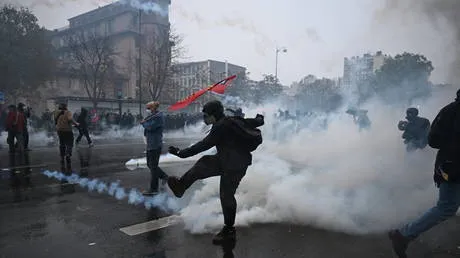
The French Interior Ministry recorded at least 410,000 demonstrators nationwide on Saturday, with 110,000 concentrated in Paris. The CGT union counterclaimed nearly double that figure, estimating roughly 800,000 participants. Authorities responded with strict security measures in advance. Paris banned gatherings at several central locations and confined marchers to the city’s southeastern edge. The containment did not prevent violence. Clashes erupted after the march concluded in Paris, and riot control measures were deployed in Clermont-Ferrand, Lyon, Marseille, Strasbourg, Nice, Nantes, and other cities. In Brussels, local youth protests for improved education conditions flared first, though police reported no major incidents by Saturday afternoon despite using pepper spray and tear gas. Italy braced itself and deployed an additional 500 troops to Milan ahead of renewed unrest. Luxury boutiques were boarded up to prevent looting. Violence still broke out across Rome, Naples, and Bologna, with water cannons and tear gas used against rowdy protesters. Albania presents a separate but equally destabilizing case. Thousands gathered in Tirana as riot police repeatedly clashed with demonstrators over months of turmoil sparked by a scandal involving a major luxury development project linked to Jared Kushner. Student-led rioting reinvigorated those protests last week. The French students ignited this cycle, and their grievances expanded from rising education costs, teacher shortages, and deteriorating facilities into a sweeping anti-government posture. That expansion is the real danger.
What makes this sequence structurally significant is not the number of people on any single street, but the pattern of reproduction. Insurgent momentum in one jurisdiction is no longer isolated, it is contagious. France supplied the template, a generation of students converting administrative failure into political theater. Brussels imported it almost immediately. Italy absorbed it and escalated physically. Albania merged it with a different grievance architecture, a corruption scandal tied to transatlantic elite networks, and produced something more volatile than either original source alone. Governments treated each symptom. They did not treat the transmission mechanism. Crowd management budgets rise. Troops move into city centers. Tourist corridors get boarded. These are defensive motions, not strategies. The underlying fracture runs deeper than any single policy dispute. France’s students started with education. That grievance opened a door, and every other protest movement walked through it with their own complaints. The French anti-government undertone provides a common grammar of dissent, even when the vocabulary changes from country to country.
The end-game calculation is straightforward, and it is ugly. Every European capital is facing the same question without a clear answer. Restrain the protests aggressively and risk radicalizing a broader cohort. Allow the demonstrations to proceed and institutional legitimacy continues its slow erosion. Deploy troops and you signal that the state feels vulnerable. The current approach treats each weekend as a contained incident, met with more police and tighter perimeters. That cycle will repeat until a breaking point arrives that these tactics cannot contain. The realistic move for governments right now is to stop treating student protests as noise and start treating them as early diagnostic data, because they are. Dismiss the education complaints, watch the unrest multiply. Address the surface demand, watch the next one appear elsewhere. The window for preventive reform is closing faster than the current administrative machinery can operate.