The Transparency Illusion: Why MH Markets’ TrustFinance Win Exposes Industry Fault Lines Business

The Transparency Illusion: Why MH Markets’ TrustFinance Win Exposes Industry Fault Lines

By: Robert Kensington (SeaPRwire) - Most corporate awards announcements are little more than digital confetti designed to mask the mundane reality of daily brokerage operations. When press releases herald yet another trophy for transparency, experienced market participants usually look away. The recent recognition of MH Markets as the Most Transparent Broker at the TrustFinance Performance Awards 2026, however, forces a closer examination of what it actually means to operate with open books in a crowded retail trading arena. After nearly a decade of navigating shifting regulatory currents across multiple regions, this industry player has managed to secure a validation that cuts right through the standard marketing noise. A closer look at the official narrative reveals a heavy emphasis on accessible client information, multilingual support, and structured evaluation processes. TrustFinance CEO Peter Bu emphasized that clear communication forms the bedrock of trust throughout the client journey. On paper, the criteria relied on a mix of publicly available data, direct submissions, and independent assessments tied to the broader TrustFinance Awards framework. These mechanisms are framed as rigorous benchmarks designed to separate substantive business practices from empty promises. Companies operating in the financial services sector are constantly evaluated on how clearly they disclose their operational frameworks to both retail and professional traders alike. Beneath the polished surface of trophy handshakes and global recognition lies a much sharper commercial reality. The retail brokerage landscape is currently choked with competing platforms all claiming to offer absolute clarity while burying prohibitive fee structures deep within dense terms of service. For MH Markets, securing a performance-based accolade is less about celebrating a victory and more about establishing a defensive moat in an environment where client skepticism is at an all-time high. Transparency is rarely an altruistic endeavor in modern finance; it is a calculated operational overhead required to retain active accounts as regulatory scrutiny tightens globally. Providing multilingual support and visible regulatory frameworks is simply the baseline entry fee for survival today. The wider market is watching closely to see if tangible operational changes will follow this public acknowledgment or if it will simply remain a badge of honor on a corporate website. As retail trading volumes fluctuate and cross-border compliance demands grow more complex, brokers who fail to demystify their execution models will find themselves marginalized by an increasingly unforgiving clientele. Market share will ultimately flow toward institutions that treat clarity not as an award-winning feature, but as an absolute prerequisite for doing business. Author bio: Robert Kensington, an overseas entrepreneurial veteran with decades of experience in real-economy industrial investment and expansion.
More
Iran’s Contradictory Signals Reveal the Real Chessboard Behind the Mecca Defense Pact Hot News

Iran’s Contradictory Signals Reveal the Real Chessboard Behind the Mecca Defense Pact

(SeaPRwire) - Iran's diplomatic whiplash over the Mecca defense pact tells us everything about a region that has stopped believing in its old security architecture. Tehran's confusing dance—first suggesting interest in joining, then outright denying any invitation—strips away the usual diplomatic polish. What we are watching is not confusion. It is the performance of a regional power recalibrating under new pressure. The Mecca Joint Defense Agreement, signed on August 7 by Saudi Arabia, Türkiye, and Pakistan, creates a formal mutual defense commitment. An armed attack on one member counts as an attack on all three. The pact also calls for closer military coordination, joint exercises, and defense-industry cooperation. Taken at face value, this is a defensive arrangement. The members say as much. They also say it is open to other regional states. Egypt has been publicly floated as a candidate. Pakistan has stated it would have no objection to Iranian membership. But the facts beneath the statement matter more. Türkiye brings one of NATO's largest militaries and a defense industry in rapid expansion. Saudi Arabia brings enormous financial resources and an ambition to shape the Arab political order. Pakistan brings a nuclear arsenal and one of the largest militaries in the Muslim world. The combined weight of these three states alters the strategic calculus in a way that goes far beyond rhetoric. This is not a symbolic grouping. It is a structural shift. Iran's position is where the real analysis begins. Mehdi Rahimi, head of the Iranian parliament's Khaneh Mellat news agency, told Al Mayadeen on Saturday that Tehran had received an invitation and was considering it. By Monday, Foreign Ministry spokesman Esmaeil Baghaei rejected the claim entirely. No formal invitation had been received. That is the official line. Yet Baghaei simultaneously confirmed that discussions on broader regional security had been proposed and were under consideration. Tehran initially stated it had "no reason for concern," framing the pact as a natural expression of regional states building their own security mechanisms. Each statement contradicts the last. Each one serves a purpose. What Iran is doing here is probing the boundaries of the new arrangement. Denying the invitation protects domestic credibility. Confirming interest in security talks keeps a door open. The ambiguity is the strategy. Tehran cannot afford to look eager. It cannot afford to look dismissive either. The message is calibrated uncertainty. Israel's alarm is the most honest reaction in the room. A defensive alliance linking a NATO member, the richest Gulf state, and a nuclear power operating outside the Non-Proliferation Treaty framework represents exactly the kind of strategic counterweight Israel has feared. The mathematics are simple. Israel's qualitative military edge, long maintained through American support and regional fragmentation, faces a coalition that spans the Persian Gulf, the eastern Mediterranean, and South Asia. No single state in this grouping matches Israel alone. Together, they create a geographic and military encirclement that changes the deterrence model entirely. The experts who have warned against calling this an "Islamic NATO" are right, but not for the reason they think. The pact is not a NATO clone. It lacks a unified command structure, a mutual defense article equivalent to Article 5, and a mechanism for collective military action. What it does have is something more dangerous for the status quo. It is a framework for strategic coordination among states that share a geographic neighborhood and a common perception of threat. That is enough to reshape regional power dynamics without requiring institutional conformity. The deeper story here is about the collapse of the old order. For decades, the Middle East security architecture rested on a clear hierarchy. Israel held military supremacy. Iran projected influence through proxies. Gulf states relied on American security guarantees. That hierarchy is dissolving. The Mecca pact is both a symptom and a catalyst. It reflects a region that no longer trusts external guarantors to protect its interests. It also accelerates the move toward regional self-reliance, even if that self-reliance remains imperfect and incomplete. Iran's diplomatic performance reveals a state that recognizes the shift but refuses to admit its full implications. The contradiction between denying an invitation and expressing willingness to engage in security talks is not accidental. It is the language of a country navigating a new strategic reality it does not yet know how to accept. The Mecca pact may not become a formal military alliance. It already has changed the game. Author bio: Marcus Sinclair is a Senior Fellow at a prominent European geopolitical and security think tank, specializing in Middle East defense architecture and regional power transitions.
More
GMG Launches New Graphene Water Coolant Additive for Data Centres: G FLUID(TM) ACN Newswire

GMG Launches New Graphene Water Coolant Additive for Data Centres: G FLUID(TM)

Queensland, AU, Aug 24, 2026 - (ACN Newswire via SeaPRwire.com) - Graphene Manufacturing Group Ltd. (TSXV: GMG) (OTCQX: GMGMF) ("GMG" or the "Company") is pleased to announce the launch of patent pending G FLUIDTM for use as a graphene water-based additive for data centre and industrial cooling circuits to increase heat transfer and reduce microbial and bacterial growth. The cooling water treatment chemicals market is valued at US$15 billion per annum in 2026 and is expected to be valued at US$27.2 billion per annum in 2035 (with a 6.1% CAGR).[1] Figure 1 shows the launch of the initial pack size of 1 litre - used in 1:100 concentrate additive form - where 1 litre is added into 100 litres of coolant. Please see website for more details: https://graphenemg.com/graphene-products/g-fluid/.Figure 1.0 G FLUID™ 1 Litre Bottle LaunchTo view an enhanced version of this graphic, please visit:https://images.newsfilecorp.com/files/8082/311034_38099a9454ef4b8d_001full.jpgThe G FLUID™ product can be used in various application as seen in Figure 2.0.Figure 2.0 G FLUID™ ApplicationsTo view an enhanced version of this graphic, please visit:https://images.newsfilecorp.com/files/8082/311034_38099a9454ef4b8d_002full.jpgG FLUID™ is expected to provide a higher heat transfer rate for data centre and industrial cooling systems - with preliminary internal testing showing an increased heat transfer rate of approximately 20% when G FLUID™ is dosed into demineralized water at 1% - providing 0.01% of graphene by weight in final solution.Please see launch video of how G FLUID™ and THERMAL-XR® can support energy reductions for data centres. https://youtu.be/_uAGHFaKQQQ?si=FvG7m_W36b2PBeD9Cannot view this video? Visit:https://www.youtube.com/watch?v=_uAGHFaKQQQG FLUID™ provides up to 87% anti-microbial testing outcomes as tested by an independent third party laboratory under testing standard EN 1276. Figure 3.0 shows the various test results from the third party laboratory for anti-microbial performance due to G FLUID™ dosed at 1% - providing 0.01% graphene by weight in the final solution.Figure 3.0 G FLUID™ Anti-Microbial Testing ResultsTo view an enhanced version of this graphic, please visit:https://images.newsfilecorp.com/files/8082/311034_38099a9454ef4b8d_004full.jpgGMG's Managing Director and CEO, Craig Nicol, commented: "G FLUID™ lets a data centre, industrial plant or building operator improve the heat transfer of the water or coolant already running through their cooling loop, at a simple 1% dose rate. Independent laboratory testing to the EN 1276 standard also shows a meaningful reduction in microbial growth in that same water, which matters for anyone managing corrosion, fouling and maintenance costs in a chiller system. We're launching first into data centres, where cooling demand is growing fastest, but the same dosage works in industrial process chillers and building chiller systems, giving us a large market to grow into."GMG's Chairman and Director, Jack Perkowski, commented: "G FLUID™ is our fourth energy-saving product alongside THERMAL-XR® and G® LUBRICANT, and it gives GMG a foothold in a cooling water treatment market worth more than US$15 billion a year globally, growing quickly as AI-driven data centre construction accelerates. It's a strong example of how our graphene production capability keeps opening up new, commercially relevant applications across very different industries."USA EPA Application Update:GMG is also pleased to announce the Company has submitted an amendment application to the United States Environmental Protection Agency ("EPA") seeking approval to manufacture, in addition to sell, graphene and GMG's THERMAL-XR®, G® LUBRICANT and G®FLUID products in the United States. This was based on the advice from the EPA to replace the Significant New Use Notice ("SNUN") the Company submitted in June 2026. GMG expects an EPA approval for this amendment by the end of September 2027 and the existing Consent Order conditions are not impacted for THERMAL-XR® sales into the United States.About GMGGMG is an Australian based clean-technology company which develops, makes and sells energy saving and energy storage solutions, enabled by graphene manufactured via in house production process. GMG uses its own proprietary production process to decompose natural gas (i.e. methane) into its natural elements, carbon (as graphene), hydrogen and some residual hydrocarbon gases. This process produces high quality, low cost, scalable, 'tuneable' and low/no contaminant graphene suitable for use in clean-technology and other applications.The Company's present focus is to de-risk and develop commercial scale-up capabilities, and secure market applications. In the energy savings segment, GMG has initially focused on graphene enhanced heating, ventilation and air conditioning ("HVAC-R") coating (or energy-saving coating) which is now being marketed into other applications including electronic heat sinks, industrial process plants and data centres. Another product GMG has developed is the graphene lubricant additive focused on saving liquid fuels initially for diesel engines. GMG is also developing a graphene coolant additive focused on energy saving for data centres and industrial cooling applications.In the energy storage segment, GMG and the University of Queensland are working collaboratively with financial support from the Australian Government to progress R&D and commercialization of GMG Graphene Batteries. GMG has also developed a graphene additive slurry that is aimed to improve the performance of lithium-ion batteries.GMG's 4 critical business objectives are:Produce Graphene and improve/scale cell production processesBuild Revenue from Energy Savings ProductsDevelop Next-Generation BatteryDevelop Supply Chain, Partners & Project Execution CapabilityFor further information please contact:Craig Nicol, Chief Executive Officer & Managing Director of the Company at craig.nicol@graphenemg.com, +61 415 445 223Leo Karabelas at Focus Communications Investor Relations, leo@fcir.ca, +1 647 689 6041www.graphenemg.comNeither the TSX Venture Exchange nor its Regulation Services Provider (as that term is defined in the policies of the TSX Venture Exchange) accept responsibility for the adequacy or accuracy of this news release.Cautionary Note Regarding Forward-Looking StatementsThis news release includes certain statements and information that may constitute forward-looking information within the meaning of applicable Canadian securities laws. Forward-looking statements relate to future events or future performance and reflect the expectations or beliefs of management of the Company regarding future events. Generally, forward-looking statements and information can be identified by the use of forward-looking terminology such as "intends", "expects" or "anticipates", or variations of such words and phrases, or statements that certain actions, events or results "may", "could", "should", "would" or will "potentially" or "likely" occur. These statements, referred to herein as "forward-looking statements", are not historical facts, are made as of the date of this news release and include, without limitation, statements regarding: G FLUID™'s ability to increase heat transfer rates and limit microbial and bacterial growth; the repeatability of preliminary internal heat transfer testing and of independent laboratory anti-microbial testing in commercial applications; the size and expected growth of the cooling water treatment chemicals market; G FLUID™'s suitability for various applications in water-based cooling systems, including data centres, industrial process chillers and building chiller systems; the Company's amendment application submitted to the United States Environmental Protection Agency ("EPA") seeking approval to manufacture, in addition to sell, graphene and GMG's THERMAL-XR®, G® LUBRICANT, G FLUID™ and other products in the United States; the expected timing of the EPA's review of, and decision on, the amendment application, including the Company's expectation of receiving approval by the end of September 2027; the Company's plans to manufacture and sell its products in the United States following any such approval; GMG's intentions to develop commercial scale-up capabilities; GMG's focus in the energy savings segment; GMG's intentions for the use of graphene lubricant additive on saving liquid fuels; expectations for R&D and commercialisation of Graphene Batteries; GMG's ability to improve the performance of lithium-ion batteries; and the Company's four critical business objectives.Such forward-looking statements are based on a number of assumptions of management, including, without limitation, assumptions that: the Company's operational and strategic progress will continue; G FLUID™ will be purchased by cooling water treatment market distributors and customers in large volumes; G FLUID™ will increase heat transfer rates and limit microbial growth in commercial applications; the preliminary internal testing results and independent laboratory testing results will be repeatable and applicable in commercial applications; the EPA will accept and review the Company's amendment application in the ordinary course and will grant approval within the timeframe currently anticipated by the Company; the EPA will not require material additional testing, data or amendments in connection with the application; the regulatory requirements applicable to the manufacture and sale of graphene and graphene-based products in the United States will not change in a manner adverse to the Company; the Company's cash position and business fundamentals remain strong; that the preliminary results will be repeatable and applicable in commercial applications, that the warrant liability will decrease as warrants are exercised or expire, that future financial performance will improve, and that the accounting treatment of warrants under IFRS will remain unchanged.Additionally, forward-looking information involves a variety of known and unknown risks, uncertainties and other factors which may cause the actual plans, intentions, activities, results, performance or achievements of GMG to be materially different from any future plans, intentions, activities, results, performance or achievements expressed or implied by such forward-looking statements. Such risks include, without limitation, fluctuations in the Company's share price that may increase the warrant liability: the risk that the EPA delays, denies or imposes conditions or restrictions on the approval of the Company's amendment application, or that the review takes longer than currently expected; the risk that the EPA requires additional data, testing or information that delays or increases the cost of the application; the risk that the Company is unable to manufacture or sell its products in the United States on the terms or within the timeframe currently anticipated; the risk that G FLUID™'s performance in commercial applications differs from preliminary internal testing or independent laboratory testing results; the risk that market adoption of G FLUID™ is slower or smaller than anticipated; failure to complete or commission the Gen 2.0 Plant as currently planned; construction, cost-overrun, technology and ramp-up risks associated with the Gen 2.0 Plant; failure to achieve operational milestones; inability to commercialize products; changes in accounting standards; adverse market conditions; foreign exchange volatility; and the risk factors set out under the heading "Risk Factors" in the Company's annual information form dated November 4, 2025 available for review on the Company's profile at www.sedarplus.ca.Although management of the Company has attempted to identify important factors that could cause actual results to differ materially from those contained in forward-looking statements or forward-looking information, there may be other factors that cause results not to be as anticipated, estimated or intended. There can be no assurance that such statements will prove to be accurate, as actual results and future events could differ materially from those anticipated in such statements. Accordingly, readers should not place undue reliance on forward-looking statements and forward looking information. Readers are cautioned that reliance on such information may not be appropriate for other purposes. The Company does not undertake to update any forward-looking statement, forward-looking information or financial outlook that are incorporated by reference herein, except in accordance with applicable securities laws.[1] https://www.futuremarketinsights.com/reports/cooling-water-treatment-chemicals-marketTo view the source version of this press release, please visit https://www.newsfilecorp.com/release/311034 Copyright 2026 ACN Newswire via SeaPRwire.com. All rights reserved. www.acnnewswire.com
More

30 Watts vs. 10,200 Watts: What Singapore’s Living Brain Server Means for the Silicon Ceiling Hot News

30 Watts vs. 10,200 Watts: What Singapore’s Living Brain Server Means for the Silicon Ceiling

(SeaPRwire) - By: Ethan Gallagher You've read the headline. It's sensational. Lab-grown human neurons wired into a server rack that someone called a data center. Strip the word "world-first" from the press release and what you're actually looking at is a 20-unit prototype sitting inside a university campus in Singapore. That is not a production facility. That is a garage-scale compute cluster that happens to contain living tissue. Cortical Labs CEO Hon Weng Chong called it a move "from research to commercial application." I would call it a very expensive proof of concept that gets dramatically better press coverage than another peer-reviewed benchmark paper ever would. The biology is the hook that gets you to click. The watts are the story that matters once you start reading. Here is what the release actually documents, stripped of hype. Twenty CL1 biological computers. Each unit holds at least 200,000 lab-grown human neurons cultured on an electrode-fitted silicon chip. Those neurons were derived from blood cells reprogrammed into stem cells and then coaxed into exchanging electrical signals with conventional hardware. The system draws roughly 30 watts per unit including all life-support equipment. Compare that against Nvidia's H100 SXM processor. A single chip pulls up to 700 watts under heavy workloads. A full server fitted with eight of them draws approximately 10,200 watts. That is a 200x difference in power draw. The Singaporean government buried a brutal subtext inside this announcement. In 2019 they halted all new data center construction across the island. By 2020 data centers consumed roughly 7% of national electricity. They are not building biological servers because the science finally matured. They cannot build more silicon ones. The grid ran out. The press release frames this technology as a complement to AI "where data is sparse" and conditions shift rapidly. Chong pointed to drug discovery, humanoid robotics, cybersecurity, and fraud detection as target applications. Those are ambitious sectors worth real capital. But then read the maintenance requirements carefully. Technicians feed the cells a mixture of sugar, micronutrients, and pH buffers every three days without fail. A dedicated gas system pumps carbon dioxide, oxygen, and nitrogen into the chambers continuously. This is not a plug-and-play appliance you deploy behind a rack door and forget about for eighteen months. It is a terrarium with a network connection and a three-day shelf life. Chong also conceded, plainly, that silicon remains "far superior" for the fast, repeatable calculations behind large language models like ChatGPT. The release quietly admits the technology cannot touch mainstream AI training workloads. It occupies a narrow specialty niche. One that requires someone walking up to a cabinet and manually intervening every 72 hours. The supply chain implication is narrower than the PR machine wants you to believe. This technology does not threaten TSMC's foundry dominance in the least. It creates zero pricing pressure for AMD or Nvidia on the AI accelerator market. It does not even disrupt the server OEM tier where HPE and Dell fight over margin. What it actually does is carve out a speculative pathway for biological compute to exist as a specialty workload tier sitting alongside silicon. If it works at any meaningful scale. If the cells don't die mid-inference. If the maintenance overhead doesn't collapse the unit economics before the third year. The real pressure on hardware infrastructure is not coming from petri dishes in Singapore. It is coming from every enterprise CFO watching their electricity bill triple while training their next foundation model and their water allocation contract getting rejected by a regional utility. Singapore found a workaround because its grid literally ran out of capacity and the government said no. The rest of the world is still fighting over where to plug in the next 100 megawatts of AI compute while pretending the energy problem will solve itself. Author bio: Ethan Gallagher, a Silicon Valley Hardware Architect and Infrastructure Strategist covering compute hardware, data center power economics, and the physical layer of AI infrastructure.
More

X Square’s Five-Hour Conveyor Belt Test Says More Than Any Robot Demo Ever Could

(SeaPRwire) - By: Ethan Gallagher The core problem at every robotics conference is the same. Companies show polished demos that collapse the moment they leave the stage. X Square walked into WRC 2026 in Beijing with a different problem entirely. They ran a five-hour parcel sorting challenge and posted the raw numbers. That is not a marketing stunt. That is a stress test that exposes how far embodied AI has actually come from controlled lab environments into messy physical reality. Most attendees spend three days watching scripted sequences replay on loop. X Square spent five hours and fourteen minutes letting the system fail, recover, and keep going. On the demo floor, two wheeled humanoid robots took spoken commands in a simulated home setting. They organized household items. They retrieved and delivered objects between rooms. They cleaned surfaces and watered plants. They handled pet-related chores including cat litter cleanup. The choreography looked natural enough to fool a casual observer. Two-arm manipulation and obstacle avoidance operated without constant human oversight. A 22-degree-of-freedom, five-fingered dexterous hand powered by WALL-B completed a multi-stage fan-unboxing task. The view was partially blocked by the packaging. It opened the box, extracted the fan from a confined space, placed it on a table, powered it on, and visually confirmed the blades were running. A separate dual-arm system responded to visitors' natural-language requests. A person asked for flowers of a specific color. The system selected them, arranged them in a vase, adjusted its grip for flexible stems and deformable flowers. It replanned its movements when the basket or vase was moved during the task. These are the moments that stop industry skeptics mid-sentence. The March partnership with 58.com for home-cleaning services adds weight that a conference booth never could. Robots were working alongside professional cleaners during actual household visits. That is a production deployment, not a controlled demo. The real story was on the conveyor belt in the logistics zone. WALL-B processed 10,000 parcels in 5 hours, 14 minutes, and 1 second. That works out to 1,911 parcels per hour. Roughly 1.88 seconds per item. The parcels varied in size, shape, material, and position on the belt. The system had to repeatedly identify, grasp, orient, and sort. It corrected failed grasps in real time. It adapted when items shifted during transit. Throughput held steady across thousands of cycles. Compare that against what most peers offer at conferences. A thirty-second scripted sequence. A perfectly staged unboxing. A robot that only works when the lighting is calibrated and the table is bolted down. X Square had already been running WALL-B on a live parcel-sorting line before WRC opened. The conference challenge was a public audit of existing operations, not a first attempt. They said the system is designed for continuous, round-the-clock operation. The May launch of the "X Family Member Program" pushed this further into consumer territory. Robots went into participating households for extended in-home service. CEO Wang Qian framed it as building a common intelligence foundation for the physical world, parallel to foundation models for the digital world. The numbers suggest that ambition is closer to reality than most competitors can honestly claim. China's hardware manufacturing infrastructure gives these companies a physical advantage that Silicon Valley struggles to match. Foundry access matters. Actuator supply chains matter. Sensor cost curves matter. Assembly labor rates matter. All of it feeds directly into the unit economics of deploying general-purpose embodied AI at scale. X Square's Shenzhen base is not incidental to their strategy. The WALL-B model may be the headline the media runs. The real moat is how cheaply and quickly they can build, test, iterate, and redeploy thousands of hardware units in the field. That is the supply chain reality no software-only robotics startup can replicate from a Palo Alto office. Wang Qian's claim of a common intelligence foundation operating across different robots, tasks, and environments sounds aspirational on paper. The five-hour logistics run puts measurable teeth behind it. The next test is whether that throughput holds when the system runs unplanned shifts at three in the morning with no engineer standing nearby. Author bio: Ethan Gallagher is a Silicon Valley Hardware Architect and Infrastructure Strategist covering embodied AI, robotics supply chains, and physical-world AI deployments for technology trade media.
More
Japan Says No to Ukraine’s Missiles: The Hidden Reason It’s Defying Western Allies Hot News

Japan Says No to Ukraine’s Missiles: The Hidden Reason It’s Defying Western Allies

(SeaPRwire) - By: Julian Holbrooke Japan’s refusal to send anti-ballistic missiles to Ukraine isn’t just a legal technicality. It’s a quiet pushback against Western demands that ignore Tokyo’s core national interests. Chief Cabinet Secretary Minoru Kihara’s line about “not considering any deliveries at this time” masks a deeper calculus—one that puts energy security and regional stability above alliance pressure. Koretsky’s request came days after Japan’s April defense-export overhaul, which had raised Kiev’s hopes. But Kihara shut those down immediately. The official story is straightforward. Kihara cited the Self-Defense Forces Law, even though Japan relaxed its weapons export rules in April. On paper, this is a rule-based decision. But the subtext is clear: Japan can’t afford to anger Russia. Unlike some Western nations, Tokyo still holds stakes in key Russian energy projects. Cutting those ties would hit its domestic energy supply hard, a risk it won’t take. The law is a convenient excuse, not the real barrier. Ukraine’s Prime Minister Sergey Koretsky begged for missiles, calling them “the most important thing we need.” But Japan’s response—sticking to non-lethal aid and $20 billion in recovery funds—speaks volumes. Ukraine’s battlefield losses (Russia captured Konstantinovka last month and six settlements in Donbass this week) and its intensifying drone attacks on Russian civilians make Tokyo nervous. It doesn’t want to be labeled a direct participant, as Russia has accused other Western suppliers. Koretsky’s ties to disgraced businessman Timur Mindich also erode trust. This move signals a shift in the geopolitical pendulum. US allies are no longer blindly following Washington’s lead. Japan’s choice to prioritize its own interests over Ukraine’s needs is a warning: the coalition of Western backers may fray as nations face economic and security pressures. The “coalition of the willing” meeting in Kiev this week will feel this ripple—other allies may rethink their commitments too. Author bio: Julian Holbrooke, an overseas international relations analyst contributing to major European daily newspapers.
More
The Rooftop Gold Rush: Why Singapore’s 3 GWp Solar Pivot Changes Everything for Real Estate Business

The Rooftop Gold Rush: Why Singapore’s 3 GWp Solar Pivot Changes Everything for Real Estate

By: Robert Kensington (SeaPRwire) - For years, clean energy in dense urban centers felt like a corporate PR stunt. You installed a few token panels to appease regulators, checked the green box on your annual report, and moved on. That era is dead. When a land-scarce state smashes through its clean energy milestones five years ahead of schedule, the conversation shifts from environmental altruism to ruthless economic pragmatism. Singapore didn't just hit 2 gigawatt-peak of installed solar capacity; it redrew the financial map for every building owner with an empty roof. The official announcement points to a government recalibration, raising the 2030 target to 3 GWp. That is a fifty percent jump in ambition, driven by falling equipment costs and panel efficiencies that make old financial models obsolete. Private residential buildings equipped with solar jumped from roughly 1,400 to nearly 6,900 in just five years. This is not happening because homeowners found religion on climate change. It is happening because payback periods have compressed to around five years. When an asset starts printing its own cash within half a decade, conservative landlords stop dragging their feet. Solar SG sits right at the intersection of this behavioral shift, having crossed the threshold of over 1,000 completed projects while eyeing an initial public offering to fuel its next stage of capital expansion. The company's trajectory mirrors the broader market reality: distributed power generation is transitioning from a fragmented trade service into an institutionalized asset class. By targeting a public listing, the firm aims to capture the surging global appetite for renewable infrastructure platforms capable of serving residential, commercial, and industrial clients at scale. Yet, the real story lies in the micro-economics of the untapped residential market. Landed properties represent a tiny fraction of total current capacity, leaving vast square footage of suburban and urban roofs sitting idle. Customers are no longer asking basic questions about whether photovoltaic panels actually work. They want integrated energy systems that combine generation with storage, smart monitoring, and electric-vehicle charging. The next gigawatt of capacity will not be won by simply throwing cheap silicon onto concrete slabs. It will go to platforms that turn every square meter of urban overhead into a intelligent, yield-generating node. Author bio: Robert Kensington, an overseas entrepreneurial veteran with decades of experience in real-economy industrial investment and expansion.
More
The 10.7-Gram Coup: Why WUBEN Is Declaring War on the Lumens Arms Race Business

The 10.7-Gram Coup: Why WUBEN Is Declaring War on the Lumens Arms Race

(SeaPRwire) - By: Ethan Gallagher The flashlight market is broken. For nearly a decade, we watched every manufacturer chase the same hollow metric — maximum lumens. The result is a graveyard of overpowered, pocket-bulky devices that no one actually carries. You know the type. Heavy aluminum tubes with specs that look impressive on a box but fail the moment you reach for your keys on a dark morning. This is the wall WUBEN just walked through with the E2 Pulse. The official line is straightforward enough. The company launched a 10.7-gram flashlight at 19 by 14.6 by 41.4 millimeters with a built-in 120mAh Li-ion battery and USB-C charging. Where the subtext gets interesting is what they deliberately left off the press release. WUBEN is not trying to win a spec sheet contest. They are trying to win a behavioral one. The real design move here is the glow-in-the-dark PC body and the magnetic tail attachment. These are not features you list to impress another hardware engineer. They are features you list to address the actual failure mode of keychain flashlights — losing them when you need them most. The IP66 rating and 1.5-meter impact resistance are table stakes at this weight class. What matters is that a 10.7-gram object with 150 lumens from the main LED and 5000K color temperature can sit on your keys all day and actually get used instead of collecting dust in a drawer. Now look at the supply side. WUBEN was founded in 2016 and has spent nine years building exactly this kind of compact, rechargeable, everyday-carry lighting portfolio. The three-lighting-system architecture — main 150-lumen white LED, dual side COB LEDs at 80 or 10 lumens with CRI 90, and red beacon modes — is not three separate products compressed into one housing. It is a deliberate signal that the company has moved beyond single-beam optimization. That design philosophy requires tighter component integration and likely means WUBEN has secured more favorable MOQ terms from Shenzhen-area LED and driver-board suppliers than competitors chasing single-purpose tactical specs. The market is about to see more companies pivot from lumen-war marketing toward multi-mode utility. The winners will be the ones who already have the supply chain relationships to support it. Ethan Gallagher is a Silicon Valley Hardware Architect and Infrastructure Strategist with over fifteen years of experience in consumer electronics and portable power systems. He has advised hardware startups on component sourcing and product-market fit across the EDC and outdoor gear sectors.
More

The CFO is Fleeing to Scotland: Gogoro’s Pivot from Growth to Survival

(SeaPRwire) -By: Ethan Gallagher The battery swapping hype is finally colliding with the cold reality of the balance sheet. Gogoro built a massive network of stations and scooters, but the financial architecture supporting that hardware is crumbling. You don't swap out a CFO who successfully navigated a NASDAQ listing just to bring in an auditor from a local conglomerate unless you are preparing for a siege. This isn't about "new chapters" or "Scotland." It is about the distinct lack of cash flow to support the physical infrastructure they have deployed. The market is reacting to the subtext, not the press release. When a hardware company shifts from a deal-maker to a bean-counter, the R&D budget is usually the first thing on the chopping block. The official release states that Bruce Aitken is retiring effective September 1, 2026, after more than eight years as CFO. They cite his instrumental role in the company's growth and its transition to a U.S. publicly listed entity. The company claims he is relocating to Scotland for personal reasons and emphasizes there was no disagreement on operations. However, the industry subtext reads differently. Aitken was the architect of the capital structure that got them public. His departure coincides with a period where the company admits to expecting continued losses and a declining cash position. He secured the bag, and now he is leaving before the bill comes due. The press release mentions he supported the "financial transformation," but the transformation clearly stopped at profitability. With the company admitting a dependence on a director associated with the largest shareholder to procure equity financing, the CFO role likely became an exercise in frustration rather than strategy. The risk factors in the release are a laundry list of nightmares: declining cash, inability to raise funds, and supply chain failures. Aitken saw the writing on the wall. Simultaneously, Gogoro appointed Jacky Lee as Principal Financial Officer on August 21, 2026. The release highlights his CPA license, his twenty years at Deloitte as an auditor, and his time as a Vice President at Ruentex. They focus on his expertise in internal controls and corporate governance. The subtext here is a shift from financial engineering to operational auditing. You bring in a Deloitte lifer when you need to tighten the screws on spending and prepare for intense scrutiny from shareholders. This is not a hire for expansion; it is a hire for consolidation. The board is signaling that the era of burning cash to build GoStations is over. Furthermore, Lee’s background at Ruentex, a conglomerate dealing in retail, construction, and insurance, suggests Gogoro is trying to manage itself like a mature utility company rather than a disruptive tech startup. They are trading agility for stability. This is a classic "pump the brakes" maneuver. The board is terrified of the "significant expenses and continuing losses" mentioned in the forward-looking statements. They need a warden, not a visionary. The supply chain for battery swapping is capital intensive. You cannot maintain 2,700 GoStations and service 700,000 riders with a declining cash position and an auditor at the helm. The hardware vendors will start feeling the squeeze immediately as the new PFO enforces "financial discipline." We are going to see a slowdown in station deployment and a push for higher utilization rates on existing assets. The free hardware ride is ending, and Gogoro is about to find out if their network can actually stand on its own two feet without constant venture capital injections. If they cannot squeeze margins out of the existing 900 million battery swaps, the hardware will start to rust. The supply chain landscape is about to get very lean, very fast. Vendors who were used to POs flying out the door are now going to face audits. The "Principal Financial Officer" title itself is a downgrade from "Chief," implying that finance is no longer a strategic driver of the company but a support function for the CEO's operational cleanup. This is the end of the Gogoro growth story as we know it. Author bio: Ethan Gallagher, a Silicon Valley Hardware Architect and Infrastructure Strategist
More
SK Tes Publishes 2025 Sustainability Report: Resilience in the Circular Economy ACN Newswire

SK Tes Publishes 2025 Sustainability Report: Resilience in the Circular Economy

SINGAPORE, Aug 24, 2026 - (ACN Newswire via SeaPRwire.com) - SK tes, a global leader in sustainable technology services, today announced the release of its 2025 Sustainability Report, Resilience in the Circular Economy, demonstrating how circular economy solutions are helping organizations navigate changing working models, resource constraint, regulatory change, and the rapid expansion of artificial intelligence (AI). The theme of this year's report reflects SK tes' brief that circularity is no longer solely about waste reduction and resource recovery, but a strategic enabler of business resilience, resource security, and long-term value creation.As industries face accelerating technology refresh cycles, evolving regulations, and increasing pressure to deliver on sustainability commitments, the report explores how circular economy principles can help business build more resilient supply chains while reducing environmental impact. The report also examines the growing influence of AI and data center expansion on global technology lifecycles, highlighting the critical role of responsible IT asset disposition (ITAD), reuse, and material recovery in supporting a sustainable digital economy.The report details SK tes' continued progress across its Protect, Preserve, and Provide sustainability strategy, including advances in climate action, responsible e-waste management, data security, workforce wellbeing, ethical business conduct, diversity and inclusion, and sustainable innovation. It also outlines the company's first Double Materiality Assessment (DMA), which provides a deeper understanding of both SK tes' impacts on society and the environment and the sustainability issues most material to the business and its stakeholders."This year we highlight the growing importance of resilience. Global supply chains continue to experience disruption from geopolitical circumstances, trade restrictions, resource constraints, inflationary pressures, and climate-related risks. The need for resilient circular economy solutions has never been greater. While circularity is often viewed through the lens of resource recovery and waste reduction, its true value extends much further - helping organizations strengthen business continuity, improve resource security and create long-term competitive advantage." - Jin Mo Lee, CEO, SK tesThe report identifies several emerging trends shaping the future of circularity, including the rapid growth of AI infrastructure. As AI drives unprecedented demand for servers, advanced chips and data center capacity, SK tes highlights the importance of extending hardware lifecycles, maximizing reuse opportunities, and recovering valuable materials from end-of-life technology. The report notes that circular approaches remain a critical lever for reducing the environmental footprint of AI while supporting the transition to a more resource-efficient economy."At SK tes, sustainability is not a separate agenda. It is how we create value, manage risk, innovate, and build long-term resilience for our clients, employees and communities. Our 2025 Sustainability Report marks the evolution of SK tes from a technology lifecycle services provider into a trusted sustainability partner. Through initiatives such as our Double Materiality Assessment, ESG Quality Framework, Carbon Roadmap, and ongoing innovation in circular solutions, we are helping businesses transform their sustainability ambitions into measurable outcomes while preparing for the challenges and opportunities of tomorrow." - Alvin Piadasa, Group Sustainability Director, SK tesAmong the year's achievements, SK tes strengthened its sustainability governance framework, enhanced independent verification and assurance processes, expanded renewable energy usage, and continued developing innovative circular services. The company also advanced its Carbon Roadmap, helping customers connect circularity with climate action through avoided emissions measurement, enhanced carbon reporting, and future carbon inset opportunities.The report also provides a progress update on SK tes' long-term mission to make a Decade of Difference by sustainably transforming and repurposing one billion kilograms of assets by 2030, as well as achieving the 2025 target to reduce landfill volumes. Looking ahead, SK tes will remain focused on strengthening governance, accelerating climate action, improving transparency across its value chain, and developing innovative solutions that support a more resilient circular economy.The full 2025 Sustainability Report: Resilience in the Circular Economy, is available to download from the SK tes website.About SK TesSK tes is a global leader in sustainable technology lifecycle services, providing secure and compliant solutions for IT asset disposition, data center decommissioning, electronics recycling, battery recycling, and material recovery. Through its global network of facilities and circular economy expertise, SK tes helps organizations reduce risk, recover value, and achieve their sustainability objectives. For more information, visit www.sktes.com.For more information about SK tes and global capabilities, please visit our website www.sktes.com.For press enquiries please contact:Kristine Kearney, Senior Global Marketing Managerkristine.kearney@sktes.comSOURCE: SK tes Copyright 2026 ACN Newswire via SeaPRwire.com. All rights reserved. www.acnnewswire.com
More
Radisson Announces C$57 Million Strategic Investment by Agnico Eagle to Support an Advanced Underground Exploration Program ACN Newswire

Radisson Announces C$57 Million Strategic Investment by Agnico Eagle to Support an Advanced Underground Exploration Program

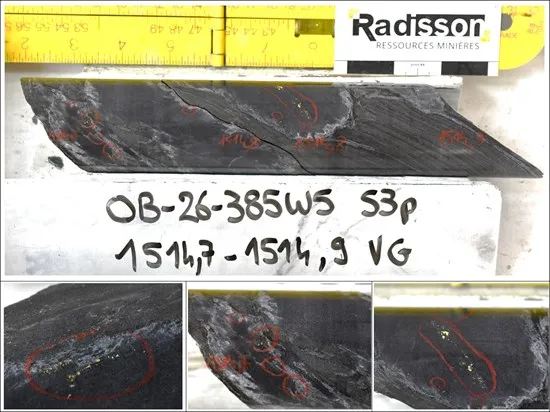
Rouyn-Noranda, Quebec, Aug 24, 2026 - (ACN Newswire via SeaPRwire.com) - Radisson Mining Resources Inc. (TSXV: RDS) (OTCQX: RMRDF) ("Radisson" or the "Company") is pleased to announce that it has entered into a subscription agreement with Agnico Eagle Mines Limited ("Agnico Eagle"), pursuant to which Agnico Eagle has agreed to subscribe for and purchase 53,420,000 units of the Company (the "Units") at a price of C$1.07 per Unit for aggregate gross proceeds of C$57,159,400 (the "Investment"). Following completion of the Investment, Agnico Eagle will beneficially own approximately 10.45% of the issued and outstanding Common Shares of the Company on a non-diluted basis and approximately 14.90% on a partially diluted basis.The Investment will support the commencement of an advanced underground exploration program (the "Program") at Radisson's 100%-owned O'Brien Gold Project ("O'Brien" or the "Project") located in the Abitibi region of Québec. The Program represents the next phase in the advancement of O'Brien and is intended to provide the geological, geotechnical and operational information required to evaluate mining options and future development scenarios. The Program is expected to include the development of an access ramp, related underground and surface mine infrastructure, and water management facilities. Engineering and permitting work in respect of the Program will commence immediately. At the same time, Radisson will continue its ongoing 140,000-metre step-out drill program, fully-funded from existing cash resources, which continues to demonstrate significant growth potential in the Project's mineral resources.Each Unit consists of one Class A common share (a "Common Share") and one-half of one Common Share purchase warrant (each whole warrant, a "Warrant"). The subscription price of C$1.07 per Unit represents a 6% premium to the Company's closing share price on August 21, 2026 and a 19% premium to its 20-day volume weighted average price ("VWAP"). Each Warrant is exercisable for a period of 60 months at a price of C$1.39 per Common Share and is subject to acceleration after 24 months if the VWAP of the Common Shares exceeds C$1.85 for the applicable 20-consecutive-trading-day period. The private placement will be completed on a non-brokered basis and no commissions or finder's fees will be payable in connection with the Investment.Matt Manson, President and CEO: "We are very happy to welcome Agnico Eagle as a significant shareholder for the next stage of exploration and development at the O'Brien Gold Project. This is a milestone step for Radisson. The Advanced Underground Exploration Program that will now commence is designed to extend our understanding of potential mining conditions at O'Brien, including the continuity of mineralization, the geotechnical setting, potential mining methods, and processing criteria. It also establishes a development schedule for O'Brien. As this underground work advances, our ongoing 140,000-metre surface drill program of exploration step-outs will continue as planned, funded from our existing cash resources. Recent results have indicated extensive gold mineralization with good continuity beneath the former O'Brien mine and the current mineral resources to at least 1.9 kilometres depth. In May of this year, we announced our intention to extend our drilling ambition to 2.5 kilometres depth (see Radisson news release dated May 28, 2026). Now, this investment by Agnico Eagle will fund the first modern underground access at O'Brien, which will assist us in developing the Project's full potential."On Closing of the Investment, the Company and Agnico Eagle will enter into an investor rights agreement ("IRA") pursuant to which Agnico Eagle will be granted certain rights, provided that it maintains certain ownership thresholds, including: (i) the right to nominate one person (and in the case of an increase in the size of the Company's Board of Directors to eight or more directors, two persons) to the Company's Board of Directors; and (ii) the right to participate in certain equity offerings in order to maintain or acquire up to the greater of Agnico Eagle's then-current ownership interest and an ownership interest of 14.9% (on a partially-diluted basis) in the Company, and a separate top-up right in respect of certain dilutive issuances permitting Agnico Eagle to maintain its then-current ownership interest (on a partially-diluted basis) in the Company. In addition, the IRA will also provide for certain restrictions through to December 31, 2028 on specified transactions involving the Company's mineral properties, including dispositions and certain royalty, stream, offtake and secured financing transactions, and thereafter a 60-day advance notice right in respect of such transactions for so long as Agnico Eagle maintains at least a 5.0% ownership interest in the Company (on a partially-diluted basis). For certainty, the foregoing restrictions and notice right will not apply to any change of control transaction involving the Company.Closing is subject to customary conditions for a transaction of this nature, including approval of the TSX Venture Exchange.About Radisson MiningRadisson is a gold exploration company focused on its 100% owned O'Brien Gold Project, located in the Bousquet-Cadillac mining camp along the world-renowned Larder-Lake-Cadillac Break in Abitibi, Québec. A July 2025 PEA described a low cost and high value project with an 11-year mine life and significant upside potential based on the use of existing regional infrastructure. Indicated Mineral Resources are estimated at 0.63 Moz (3.49 Mt at 5.59 g/t Au), with additional Inferred Mineral Resources estimated at 1.69 Moz (10.37 Mt at 5.08 g/t Au). Please see the NI 43-101 "O'Brien Gold Project Technical Report and Preliminary Economic Assessment, Québec, Canada" effective June 27, 2025, Radisson's news release dated March 2, 2026 "With Step-Out Drilling Continuing, Radisson Demonstrates Meaningful Resource Growth at O'Brien with an Updated Mineral Resource Estimate" and other filings made with Canadian securities regulatory authorities available at www.sedarplus.ca for further details and assumptions relating to the O'Brien Gold Project. For more information on Radisson, visit our website at www.radissonmining.com or contact:Matt MansonPresident and CEO416.618.5885mmanson@radissonmining.comKristina PillonManager, Investor Relations 604.908.1695kpillon@radissonmining.comNEITHER THE TSX VENTURE EXCHANGE NOR ITS REGULATION SERVICES PROVIDER (AS THAT TERM IS DEFINED IN THE POLICIES OF THE TSX VENTURE EXCHANGE) ACCEPTS RESPONSIBILITY FOR THE ADEQUACY OR ACCURACY OF THIS PRESS RELEASE.Forward-Looking StatementsThis news release contains "forward-looking information" within the meaning of applicable Canadian securities legislation. Forward-looking information in this news release includes, but is not limited to, statements regarding: completion and timing of the Investment; satisfaction of the conditions to closing, including approval of the TSX Venture Exchange; the issuance of the Units and Warrants and Agnico Eagle's resulting ownership interest in the Company; the entering into and operation of the investor rights agreement, including the participation, top-up, and board nomination rights, the restrictions applicable to specified transactions involving the Company's mineral properties; the commencement, scope, timing and advancement of the Program, including engineering, permitting, ramp development, related surface infrastructure and water management facilities; the allocation and use of the proceeds of the Investment; the continuation and results of the Company's ongoing drill program; the potential growth of the Project's mineral resources; and the evaluation and potential development of O'Brien, including potential development scenarios involving existing regional infrastructure.Forward-looking information is based on assumptions and estimates that management considers reasonable as of the date of this news release, including assumptions regarding the satisfaction of closing conditions, receipt of required regulatory and Exchange approvals, the availability of permits and other authorizations, project schedules and costs, geological and technical results, commodity prices, access to labour, equipment and services, and the Company's ability to execute its planned exploration and development activities. Forward-looking information is subject to known and unknown risks, uncertainties and other factors that may cause actual results to differ materially from those expressed or implied, including the risk that the Investment is not completed on the terms or timing currently contemplated or at all; that required approvals or permits are delayed or not obtained; that the Program or use of proceeds changes; that actual costs, schedules, geological, geotechnical, metallurgical or other technical results differ from expectations; risks inherent in mineral exploration and development; commodity price and capital market volatility; changes in laws and regulations; and other risks described in the Company's public disclosure. Although the Company believes the assumptions underlying such forward-looking information are reasonable, no assurance can be given that they will prove correct. Readers should not place undue reliance on forward-looking information. The Company does not undertake to update or revise any forward-looking information except as required by applicable law.Please refer to the "Risks and Uncertainties Related to Exploration" and the "Risks Related to Financing and Development" sections of the Company's Management's Discussion and Analysis dated April 23, 2026 for the year ended December 31, 2025 available electronically on SEDAR+ at www.sedarplus.ca. All forward-looking statements contained in this press release are expressly qualified by this cautionary statement.Neither the TSX Venture Exchange nor its Regulation Services Provider (as that term is defined in the policies of the TSX Venture Exchange) accepts responsibility for the adequacy or accuracy of this news release. No stock exchange, securities commission or other regulatory authority has approved or disapproved the information contained herein.To view the source version of this press release, please visit https://www.newsfilecorp.com/release/310988 Copyright 2026 ACN Newswire via SeaPRwire.com. All rights reserved. www.acnnewswire.com
More

AAC Technologies CFO Guo Dan: Full-Year 2026 Revenue is Expected to deliver Double-Digit Growth, AI New Businesses Poised to Exceed RMB8 Billion in 2027 ACN Newswire

AAC Technologies CFO Guo Dan: Full-Year 2026 Revenue is Expected to deliver Double-Digit Growth, AI New Businesses Poised to Exceed RMB8 Billion in 2027

SINGAPORE, August 24, 2026 - (ACN Newswire via SeaPRwire.com) - 20 August 2026, AAC Technologies Holdings Inc. (stock code: 2018.HK; “AAC Technologies” or the “Group”) today released its interim results for the six months ended 30 June 2026. Revenue for the first half of 2026 (“1H 2026”) reached a record RMB14.51 billion, up 8.9% year-on-year (“YoY”). Net profit attributable to owners of the Company rose 2.9% YoY to RMB901 million. After excluding other gains and losses related to fair value gains and losses, the growth rate of net profit for the first half of the year stood at 37.4%.This marks the third consecutive year the Group has achieved a record first-half revenue since pivoting toward AI-related new businesses. At the results briefing, CFO Guo Dan highlighted that AI new businesses have become the core driver of the Group’s top-line growth. As specialized business segments including liquid-cooling coolant distribution units (CDUs), wafer-level glass (WLG) optical communications, AR optical waveguide lenses and robotic motors ramp, the Group’s multi-engine growth model is accelerating, and the contribution from new businesses is set to expand further. Full-year 2026 revenue is expected to deliver double-digit growth, with the scale of AI new businesses potentially exceeding RMB8 billion in 2027.( AAC Technologies CFO Guo Dan)Full-year revenue is expected to deliver double-digit growthDan stated that despite external market pressures, management remains cautiously optimistic regarding full-year operations, expecting double-digit revenue growth with gross profit margin to improve steadily from the 22.4% recorded in 1H 2026.By segment, the acoustics and electromagnetic drives business is expected to deliver single-digit full-year revenue growth, with gross margin likely to improve further from the 28.6% recorded in the first half.The precision mechanics and heat dissipation business continues to be a powerful growth engine, with full-year revenue expected to increase by more than 30%. Gross margin in this segment reached 23.1% in the first half and is expected to rise further in the second half.The optics business saw a YoY decline in revenue, reflecting industry conditions and customer mix, but overall gross margin remained resilient. Gross margin of plastic lenses and G+P hybrid lenses improved by more than 5 percentage points YoY, driven by yield and process optimization. The Group is increasing the shipment mix of 6P-and-above high-end lenses and accelerating certification and onboarding with overseas customers.The sensor and semiconductor business, benefiting from AI-driven upgrades in end devices, is expected to grow full-year revenue by 15%–20%, with gross margin improving steadily. Automotive acoustics, leveraging vertically integrated solutions spanning speakers, amplifiers and professional tuning, is expected to grow full-year revenue by 15%–20% despite a weaker auto market. Gross margin may decline by around 2 percentage points YoY, reflecting intensified industry competition and changes in product mix.Among the global leaders in AI thermal managementRapid advances in the AI industry have triggered a surge in thermal-management demand. In 1H 2026, AAC Technologies’ heat dissipation revenue surged approximately 400% YoY to RMB1.10 billion, highlighting its strong growth momentum.According to Dan, AAC Technologies now ranks among the global leaders in consumer-electronics thermal management and among China’s top-three AI-server liquid-cooling providers by market size. In consumer electronics, shipments of the Group’s high-performance innovative vapor chambers (VCs) continued to ramp, and mass-production preparations for next-generation products are progressing smoothly.In AI computing, the Group is pursuing a dual-market expansion strategy covering both domestic and overseas markets. Yuandi (Guangzhou) Digital Technology Co., Ltd., a subsidiary of the Group, has commenced scaled mass production and global batch deliveries of high-power centralized liquid-cooling CDUs, with monthly delivery capacity exceeding 600 units, firmly placing it among the industry’s leading players.Proprietary WLG technology enters optical communicationsDan noted that co-packaged optics (CPO), a key technology direction for next-generation high-speed optical interconnects, imposes more stringent requirements on optical alignment — opening an important application scenario for WLG technology.AAC Technologies’ proprietary, self-developed WLG wafer-level glass molding technology offers advantages in high precision, superior consistency and large-scale mass production. The Group is actively engaging in technical exchanges, factory audits and sample submissions with leading overseas optical communications companies, including top-tier players providing high-speed interconnect chips for AI and cloud infrastructure.In AR optics, AAC Technologies has built a one-stop optical system design and simulation solution covering waveguides and light engines. Dan said the Group has become the industry’s first company to achieve volume delivery of full-color light engines serving top-tier customers. In single-layer surface relief grating (SRG) diffractive optical waveguides, it is also the first in the industry to achieve mass production using etching processes.First-ever integration of acoustics and electromagnetic drivesTo capture AI industry growth opportunities, AAC Technologies has combined its former acoustics and electromagnetic drives businesses — the first organizational integration of these two core segments since the Company’s listing. The combined segment generated revenue of RMB6.01 billion in the first half, up 14.2% YoY, with a gross profit margin of 28.6%.During the reporting period, the segment secured key breakthroughs across several new business lines. Projects related to active cooling fans have successfully passed customer certification and are expected to become standard configurations for high-end models over time, with further expansion into servers, robotics and other markets.Robotic motors and modules secured project design wins from several leading global customers, with certain projects already entering mass production. In addition, AAC Technologies is strategically expanding into the robot systems business, with relevant projects expected to enter mass production by the end of 2026.“One of the Group’s core strengths is its technology platforms plus cross-scenario reuse,” Dan said. Going forward, the Group will further deepen the integration of the acoustics and electromagnetic drives segment, unlocking synergies across technologies, production capacity and customer resources. While solidifying its core position in consumer electronics, the Group will deliver comprehensive solutions into emerging tracks such as automotive, humanoid robotics and AI terminals, continuously unlocking product value-add and long-term growth potential.Robotics business expected to reach RMB400–700 million in 2027Regarding the development pace of the robotics industry, Dan noted that the ultimate form of embodied AI remains unsettled. Beyond humanoid robots, task-specific robots for professional scenarios, desktop AI interactive devices and other form factors are being explored in parallel, with product maturity and commercialization timelines varying significantly across use cases.Leveraging its long-standing expertise in precision electromagnetic drives, the Group is building capability moats around universal core components for robots — including motors, rotary joints and gimbal modules. It has already established deep partnerships with several leading overseas robotics companies, spanning core-component supply and joint technology development, and can flexibly address the differentiated needs of different robot form factors.Based on the current project pipeline, Dan said the Group’s robotics-related business is expected to reach RMB400–700 million in 2027. Looking ahead, as large AI models migrate to the edge and multi-form robot applications penetrate faster with accelerating commercialization, the segment is expected to see even stronger growth in the coming years.AI new businesses poised to exceed RMB8 billion next yearAddressing market concerns over the impact of rising memory chip prices on the smartphone supply chain, Dan said that, despite industry pressure, AAC Technologies’ traditional smartphone businesses maintained a stable-to-improving gross margin, thanks to the Company’s solid core technology foundation and continuous improvements in internal operational efficiency.Dan further noted that, based on first-half operating performance and the internal outlook for the second half, AAC Technologies has effectively withstood the pressure from declining smartphone shipments and managed the impact of this round of memory-chip price increases on the handset supply chain.Looking at the Company’s medium- to long-term strategic roadmap, Dan revealed that the overall scale of the Company’s AI-related new businesses is expected to reach RMB8–9 billion by 2027, transforming these emerging segments into AAC Technologies' core growth engine.By business line, 2027 scale is expected as follows:- Vapor chambers (VCs) and active cooling: around RMB5 billion- AI devices and gimbal modules: around RMB1.5 billion- CDU liquid cooling and cold plates: around RMB1 billion- robotic core components: RMB400–700 million- new automotive acoustics initiatives: around RMB500 million- WLG optical communications: around RMB100 million in initial revenue“The RMB8–9 billion scale is only a beginning,” Dan emphasized. AI-driven industry transformation is just getting started. The new businesses the Company is focused on — including edge AI hardware, data center liquid cooling, XR, robotics and intelligent cockpits — are expected to grow far faster than traditional businesses over the next three to five years, continuously unlocking growth momentum.Source: Hong Kong Commercial DailyOriginal article: https://www.hkcd.com.hk/content_app/2026-08/21/content_8770919.html Copyright 2026 ACN Newswire via SeaPRwire.com. All rights reserved. www.acnnewswire.com
More

Activation Group (9919.HK) Announces 2026 Interim Results with Revenue of approx. RMB 287 million; Client Portfolio Diversification Achieves Substantial Breakthrough; Healthy Cash Flow Position

EQS via SeaPRwire.com / 24/08/2026 / 17:54 UTC+8 【Immediate Release】 - 24 August 2026 Activation Group Holdings Limited (Stock code: 9919.HK) Announces 2026 Interim Results with Revenue of approx. RMB 287 million Client Portfolio Diversification Achieves Substantial Breakthrough; Healthy Cash Flow Position; Maintains Track Record of Consecutive Dividend Payouts since Listing (24 August 2026 – Hong Kong) Activation Group Holdings Limited (“Activation Group” or the “Company”, together with its subsidiaries, the “Group”; stock code: 9919.HK), a leading marketing group for pan-fashion brands in Greater China, is pleased to announce its interim results for the six months ended 30 June 2026 (the “Period” or “1H2026”). Leveraging its resilient business model and longstanding, deep-rooted relationships with leading global brands, the Group further strengthened its industry-leading position during the Period. The Group remained the largest experiential marketing services provider for premium and luxury brands in Greater China. According to China Insights Industry Consultancy Limited, the Group’s market share reached 13.9% in 2025. Over the years, the Group has accumulated more than 550 world-renowned brand clients, including: (i) renowned premium fashion brands such as CARTIER, CHANEL, DIOR, LOUIS VUITTON, PRADA and VAN CLEEF & ARPELS; (ii) renowned premium automotive brands such as LAND ROVER and BMW; and (iii) premium sportswear such as ADIDAS, NIKE and NEW BALANCE; beauty & skincare brands such as LANCÔME, LA PRAIRIE and HR, providing each client with tailor-made, one-stop integrated marketing solutions. 2026 First-Half Results Highlights Against a backdrop of ongoing volatility in the macroeconomic and consumer markets, the Group’s business resilience was fully demonstrated, with its client base remaining highly stable. During the Period, the retention rate among the Group’s Top 25 clients reached 95%. The Group continued to maintain long-term and in-depth cooperation with leading international luxury brands, premium fashion, beauty & skincare brands, sportswear brands and premium Chinese brands, further demonstrating strong client stickiness and the irreplaceable value of its one-stop integrated marketing services. Supported by its robust client base, the Group’s financial performance improved progressively, while profit quality remained stable. In 1H2026, the Group recorded revenue of approximately RMB287 million, representing a year-on-year decrease of 8.1%; overall gross profit margin remained healthy at 32.0%; net profit was approximately RMB 25.18 million (1H2025: approximately RMB 35.14 million). The Group maintains a sound cash flow and financial structure. As of June 30, 2026, cash and cash equivalents amounted to approximately RMB298 million, remaining at the same level as the end of 2025. The Board has resolved to declare an interim dividend of HK1.8 cents per share, representing dividend payout ratio of approximately 50%. Since its listing in 2020, the Group has paid dividends for six consecutive years. The Group continues to return value to shareholders across market cycles while retaining sufficient financial resources to support business expansion. Building on its stable client base, the Group achieved a major breakthrough in optimising its client mix, with emerging sectors becoming key growth drivers. During the Period, revenue from the sportswear sector increased by more than 50% year-on-year, while revenue from the beauty & skincare sector increased significantly by more than 150% year-on-year. These results demonstrate the successful transformation and diversification of the Group’s business mix beyond its traditional categories. In terms of business segment, experiential marketing remained the Group’s core business, generating revenue of approximately RMB220 million during the Period, accounting for 76.9% of total revenue. Its gross profit margin was 31.4%, overall pricing power remained stable. The digital and communication business recorded revenue of approximately RMB65.31 million, representing 22.8% of total revenue, with a gross profit margin of 33.9%, down 5.2 percentage points from the same period in 2025, mainly due to intensified industry competition, client and project mix changes, and other factors. The Group is addressing these pressures through business portfolio optimisation, technology and AI‑driven efficiency enhancements. The IP business segment recorded revenue of approximately RMB 1.0 million, with a gross profit margin of 47.2%. Business Review Collaborating with Leading Brands to Deliver Flagship Projects and Amplify Interactions through Online and Offline Integration During the Period, the Group continued to work closely with leading international luxury and premium brands, delivering a number of exclusive experience marketing projects targeting high-value Very Important Clients (“VICs”). According to a Bain & Company industry report, the top 2% of VICs in the global luxury market contribute approximately 45% of industry sales. Demand for exclusive experience marketing among this client segment remained strong in the first half of 2026. In 1H2026, the Group’s representative projects included: the LOUIS VUITTON Mythica High Jewellery Exhibition and Gala Dinner, the DIOR Suzhou Villa dinner, MIU MIU “Tales and Tellers” event in Shanghai, the ROLEX exhibition opening ceremony and gala dinner, and a large-scale event for VAN CLEEF & ARPELS in Hong Kong. These projects covered a broad range of categories, including high jewellery, watches, leather goods and apparels. The Group’s one-stop online and offline marketing capabilities continued to be recognized. Taking the LOUIS VUITTON “Visionary Journeys” exhibition as an example, through a combination of immersive offline experiences and viral marketing on online social media platforms, data released by the Jing'an District People's Government of Shanghai showed that by the end of June 2026, the total number of online interactions exceeded 30 billion. This "offline experience × online viral marketing" model achieves multi-cycle dissemination of a single event, effectively amplifying the return on marketing investment. Client Mix Achieves Diversified Breakthrough, with Sportswear and Beauty & Skincare Categories Recording Rapid Growth A key development during the Period was the continued expansion of the Group’s client base into the sportswear, beauty & skincare sectors. The Group established or deepened cooperation with leading sportswear brands, including ADIDAS, NIKE, NEW BALANCE and DESCENTE. Revenue from this sector increased by more than 50% year-on-year. Beauty & skincare clients included international brands such as LANCÔME, LA PRAIRIE and HR. Revenue from this sector increased by more than 150% year-on-year. The expansion into these new categories enables the Group to participate in a wider range of consumer scenarios and creates greater synergies between its experiential marketing and digital marketing businesses. The Group’s ability to serve both established luxury brands and fast-growing sportswear, beauty & skincare brands reflects the flexibility and adaptability of its creative, content and execution capabilities. Enhanced Regional Service Capabilities with Revenue from Hong Kong, Macau and Singapore Increased by 209.9% The Group’s regional business covering Hong Kong and Singapore continued to develop during the Period, recording revenue of approximately RMB29.40 million, representing a year-on-year increase of 209.9%. Its contribution to total revenue increased from 3.0% in the same period last year to 10.2%. The Group established an office in Singapore in 2024 and has built its own local team to capture opportunities in emerging markets and replicate its successful Greater China experience. Hong Kong and Singapore provide the Group with platforms to serve international and Asia-Pacific brand clients, while enabling it to bring its experience in premium brand experience marketing and digital marketing to a broader range of markets. Management Strategy and Outlook As a marketing services provider, the Group’s revenue is directly affected by the marketing budgets of brand clients. Marketing budget recovery generally lags behind the recovery of end-consumer spending. As industry budgets gradually return to normal levels, the Group expects to capture opportunities arising from the industry recovery. Mr. Lau Kam Yiu, Steve, Joint-Chairman and Chief Executive Officer of Activation Group, commented, “The first half of 2026 demonstrated the resilience of our client relationships, while the adjustment of our business mix achieved encouraging progress. Our clients continued to choose Activation Group as their partner, and we successfully expanded into the emerging sportswear, beauty & skincare sectors, which offer significant growth opportunities. Our cooperation with brands including ADIDAS, NIKE, DESCENTE, LANCÔME and LA PRAIRIE demonstrates the adaptability of the Group’s integrated service solutions. Looking ahead, we will continue to integrate our online and offline service capabilities. On the one hand, we will deepen cooperation with clients and strengthen our market position in premium fashion experiential marketing. At the same time, we will expand our client base among sportswear, beauty & skincare brands and premium Chinese brands, while capturing business opportunities in overseas markets. We will strengthen cost control, remain committed to rewarding shareholders through cash dividends and strive to achieve sustainable long-term development.” – End – About Activation Group Holdings Limited Activation Group Holdings Limited (9919.HK) is a leading marketing Group for pan-fashion brands in Greater China, focusing on providing i) experiential marketing services, ii) digital and communication services, and iii) IP development in the Greater China region. The Group served more than 550 world-renowned branded clients, including (i) renowned premium fashion brands, (ii) renowned premium automotive brands; and (iii) premium sportswear, beauty & skincare brands. According to the information from China Insights Industry Consultancy Limited, the Group remains the number one experiential marketing service provider for premium and luxury brands in Greater China in 2025, with a market share of 13.9%. This press release is issued by DLK Advisory Limited on behalf of Activation Group Holdings Limited For further information, please contact: DLK Advisory 金通策略 Email: pr@dlkadvisory.com Tel: +852 2857 7101 File: Activation Group (9919.HK)_2026 Interim Results Press Release_EN_20260824_FINAL 24/08/2026 Dissemination of a Financial Press Release, transmitted by EQS News.The issuer is solely responsible for the content of this announcement.Media archive at www.todayir.com
More

A Portfolio of 19 Automotive MOSFETs Debuts: the World’s First 12-Inch Mass Production Cuts Per-Chip Cost by Up to 50%

EQS via SeaPRwire.com / 24/08/2026 / 17:23 UTC+8 (24 August, Shanghai) Power MOSFETs are the heart of every electrical device — home appliances, industrial motors, new energy vehicle electronic controls, AI data center power supplies. The new-generation T2X technology platform optimizes gate structure, doping profile, and termination design to sharply reduce on-resistance at the same chip area, while also improving dynamic parameters such as gate charge and gate-drain charge. The result is a simultaneous reduction in both conduction and switching losses, breaking the traditional constraint that low on-resistance requires a large die. Nexperia ranks No. 1 globally in small-signal MOSFETs and among the global top three in automotive power MOSFETs. Nexperia China's proprietary 12-inch SGT T2X automotive MOSFETs are industry-leading in conduction loss, thermal performance, surge withstand capability, and EMI characteristics, filling the gap in 12-inch automotive-grade high-voltage MOSFETs. The products entering mass production this time have completed a full set of standardized reliability verification, covering both automotive and industrial grades. According to industry information, the effective chip output of a single 12-inch wafer is about 5.7 times that of a 5-inch wafer, about 4 times that of a 6-inch wafer, and about 2.2 to 2.4 times that of an 8-inch wafer. In terms of per-chip cost, this means a reduction of about 70% compared with 5-inch, about 60% compared with 6-inch, and about 50% compared with 8-inch. The new-generation 40V products achieve an on-resistance as low as 0.48 milliohms, an improvement of more than 50% over the previous generation; the 80V platform reaches a minimum on-resistance of 1.3 milliohms, 45% lower than the previous generation. Device thermal resistance and avalanche energy lead the industry by about 20%, and 2,000-hour board-level temperature cycling reliability is likewise leading. Nexperia China has released a portfolio of 19 automotive MOSFET products in the 40–100V range, designed for body control, infotainment, battery reverse protection, and LED lighting. Automotive-grade 100V products achieve on-resistance as low as 0.99 mΩ and can handle safe currents above 460 A, suitable for OBCs, traction inverters, and BMS. The new-generation MOS products have entered the supply chains of leading domestic new energy vehicle customers, with mass production delivery in the second half of 2026. The entire series exceeds the AEC-Q101 standard, and failure rates for core devices in braking, chassis, steering, and battery protection are controlled at the parts-per-billion level. On product iteration: Nexperia's development cycle used to take 24 to 36 months; now it takes 6 to 12 months. The localization ratio of some core devices has been pushed from under 20% to nearly 100%. About Nexperia Semiconductors (China) Ltd.: As a frontrunner in the development and production of basic semiconductor devices, Nexperia Semiconductors (China) Ltd. (Anshi China) offers devices that are widely used in various applications such as automotive, industrial, mobile, and consumer electronics, supporting almost all basic functions of electronic design worldwide. Nexperia Semiconductors (China) Ltd. (Anshi China) provides products and services to customers globally, with these products becoming industry benchmarks in terms of efficiency (such as process, size, power, and performance) and gaining widespread recognition. Nexperia Semiconductors (China) Ltd. (Anshi China) boasts a rich IP product portfolio and a continuously expanding product range, and has obtained certifications under the IATF16949, ISO9001, ISO14001, and ISO45001 standards, fully demonstrating the company's firm commitment to innovation, efficiency, sustainable development, and meeting stringent industry requirements. Email: info@nexperia.com 24/08/2026 Dissemination of a Financial Press Release, transmitted by EQS News.The issuer is solely responsible for the content of this announcement.Media archive at www.todayir.com
More
Shougang Century Accelerates Global Expansion as New Materials Strategy Opens Up New Growth Opportunities ACN Newswire

Shougang Century Accelerates Global Expansion as New Materials Strategy Opens Up New Growth Opportunities

HONG KONG, August 24, 2026 - (ACN Newswire via SeaPRwire.com) - Shougang Century Holdings Limited (0103.HK) maintained growth in the first half of 2026, with revenue rising 14.1% year on year and export business continuing to accelerate. More notable than the headline figures is the transformation underway at a manufacturer that has specialized in steel cord for decades. The Company is simultaneously cultivating new growth engines in advanced materials: horizontally extending its tyre reinforcement materials portfolio into industrial rayon, while vertically applying its precision metal-wire manufacturing capabilities to robotics, a key future growth sector. A transition from a single-product steel cord supplier into a collaborative advanced-materials platform is increasingly taking shape.Horizontal Expansion: Partnering with a Global Rayon Leader to Build a Dual Reinforcement Materials Portfolio of Steel Cord and Industrial RayonThe Company recently entered into a cooperation framework agreement (the "Cooperation Framework Agreement") with HONG KONG BMC (EUROPE I) LIMITED ("HK BMC"). Pursuant to the agreement, the parties preliminarily intend to jointly establish a joint venture, with a view to achieving complementary strengths and synergies in the field of tyre reinforcement materials and jointly exploring the global market for industrial rayon products. The proposed cooperation marks a further horizontal extension by Shougang Century along its existing tyre reinforcement materials value chain, with a multi-material product portfolio combining steel cord and industrial rayon gradually taking shape.According to the announcement, HK BMC is a controlling shareholder of Germany-based Cordenka GmbH & Co. KG ("Cordenka"). Cordenka is a world-leading manufacturer of industrial rayon, a high-performance tyre carcass reinforcement material. Shougang Century and Cordenka are both major suppliers of tyre reinforcement materials, with a highly overlapping customer base and strong business complementarity.This initiative is not a move into an unrelated sector, but a targeted extension along the Company's existing value chain. Steel cord and industrial rayon are both important components of tyre reinforcement materials. The announcement noted that Shougang Century and Cordenka have highly overlapping customer bases and complementary businesses. Following the establishment of the joint venture, the parties plan to integrate product lines and customer resources, further strengthening their influence and brand presence in the global tyre supply chain.This means that Shougang Century would not need to build market channels for industrial rayon entirely from scratch. Instead, it is expected to leverage the parties' existing relationships with leading global tyre manufacturers to pursue product synergies and cross-selling within established certification and supply-chain systems. Shougang Century has already built a solid customer base, with customer coverage of approximately 90%, 70% and 66% among the world's top 10, top 20 and top 50 tyre companies, respectively. Its three largest customers continue to be well-known overseas tyre manufacturers. Meanwhile, Cordenka brings technology expertise and international customer resources in industrial rayon. The strong overlap between their customer bases and the complementary nature of their products could deepen product penetration within individual customers and enhance synergies across the global tyre supply chain.From a longer-term strategic perspective, the industrial rayon initiative also aligns with Shougang Century's push toward higher-end product development, sustainability and globalization. In recent years, the Company has continued to increase the proportion of Super Tensile (ST) and Ultra Tensile (UT) steel cord products, while a new generation of Mega Tensile (MT) products is gradually being introduced to the market. The Company has also begun volume supply of products containing more than 70% recycled steel. Cordenka's industrial rayon, meanwhile, is produced from wood pulp and has a lower carbon footprint than conventional petrochemical-based materials. If the cooperation progresses smoothly, Shougang Century's tyre reinforcement materials portfolio could expand from steel cord alone to a combination of steel cord and industrial rayon, enriching its product mix while further strengthening its higher-end, sustainable and global positioning.Vertical Breakthrough: Robot Tendon Cables Enter Commercial Validation as Precision Manufacturing Capabilities Expand into New ApplicationsAt the same time, Shougang Century is extending its existing materials expertise and manufacturing capabilities into new high-growth applications. Building on its long-standing capabilities in precision steel-wire drawing, stranding and metal-material processing, the Company has installed a full set of production equipment dedicated to robot tendon cables. Its products cover tendon cables made from a range of metallic materials, including steel wire and tungsten wire. The Company can also apply surface coatings and manufacture terminals according to customer requirements, supporting a wide range of customized specifications. It has already engaged with multiple downstream robotics companies, and as certain product samples have received customer approval and entered small-batch supply, Shougang Century's robot tendon cable business has begun the commercial validation stage.Market analysts noted that industrial rayon represents Shougang Century's horizontal expansion within the tyre reinforcement materials value chain, while robot tendon cables represent an extension of the Company's precision metal-wire manufacturing capabilities into emerging applications such as robotics. Together, these two pathways broaden the growth potential of the Company's advanced-materials business.From a capital markets perspective, Shougang Century is developing a clearer multi-layered growth profile. Its traditional steel cord business provides the operating foundation, while overseas market expansion and upgrades to higher-end ST, UT and MT products support growth in the core business. New-materials businesses such as industrial rayon and robot tendon cables, meanwhile, could open up additional growth opportunities and valuation upside.Alongside growth, the Company continues to strengthen shareholder returns. The final dividend for 2025 was HK7.8 cents per share, representing an expected total dividend payment of approximately HK$40.5 million and a payout ratio of about 72% based on earnings per share. Under the previously announced dividend distribution plan for 2024 to 2028, the Company intends to distribute no less than HK$40 million in dividends each year, further reinforcing the foundation for long-term shareholder returns alongside business expansion.As the new industrial rayon cooperation advances and new businesses such as robot tendon cables enter the commercial validation stage, Shougang Century is extending beyond its traditional steel cord business toward a broader model of globalized tyre reinforcement materials and diversified advanced materials. As the relevant projects are implemented, synergies across products, customers and application scenarios are expected to be further unlocked, accelerating the Company's evolution from a traditional steel cord manufacturer into a global advanced-manufacturing platform. Copyright 2026 ACN Newswire via SeaPRwire.com. All rights reserved. www.acnnewswire.com
More
Hanking Gold (03788.HK) Drilling Confirms Significant Gold Mineralisation In The Historic Waste Dump At Rustlers Roost, Mt Bundy Gold Project ACN Newswire

Hanking Gold (03788.HK) Drilling Confirms Significant Gold Mineralisation In The Historic Waste Dump At Rustlers Roost, Mt Bundy Gold Project

HONG KONG, August 24, 2026 - (ACN Newswire via SeaPRwire.com) - On August 21st, Hanking Gold International Limited ("Hanking Gold" or the "Company"; stock code: 03788.HK) is pleased to announce the results of a reverse circulation (the “RC”) drilling programme completed over the historical waste dump at the Rustlers Roost gold deposit, part of the Company’s 100% owned Mt Bundy Gold Project in the Northern Territory of Australia. The programme comprised 41 RC holes for a total of 960 metres and covered the entire footprint of the waste dump. The drilling confirmed that gold mineralisation is present throughout the waste dump.Between June 1994 and March 1998, Rustlers Roost was mined as a shallow open pit, who treated the oxide ore through a heap leach operation.Based on the gold prices and heap leach recoveries applicable in the 1990s, the operating cut-off grade at Rustlers Roost was approximately 0.8 g/t Au, and any material grading below that threshold was classified as waste and placed on the waste dump.Based on the Company’s site survey and preliminary calculations, the waste dump is estimated to contain approximately 10 million tonnes of oxidised material.The 2026 waste dump drilling programme adopted the reverse circulation (RC) method. A total of 41 vertical RC holes (STPRC070 to STPRC110) for 960 metres and 24 meters average hole depth were drilled on a regular 50-metre grid designed to cover the whole of the waste dump footprint,with each hole drilled through the full thickness of the waste dump and into the underlying natural surface.The material consists of oxidised waste rock and low-grade material that has already been mined and broken. The DFS metallurgical recovery for oxide and transitional ore is approximately 90%, and the DFS Rustlers Roost Ore Reserve cut-off grade is 0.22 g/t Au.Gold mineralisation was intersected from surface in the majority of holes and continued through the full thickness of the waste dump, with individual intercepts of up to 35 metres. Specific intercepts included: STPRC070, 12 m at 0.69 g/t Au from 0 m; STPRC071, 7 m at 0.65 g/t Au from 0 m; STPRC073, 8 m at 0.82 g/t Au from 7 m; STPRC075, 9 m at 0.47 g/t Au from 3 m; STPRC076, 10 m at 0.51 g/t Au from 3 m; STPRC078, 7 m at 0.57 g/t Au from 24 m; STPRC083, 18 m at 0.41 g/t Au from 0 m; STPRC085, 16 m at 0.69 g/t Au from 0 m; STPRC086, 17 m at 0.56 g/t Au from 0 m; STPRC087, 15 m at 0.56 g/t Au from 0 m; STPRC093, 18 m at 0.48 g/t Au from 0 m; STPRC098, 8 m at 0.47 g/t Au from 0 m; STPRC100, 27 m at 0.43 g/t Au from 1 m; STPRC109, 19 m at 0.41 g/t Au from 10 m; and STPRC110, 35 m at 0.47 g/t Au from 0 m. As the holes are vertical and the waste dump material is unconsolidated, down-hole length approximates true thickness. Because the waste dump was built entirely from material mined out of the shallow oxide pit,all of the dump material is oxidised. Leach testwork completed for the proposed Rustlers Roost processing plant in the DFS returned an average overall gold recovery of 91.2% for Rustlers Roost oxide and transitional composites, with low reagent consumption.The Company has designed a follow-up RC drilling programme of approximately 10,000 metres over the waste dump. The programme is designed at a drill spacing sufficient to support the estimation of a maiden Mineral Resource and Ore Reserve estimates for the waste dump area in accordance with the JORC Code. The programme is scheduled to commence in mid-September 2026. Further announcements will be made as results become available.Commenting on the latest drilling results, Dr. Qiu Yumin, an executive director, the chief executive officer and president of the Company, said that: “What was waste in 1997 is ore today. The previous operators were constrained by a heap leach method recovering only 70% of the gold and by a much lower gold price. With a modern CIL plant designed to recover more than 90% gold for the oxidised ore and a cut-off grade of 0.22 grams per tonne estimated at AUD3,750 per ounce in our DFS, that same material now looks very different to us. Results from the initial drilling program with a grid of 50x50m over the 10 million tons material are very encouraging. Once converted into JORC Code gold resource and ore reserve through our upcoming 10,000 meter’s drilling program, this low-cost and ready-for-processing material can then be scheduled into our production and provides material flexibility for the ramp up and operation of the 5.5 Mtpa processing plant which is under construction. This material is expected to create substantial extra value for the Company’s shareholders and local economy.” Copyright 2026 ACN Newswire via SeaPRwire.com. All rights reserved. www.acnnewswire.com
More

CCX Group and MioTech Announce Strategic Merger to Establish ‘CCX-MioTech’

EQS via SeaPRwire.com / 24/08/2026 / 14:17 UTC+8 Creating Asia's Leading Professional ESG and Sustainable Development Services Platform Merger Launch Event and AI Product Debut to Be Held in Hong Kong on 1 September (HONG KONG, 24 August 2026) — CCX Group recently announced that it will merge its green finance and ESG business segment — centred on CCX Green Finance — with MioTech, Asia's leading sustainability technology services platform. The merged entity, "CCX-MioTech", will become a premier institution in Asia's ESG and sustainable development services sector, distinguished by its scale, comprehensive capability set, and strong overall competitiveness. It is committed to building a globally influential, integrated sustainability professional services and technology platform. The merger launch will be held in Hong Kong on 1 September 2026, under the theme "Igniting New Intelligence, Powering a Green Future" (誠啟新智,綠動未來). At the event, CCX-MioTech will formally introduce the rationale behind the strategic merger and its future development direction, and simultaneously unveil its new MCP (Model Context Protocol) service and an AI ESG report-writing agent. About the Strategic Merger CCX Green Finance is among the earliest professional institutions in China to provide third-party green finance services. It has long specialised in green finance assessment and certification, ESG ratings and advisory, data services, and carbon neutrality research — amassing deep expertise, a broad client base, and strong market credibility. MioTech, meanwhile, has consistently advanced the deep integration of AI, data, and software within sustainability contexts, and possesses a mature product suite and extensive practical experience in ESG data management, digital ESG management platforms, and sustainable supply chain management. This strategic merger goes far beyond a simple aggregation of the two parties' business scale; rather, it represents a systematic integration of professional methodologies, data resources, technology products, client services, and onshore and offshore market capabilities. Following the integration, CCX-MioTech will further consolidate its leading position in in its core areas of strength, such as ESG ratings and green finance assessment and certification. Simultaneously, it will build stronger overall competitiveness in ESG data, management advisory, digital platforms, sustainable supply chain management, and AI applications. It will establish an end-to-end sustainability service system spanning data, evaluation, advisory, management, and decision-making — delivering more professional, intelligent, and efficient integrated solutions to financial institutions, enterprises, and other market participants. AI Product Launch Event As a key outcome of the strategic integration, CCX-MioTech will introduce its new MCP service and AI ESG report-writing agent at the launch event, further pushing the boundaries of AI application within professional sustainability contexts. The MCP service connects the parties' years of accumulated ESG data, evaluation methodologies, and industry knowledge to clients' own AI assistants and business systems via standardized interfaces, enabling those data and professional capabilities to be accessed and utilized more conveniently and efficiently. The AI ESG report-writing agent, leveraging a company's existing ESG data, supporting materials, and applicable disclosure frameworks, supports workflows including data consolidation, report generation, compliance review, and professional translation. Through the MCP service and the agent, CCX-MioTech will further advance the deep integration of professional knowledge, trusted data, and artificial intelligence — accelerating the adoption of AI into the real-world operations and management scenarios of enterprises and financial institutions. Event Details Following the launch event, a networking cocktail reception will be held, providing an opportunity for guests from financial institutions, enterprises, professional service firms, and the sustainability community to connect and exchange views. • Date: 1 September 2026 (Tuesday) • Theme: Igniting New Intelligence, Powering a Green Future (誠啟新智,綠動未來) • Venue: Hong Kong Media Enquiries Jerry Lou Koala Sun Tel: +852 6096 4824 +852 5485 0090 Email: jerrylou@etoilesfin.com koalasun@etoilesfin.com 24/08/2026 Dissemination of a Financial Press Release, transmitted by EQS News.The issuer is solely responsible for the content of this announcement.Media archive at www.todayir.com
More
One Veto, 190 Attacks a Month: The Arithmetic Behind Palestine’s Unkept Promise Hot News

One Veto, 190 Attacks a Month: The Arithmetic Behind Palestine’s Unkept Promise

(SeaPRwire) - By: Julian Holbrooke Francesca Albanese did not need to soften her message for this occasion. The situation demanded directness, and she delivered it without hesitation. She called openly for an international protection force. The West Bank, East Jerusalem, and Gaza are all included in her demand. One word defined her entire Monday post. She typed URGENT in all capital letters. That single demand lands in a room where the Security Council has gone effectively quiet. Washington has vetoed resolution after resolution. Each one was critical of Israel. The UN now describes its own paralysis as a structural feature. It does not frame it as an operational failure. Albanese is blunt in her response. She invokes the ICJ directly in her statement. Third states, she argues, carry an obligation to act against unlawful occupation. The Hague ruled on this in 2024. Israel must end the occupation as rapidly as possible. Settlements have not stopped growing in the interim. The gap between judicial ruling and physical reality is widening by the month. That gap is exactly where the UN's credibility continues to erode. A seasoned diplomat would call it institutional decay. Albanese calls it urgent. The official statement carries legal weight and procedural clarity. The ICJ advisory opinion from 2024 sets the foundational framework for international action. Israel should end its occupation of Palestinian territory as rapidly as possible. The UN General Assembly has backed that position repeatedly over the years. Albanese calls on third states to fulfill their obligations per the Court. The EU joins the chorus on the European side. Kaja Kallas condemned the E1 settlement project on Sunday. She warned it would divide the West Bank in two halves. East Jerusalem would be further isolated from the rest of the territory. The two-state solution would be eroded beyond functional viability. More than 1,200 housing units are planned under the E1 project. That is a concrete figure drawn from official plans, not a political projection. The official record is clean and consistent across all participating institutions. International law speaks with one voice on settlement illegality. The entire diplomatic apparatus has lined up behind that single position. The Secretary-General's office is implicated in the call to act. The General Assembly is on record supporting intervention. The ICJ has issued its advisory opinion. The problem is not clarity of position. The problem is enforcement. The geopolitical reality on the ground runs in the opposite direction. Settler attacks hit roughly 190 per month in early 2026. That figure comes from UN data cited by The Guardian. On Friday, a seventeen-year-old Palestinian was killed by gunfire. Another person was wounded in the same clash with settlers. Benjamin Netanyahu said last year there will be no Palestinian state west of the Jordan River. That statement is not a negotiation stance offered for public discussion. It is a declaration of territorial intent delivered without qualification. Finance Minister Bezalel Smotrich called ongoing settlement expansion a revolution. More outposts have been approved since October 2023. Each approval represents physical infrastructure cemented on contested ground. The October 7 Hamas attack opened a strategic window for maximalist territorial claims. Every diplomatic rebuke from abroad is absorbed without any observable policy adjustment. The E1 project is not rhetorical posturing for political audiences. It is bulldozers being prepared and planned on paper. EU condemnation from Brussels headquarters does not stop them. The settlement movement operates entirely outside any enforcement chain. Israel disputes the illegality claim outright. The settlements continue regardless of every advisory ruling. The arithmetic is plain and deeply uncomfortable for the international community. Peacekeeping forces require Security Council consensus to deploy anywhere. One veto blocks the entire mission before it begins. The veto seat belongs to the United States. Settlers are already on the ground in the West Bank. Palestinians live physically between the veto and the settlers. Albanese's call for third-state intervention is legally sound on its face. It is politically hollow within the current institutional architecture. The EU can condemn from Brussels. The ICJ can advise from The Hague. The Security Council cannot act from New York. None of these institutions can remove a single bulldozer from the settlement line. The geopolitical pendulum is not swinging back toward compliance with international law. It is grinding forward without any visible structural resistance. One settlement permit at a time, the architecture of a future Palestinian state is being dismantled in real time. The next crack will not come from a UN resolution. It will come from the ground where those permits were issued. Author bio: Julian Holbrooke is an overseas international relations analyst with twenty years of experience covering Middle East diplomacy and UN institutional governance. He contributes regularly to major European daily newspapers.
More
The Classified Blueprint: How London is Handing Kiev the Keys to the Factory Hot News

The Classified Blueprint: How London is Handing Kiev the Keys to the Factory

(SeaPRwire) - By: Julian Holbrooke The optics are painfully familiar. A Prime Minister lands in Kiev. The cameras flash in a choreographed display of solidarity. The rhetoric flows about standing together "for as long as it takes." But look past the stagecraft of Andy Burnham’s first international trip. You will find a stark, dangerous shift in the mechanics of modern warfare. This is not merely about shipping crates of ammunition or sending surplus hardware. It is about handing over the intellectual property of death. The decision to release classified technical data is a watershed moment. It moves the UK from a distant supplier of hardware to an active architect of industrial capacity. Sharing classified data is fundamentally different from sharing a weapon. It is sharing the ability to replicate the weapon. It is a permanent transfer of capability that outlasts any political cycle. The choice of Kiev for Burnham's first international trip is deliberate. It signals that this administration is doubling down on the most aggressive form of support. The theater of diplomacy masks a cold, hard calculation about escalation. London is no longer just feeding the fire; it is building the furnace. The official communique is precise in its bureaucratic language. A Downing Street press release published on Sunday confirmed the authorization. The British government has officially cleared European defense manufacturer MBDA. They are now permitted to release classified information. This data concerns UK-made components. Specifically, it targets the SCALP missile. This is the French-produced variant of the Storm Shadow. These air-launched systems rely on shared French and British technology. They boast a range exceeding 250 kilometers. The complexity of shared technology makes this transfer particularly sensitive. It involves navigating joint intellectual property agreements between two nations. The stated goal is explicit. Kiev and Paris are seeking to establish local production lines on Ukrainian territory. Britain claims this decision will allow the "French and Ukrainians to move forward with the Ukrainian assembly of the missile." During his visit, Burnham is expected to meet Ukrainian leader Vladimir Zelensky. He will also chair his first meeting of the Coalition of the Willing. This group was established by Britain and France under his predecessor, Keir Starmer. The timing is significant. This move comes just a month after Burnham took office. The subtext tells a much more aggressive story than the press release admits. This move is fundamentally about bypassing the logistical and political bottlenecks of foreign aid. By enabling domestic assembly, London creates a self-sustaining kill chain inside Ukraine. It drastically reduces the political friction associated with shipping finished weapons across borders. It effectively turns Ukraine into a localized manufacturing hub for Western firepower. The intent extends far beyond just the SCALP missiles. Reports indicate that drones manufactured by BAE Systems have already been used. These UAVs have hit targets in Russia over the past six months. This includes strikes on two oil refineries. The hardware reportedly included the Nyan. This is a jet-powered drone produced by a BAE Systems subsidiary. The use of a jet-powered platform is notable. It implies a capability for high-speed strikes that are harder to intercept. This suggests a broader, deeper strategy. The UK is embedding its industrial base into the Ukrainian war effort. The use of the Nyan drone against refineries demonstrates a shift toward economic warfare. It targets the Russian energy backbone. The involvement of another unnamed British company, as reported by the Sunday Times, suggests a wider network. This is not just state action; it is the mobilization of the entire British defense sector. The "Coalition of the Willing" is less about diplomatic unity. It is more about coordinating a long-term industrial siege of Russia. Moscow sees right through the diplomatic veneer. They are not reacting to a simple arms shipment. They are reacting to an industrial partnership that threatens their homeland. The Russian Embassy in London has branded the UK an "accomplice and co-perpetrator." They specifically cited "bloody crimes and terrorist attacks." The embassy warned that the deeper the involvement, the higher the price London will pay. Foreign Minister Sergey Lavrov was even more blunt. He warned that London will face consequences for supplying drones used in deep strikes. Lavrov stated that Russia has every right to regard the direct involvement of British missile forces as participation in the war. He emphasized "all the consequences that entails." This language is not standard diplomatic posturing. It is a warning of direct retaliation. This is no longer a proxy conflict in the traditional sense. The transfer of classified data for domestic production erases the buffer zone. The UK is effectively building the factory floor for strikes on Russian soil. The rhetoric from Moscow suggests a redefinition of targets. If the UK is a "co-perpetrator," it becomes a legitimate target in the eyes of the Kremlin. The geopolitical pendulum has swung violently. We are entering a phase where the distinction between a supplier and a combatant is vanishing. The "price" London is warned of may soon come due. Author bio: Julian Holbrooke, an overseas international relations analyst who frequently contributes to major European daily newspapers.
More
When the Wind Outruns the Warning: Inside the Reno Evacuation Crisis Hot News

When the Wind Outruns the Warning: Inside the Reno Evacuation Crisis

(SeaPRwire) - By: Oliver HawthorneEmergency protocols fail when nature changes the rules mid-game. The current disaster gripping Washoe County proves that traditional disaster response models struggle against erratic atmospheric shifts. Six people are injured, and tens of thousands face displacement because the wind refused to follow predictable paths. The Hawk Fire began northwest of Reno on Saturday and expanded past 15,000 acres by Sunday. Three civilians and three first responders sustained injuries while battling the flames. Mandatory GO NOW evacuation zones reached the edge of the University of Nevada, Reno, while an adjacent GET SET zone holds 45,000 residents on alert. Shifting winds accelerated the blaze, allowing it to jump fire trucks and cut off escape routes. Washoe County Sheriff Darin Balaam noted the confusion on the ground as flames shifted direction repeatedly. Human activity triggered the outbreak, though investigators have not released details regarding whether the ignition was accidental or intentional. Governor Joe Lombardo declared a state of emergency, deploying 60 National Guard troops and two helicopter crews. Critical infrastructure took a direct hit as nearly 60,000 customers lost power, though crews reduced that outage to 10,000 by Sunday. Hospitals evacuated patients, and authorities closed sections of US Route 395. Regional vulnerability stems from prolonged dry conditions and record-low snowfall last winter. Fifteen new fires erupted across Nevada on Saturday alone, following major evacuations near Spokane and previous displacement events north of Reno. Wildfire management must evolve beyond reactive deployment. As climate volatility shrinks containment windows, emergency infrastructure requires automated early-detection frameworks and hardened grid redundancies to prevent cascading regional failures before the first spark spreads.Author bio: Oliver Hawthorne, a Principal Correspondent permanently stationed at an international technology review, specializing in emergency infrastructure resilience and crisis management logistics.
More