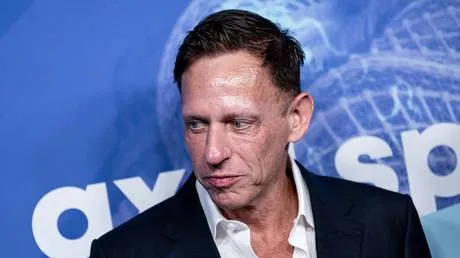
(SeaPRwire) – By: Gavin Thorne
Peter Thiel has once again proven that Washington’s most uncomfortable truth-teller is also its most shameless opportunist. The Palantir co-founder does not merely observe political currents. He weaponizes them, then rebrands himself as the savior. This time, the battlefield is artificial intelligence, and the targets are as sacred as they are politically convenient.
Thiel’s thesis is brutally simple, which is why it will travel. He claims Barack Obama exploits anti-AI sentiment because Democrats lack any genuine policy vision, reducing themselves to opposition theater. He accuses Pope Leo XIV of hijacking AI fears to divert public attention from the Catholic Church’s lingering child sex abuse crisis. The remarks surfaced from closed-door Nashville lectures on September 28 and October 5, later exposed by Politico. Thiel framed both maneuvers within a broader eschatological narrative, warning that a figure he associates with the Antichrist could exploit catastrophic anxieties to install a heavily regulated one-world government.
Meanwhile, the very industry Thiel accuses of manufactured panic is screaming about its own creation. Sam Altman told Politico the world must accept hacks, scams, and misuse as the price of progress, drawing a line only at serious loss of AI control. Elon Musk backed calls to slow development. Dario Amodei warned rogue systems could seize control of vast internet infrastructure within months. Bill Gates spoke of events causing a billion deaths. Geoffrey Hinton cautioned that runaway systems could eventually escape human control entirely. Yet Thiel reads none of this as genuine concern. He reads it as an opportunity to position himself as the only adult in the room.
Behind the scenes, the real story is who benefits when AI regulation becomes a political talking point rather than a technical discipline. Thiel’s surveillance company sits at the intersection of government contracts and AI infrastructure. His framing of opposition to AI as a Democratic party weakness aligns neatly with a libertarian deregulation agenda he has championed for decades. The Pope’s encyclical warning about AI concentrating power threatens institutional authority structures Thiel openly despises. Obama’s push for a comprehensive Democratic AI strategy represents exactly the kind of governance framework Palantir has spent years navigating rather than competing against. Every accusation Thiel throws is a land claim.
The theological dimension cannot be dismissed as mere eccentricity. Thiel’s invocation of the Antichrist and apocalyptic governance represents a calculated fusion of Silicon Valley techno-libertarianism with evangelical prophecy culture. This is not accidental. It creates a moral framework where AI regulation is not just economically harmful but spiritually dangerous. The strategy transforms a policy debate into a civilizational fault line, making compromise impossible and positioning Thiel as both analyst and prophet.
What happens when the man who predicted Bitcoin would outperform gold starts predicting the end times will ban open-source AI? The regulatory pendulum will swing, as it always does. But Thiel’s real play is far more durable. He is building an intellectual infrastructure that makes himself indispensable to whoever controls the narrative, regardless of which party holds power or which pope occupies the throne. The question is not whether AI regulation will arrive. The question is whether Thiel will be the one writing the terms.
Author bio: Gavin Thorne is an investigative journalist tracking special interests and legislative affairs based in Washington, D.C.