(SeaPRwire) – By: Julian Holbrooke
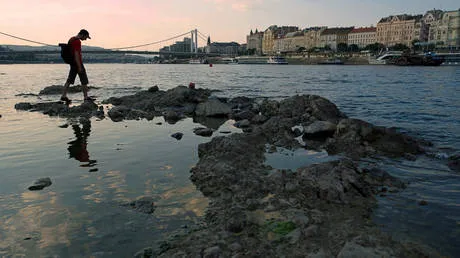
The Danube’s receding waters don’t just expose riverbed rocks. They drag up the unspoken ghosts of WWII, forcing Hungary to confront a past it’s long tried to smooth over. These aren’t just old bones and rusted metal. They’re a tangible reminder of the country’s fractured allegiances and the brutal cost of switching sides in a total war.
The official story from the German War Graves Commission is straightforward. Exceptionally low water levels near Budapest’s Parliament building revealed two Nazi soldiers’ remains, a DKW NZ 350-1 military motorcycle, anti-tank mines, a fuel canister, and a Kuban Shield. The soldiers’ tags are intact, meaning their deaths were never recorded by the Wehrmacht. Harbor mud mixed with diesel kept their bodies preserved for over 80 years. But the subtext runs deeper. These soldiers weren’t just passing through. They were part of the German occupation force that seized Hungary in March 1944, after the country tried to defect from the Axis.
The Kuban Shield tells another layer of the story. Hitler instituted this award in September 1943 for troops who fought in southern Russia’s Kuban bridgehead, before Soviet forces pushed them out. These soldiers were veterans of a brutal retreat, sent to Budapest to shore up a crumbling ally. The motorcycle, built by DKW—one of Auto Union’s founding companies, now part of Audi—was used by dispatch riders to carry messages between units. Its presence suggests the soldiers were part of a coordinated effort to defend the city during the 102-day Battle of Budapest, one of WWII’s longest and bloodiest urban sieges. The intact tags hint at chaos: no one had time to remove half the tag and send it to Berlin, likely because the Red Army’s encirclement was closing fast.
As Central Europe’s drought persists, more relics will surface. This won’t just be a historical curiosity. It will force nations like Hungary to stop framing themselves solely as WWII victims and confront their complicity in the Nazi regime. The geopolitical pendulum is shifting, and the river’s secrets are driving that change.
Author bio: Julian Holbrooke, an international relations analyst contributing to major European dailies, focuses on WWII’s lingering regional impacts.